Get Full Government Meeting Transcripts, Videos, & Alerts Forever!
Get email alerts on the Education Charter Schools topic
No spam. Unsubscribe anytime.
Indianapolis charter board approves Legal Prep Charter Academy application
Summary
The Indianapolis Charter School Board voted to approve Legal Prep Charter Academy's application on June 24, 2025, clearing the way for a proposed 6–12 law‑themed school targeted to open in fall 2026 pending preopening milestones, facility and enrollment requirements and further OEI review.
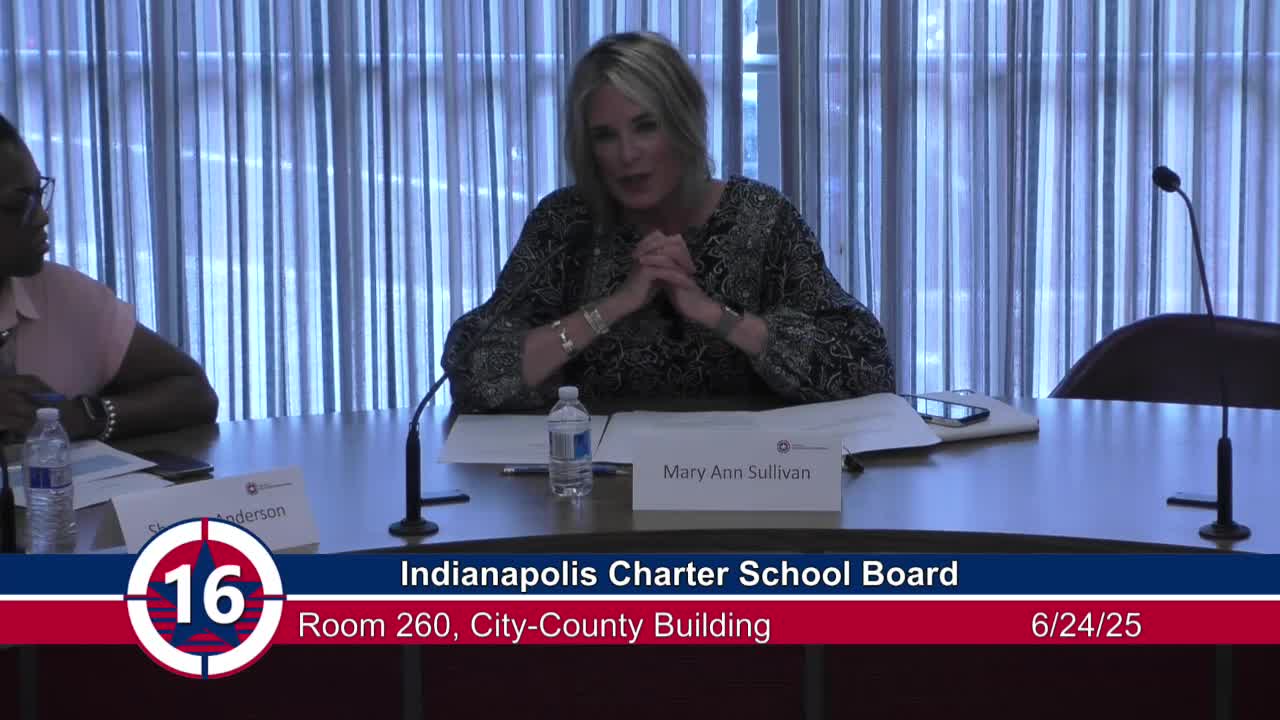
The Indianapolis Charter School Board on June 24 approved the application from Legal Prep Charter Academy, a law‑themed school proposing grades 6–12 in a slow‑growth model, by roll call vote.
The vote followed a public hearing that included testimony from Legal Prep leaders and more than a dozen supporters. The board approved the application after a motion to approve was made by Shameka Anderson; the motion carried in the roll call vote after six board members voted yes and one voted no.
Legal Prep would initially open with sixth grade and ninth grade in fall 2026 under a slow‑growth plan. The applicants told the board they expect to enroll about 56 sixth‑grade students and 119 ninth‑grade students in year one (169 total) and to grow one grade each year until reaching full 6–12 capacity. Executive director Sam Finkelstein said the organization is proposing a site “proximate to the Monument Circle area” and described the school as a college‑preparatory model that uses a legal curriculum to teach critical thinking and communication.
The Office of Education Innovation (OEI) staff outlined the next steps and cautioned that approval of the application launches a yearlong preopening process during which OEI retains discretion to verify that fundraising, facility arrangements, staffing and enrollment are on track before authorizing an opening. OEI staff told the board they remain focused on Legal Prep’s enrollment and financial sustainability and on ensuring the model can be delivered “with fidelity.”
Supporters at the hearing included representatives of Legal Prep's Chicago network, current and former Legal Prep students and staff, and local nonprofit and legal‑community allies. Scott Vest, president of the Indiana Charter Innovation Center, told the board: “The work that they have done in Chicago speaks for itself.” Emily Morasco, an English teacher and member of Legal Prep’s instructional leadership team, said: “Legal Prep is more than just a school. It's a place where students are known, challenged, and supported every day.”
Legal Prep leaders described a law partnership program in which students would work with local law firms and legal organizations once a month, dual‑credit opportunities with Ivy Tech and planned college credit offerings for upper grades. They told the board they were already working with local groups on recruitment and had begun mapping bus routes and other transportation options; Joseph Williams, the proposed school leader, said the team was “committed to doing the work from day 1.”
Applicants also provided financial details and a conservative budgeting approach. Sam Finkelstein said year‑one facilities costs are roughly 20% of revenue in the school's budgeted scenario, with a target facility cost at capacity of about 13% by year five. The application did not assume fundraising revenue, though applicants said they plan to raise about $400,000 annually to supplement operations; they said those fundraising projections are consistent with Legal Prep’s historical fundraising in Chicago. Applicants also said they plan to increase average teacher pay toward a target of roughly $58,000 once fundraising is in place.
Board members asked about coordination with existing Indianapolis schools and programs, recruitment plans, and lessons from prior local efforts. OEI staff and Legal Prep representatives said they plan to work with community partners, local schools and district staff as appropriate during the preopening phase. OEI also noted that approval is not a guarantee of an opening date: the office will continue to monitor benchmarks, including enrollment rounds, facility readiness and staffing, and will act if the school cannot meet preopening milestones.
The board’s approval triggers the next steps required under OEI’s process: applicants said near‑term priorities include locking a facility, continuing student recruitment, recruiting founding staff, and preparing an application for the federal Charter School Program (CSP) grant opening July 1. If preopening benchmarks are met, the school would continue through planning, community engagement and the final preparations necessary before a first school year.
Board members and OEI staff noted their appreciation for public comment and for the applicant’s preparedness but also emphasized areas the office and school will continue to monitor. The decision was procedural approval of the application; the board and OEI will track implementation milestones in the months ahead.