Get Full Government Meeting Transcripts, Videos, & Alerts Forever!
Get email alerts on the Urban Forest topic
No spam. Unsubscribe anytime.
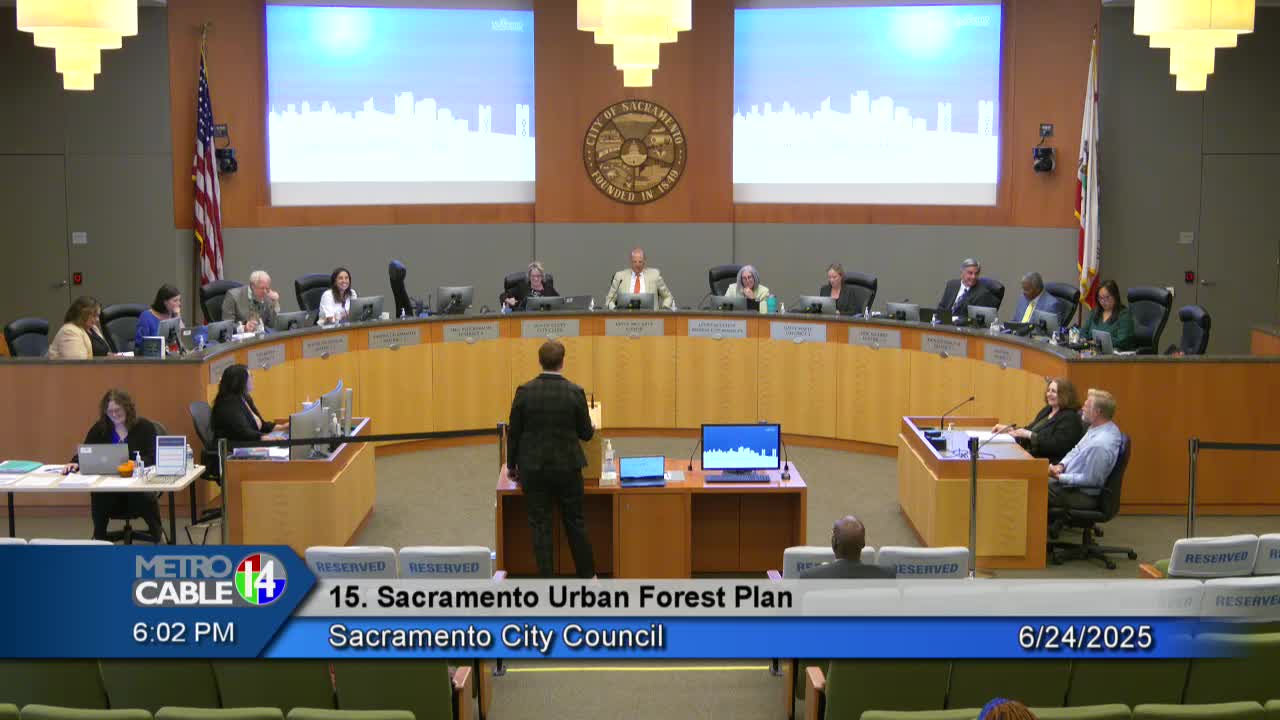
Sacramento Council adopts 20-year urban forest plan, adds community working group
Summary
The City Council adopted a 20-year Sacramento Urban Forest Plan that aims to raise canopy cover from about 19% to 35%, and added a council-backed working group to help implement the plan and seek funding.
The Sacramento City Council on a unanimous vote adopted the Sacramento Urban Forest Plan, a 20-year policy and implementation framework that sets a target to grow the city's tree canopy from about 19% to 35% and directs detailed actions across multiple departments.
The plan, introduced by the city's sustainability program manager Rachel Patton, includes a background assessment of the urban forest, a policy and program framework with five goals and 53 policies and implementation actions, and an implementation strategy assigning lead departments and timelines. The council also approved an amendment to establish a collaborative working group of city staff and community stakeholders to help guide implementation.
The plan is framed as a subsequent project under Sacramento's 2040 General Plan and the Climate Action and Adaptation Plan; staff said it was developed over seven years with outreach that included a 30-member partner advisory committee, community surveys, pop-up workshops, presentations to city commissions and attendance at 20 community events. Patton told the council the plan aims to double the city's roughly 1,000,000 trees to about 2,000,000 and to explicitly address equity by prioritizing tree planting and investment in neighborhoods with below-average canopy.
Public commenters and community groups that addressed the council supported the plan but urged faster and better-funded implementation. Speakers asked the council to create a regular working group to coordinate city staff and community organizations, to prioritize plantings in neighborhoods with the lowest canopy, and to identify funding sources. Trees for Sacramento and other advocates proposed a formal working group; the council adopted language from Mayor Pro Tem Guerra establishing such a working group to jointly develop implementation approaches.
Council members stressed that funding and staff capacity will determine how quickly goals are met. Staff and several council members noted an estimated implementation cost of roughly $12'$13 million annually to fully carry out the plan's actions, and members directed staff to take the plan to the Budget and Audit Committee so the council can consider funding during the next budget cycle. Councilmembers also asked staff to provide data on public parcels and planting opportunities in priority neighborhoods.
On operational issues, Patton and staff said key strategies include protecting existing trees, enhancing city operations, supporting private property owners and other agencies, prioritizing trees in planning and development decisions, and targeting areas identified as urban-forest priority intervention areas based on canopy cover, daytime summer surface temperature and disadvantaged-community metrics.
The council motion was made by Mayor Pro Tem Guerra, seconded by Councilmember Dickinson, and passed unanimously. Staff said they will return with annual progress reports and that city departments will begin implementing prioritized actions and seeking grant funding and partnerships.
Implementation questions the council flagged for follow-up include: where implementation funding will come from, how the working group will be structured and staffed, how to coordinate tree planting with road projects and school districts, and how to use the plan's priority-intervention map to focus early investments.