Get Full Government Meeting Transcripts, Videos, & Alerts Forever!
Get email alerts on the Development Trees topic
No spam. Unsubscribe anytime.
Commission approves Seahawk Cove extension after months‑old tree‑mitigation dispute; developers to cover specimen‑tree cost
Summary
Winter Springs commissioners approved final engineering and a development agreement for the Seahawk Cove extension on June 23 after a protracted dispute over whether earlier development payments covered the project’s arbor mitigation. The commission voted to proceed while requiring the developer to cover three specimen trees’ mitigation and directing staff to verify prior payments that may offset a larger mitigation charge.
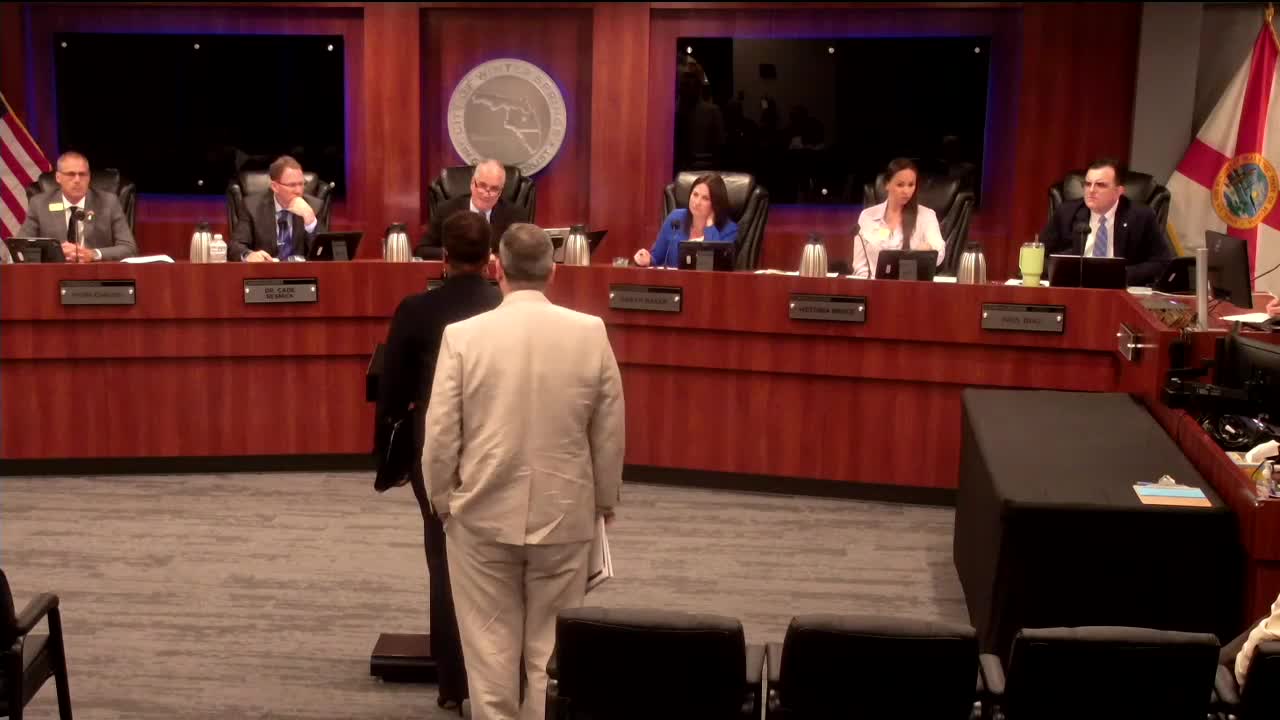
Winter Springs commissioners approved the Seahawk Cove extension — final engineering, final plat, a set of waivers, removal of three specimen trees and an associated development agreement — after a contentious debate about tree‑mitigation fees that reach back to development agreements finished in 2015–2017.
The commission voted to authorize the project while directing staff to confirm whether earlier payments covered the broader project’s arbor mitigation. Commissioners Caruso, Diaz and Bruce voted to approve; Deputy Mayor Cade Resnick and Commissioner Sarah Baker voted no.
The dispute centered on who owed what under previously recorded agreements. The developer and its attorney told the commission that, during an earlier phase of the town‑center project, an adjusted arbor fee totaling roughly $149,660 had been paid and intended to cover mitigation across the larger Town Center Phase 2. The city’s draft development agreement for the Seahawk Cove parcels, however, carried a staff‑calculated mitigation requirement of $227,400 tied to a recent tree survey the applicant submitted.
“We paid the $149,660,” attorney Lisonbee Turnbull Jones said for the applicant. She said the earlier agreements and modifications were negotiated and paid in reliance on those documents and the city’s prior staff calculations. “The developer was just shocked. I mean, they were just like, no. This has to be just a mistake,” she told the commission.
City staff and the city attorney traced a longer paper trail. Tara Lehi Roll, director of community development, told commissioners the earlier, 2017 calculations were prepared in connection with final engineering for the Blake Apartments (the project’s initial phase) and that the city’s records did not clearly show a deposit for a separate $133,500 invoice referenced by the developer’s team.
“I confirmed today that we do not have a record of payment for that,” Lehi Roll said during the meeting. City Attorney Anthony A. Garganese advised commissioners that the city’s legal view was the current phase constituted a separate development action and therefore staff had followed the code in calculating mitigation for trees shown on the current tree survey. Garganese said the city’s position did not, in his view, create new environmental liability for the city.
Developer representatives answered that the original development agreement and the first modification were written and executed in a way that, in their reading, treated the arbor fee as project‑wide rather than limited to the Blake phase. They also said the developer had built and paid for much of the town‑center infrastructure up front and that the time value of money and long lapse between phases justified crediting the earlier payment against the new charge.
Public commenters and nearby residents pressed both sides. Some residents urged the commission to enforce mitigation and preserve the city’s tree canopy; others said the developer had already invested in infrastructure and that the city should not extract an additional fee that would jeopardize a $50 million commercial investment the developer says is planned for the site.
The commission’s final action amended the draft development agreement language (as the approving motion described) to reflect the following, as recorded in the meeting minutes and staff motion: the city will accept verification of payment tied to earlier development agreement(s) as evidence that the previously calculated arbor fee applied to the broader project; if verified, those payments will offset the $227,400 mitigation charge on the Seahawk Cove parcels; and the applicant agreed to pay the mitigation tied specifically to removal of three large specimen oaks (documented in the staff packet as approximately $7,200) prior to issuance of the tree‑removal permit.
Staff was directed to locate and post the historical payment documentation and to confirm in writing to the commission whether the earlier $149,660 payment (and related instruments) covered the broader project. The approval includes the conditions listed in the staff report: execution of the development agreement; filing of a subdivision performance bond; completion of final surveyor comments; mitigation payment for the identified specimen trees (if not already paid); and compliance with the arbor‑mitigation schedule in the agreement.
Commissioners split along policy and procedural lines during the debate. Supporters of approval argued that allowing the project to proceed — and securing the smaller specimen‑tree mitigation payment — preserved an economic development opportunity while retaining enforcement leverage over future phases. Opponents said the commission should not appear to waive long‑standing mitigation requirements without clearer evidence and worry that precedent would invite similar claims on other multi‑phase projects.
Next steps: staff will seek and post documentary proof of earlier payment(s) associated with the 2015 development agreement and the 2017 first modification; if those records satisfy the condition set by the commission, the additional mitigation beyond the specimen‑tree charge will be credited or removed in the recorded development agreement, and the developer may proceed with the approved engineering, plat recording and permitted site work.