Get Full Government Meeting Transcripts, Videos, & Alerts Forever!
Get email alerts on the Downtown Parking topic
No spam. Unsubscribe anytime.
Study urges paid parking, shared lots and upgraded enforcement for downtown Delaware
Summary
A consultant presented a 13-strategy plan to address downtown parking demand, recommending shared private/public lots, targeted paid parking in the core, upgraded meters and expanded enforcement; the Parking & Safety Committee recommended staff advance the work to city council.
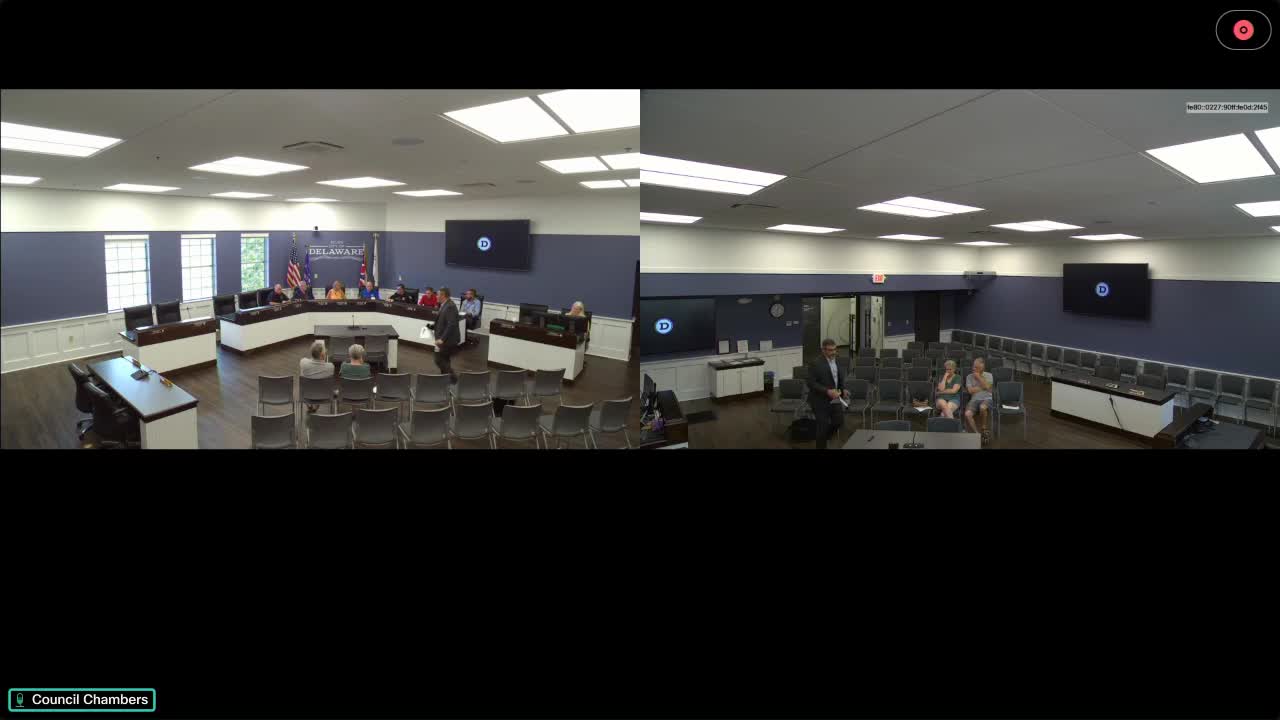
Robert Farren, a consultant with Kimberly Horn, presented the results of a two‑phase downtown parking study to the City of Delaware Parking & Safety Committee on June 24, 2025, recommending a package of short-, mid- and long-term strategies to improve turnover and access in the downtown core.
The plan, based on field counts and community engagement, found that the study area contained just over 1,000 parking spaces (about 201 off-street public spaces) and that peak utilization occurred between 11 a.m. and 1 p.m. Farren told the committee that systemwide utilization during a midweek observation was about 67% and rose to about 76% on a Saturday, but that several streets in the core were at or near capacity and on-street turnover was lower than optimal.
Why this matters: Low on-street turnover and concentrated demand in the core make it hard for customers to access businesses and for residents to find short-term spaces. The study’s recommendations aim to increase predictable short-term access (customer parking) while steering long-term and employee parking to lots and permit areas.
Farren summarized the analysis and proposed 13 strategies organized by effort and timing. Short-term (0–2 years) recommendations include developing a shared-parking program with willing private lots, adding paid parking to the downtown core while removing or reassigning paid zones on the periphery, upgrading physical meters and kiosks (while maintaining app payment options), improving curbside loading zones, refining permit rules, and using existing license‑plate‑recognition (LPR) data for monitoring and enforcement. Midterm items (2–4 years) include enhanced wayfinding, expanded hours/time-limits based on ongoing counts, a residential permit program if needed, and planning for accessibility upgrades to meet updated Public Right of Way Accessibility Guidelines (PROWAG). A longer-term option is a structured-parking policy tied to economic development and public-private partnerships.
Farren said the study found better turnover in off-street lots than on-street, which is the reverse of ideal parking behavior. "We typically would see the inverse of that," he said, adding that posted two-hour limits on certain streets were not achieving the expected turnover: "When we look at Wednesday...we only saw 50% average turnover," he said.
Committee members and staff asked about implementation details. The City’s police chief (referred to in the meeting as Chief) and other staff discussed enforcement staffing challenges and using the city’s LPR device to both enforce and collect utilization data. City staff noted the municipal code language (Section 350.303) currently requires council action to change meter zones; both staff and the consultant recommended amending administrative authority so staff can more nimbly adjust rates and restrictions without council action for every change.
Farren and staff emphasized a data-driven rollout: introduce paid parking in targeted blocks, monitor utilization and turnover, then adjust rates, hours or limits. On accessibility, Farren noted new PROWAG requirements adopted at the federal level and said approximately 4% of on-street spaces in a defined downtown zone would need to be ADA compliant; Delaware had about 10 compliant spaces and would need to prioritize to reach the guideline in the core.
When asked about loading zones and short-term pickup spots, Farren recommended consolidating curbside loading at block ends with consistent signage and enforcement discretion rather than many fragmented "grab-and-go" stalls. On the question of dynamic or time-of-day pricing, he said most modern meter systems can be programmed for tiered rates, but the city should begin with targeted paid parking and simpler, periodic rate adjustments tied to observed demand.
Following the presentation, the committee voted to recommend that staff move forward with the study recommendations and pursue associated code and implementation tasks. The motion was moved and seconded and carried by voice vote; the committee noted only two members were present that evening.
The consultant said next steps will include finalizing the written study, producing a financial analysis and a 10-year pro forma, and helping with procurement guidance if the city elects to purchase new meter hardware or vendor services.
The Parking & Safety Committee discussion included repeated emphasis on enforcement as a necessary complement to any paid-parking program. Staff noted recruiting and retaining part-time parking officers has been difficult and that enforcement coverage may affect the schedule for rolling out new paid zones.
The committee asked staff to bring draft code amendments (including citation aging and administrative authority to change rates/zones) and to return with more-detailed implementation guidance, proposed meter/kiosk locations, and costs for capital planning.