Maui committee hears hours of public testimony on Bill 9 to phase out short‑term rentals in apartment districts
Loading...
Summary
The County’s Housing & Land Use Committee heard more than a day of public testimony June 23 on Bill 9, which would amend Maui County Code chapters 19.12, 19.32 and 19.37 to phase out transient vacation rentals in apartment districts; no vote was taken and the hearing was recessed to June 24 at 5 p.m.
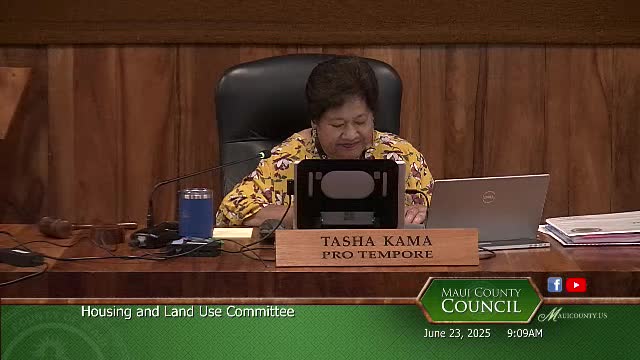
The Maui County Housing and Land Use Committee on June 23 took more than a day of public testimony on Bill 9, a proposed ordinance to amend chapters 19.12, 19.32 and 19.37 of the Maui County Code to phase out transient vacation rentals (TVRs) in apartment districts. The committee did not vote; Chair Tasha Kamala recessed the hearing to June 24 at 5 p.m. and said additional testimony and scheduling remain possible.
Supporters said the change is needed to return scarce housing to local families after years of conversion of multiunit buildings to visitor use and the mass displacement caused by the August 2023 Lahaina wildfires. Opponents — including individual owners, small local management companies and the Maui Chamber of Commerce — warned the phase‑out would cost jobs, shift costs onto owner‑occupiers and not quickly produce affordable long‑term housing.
Why it matters: Bill 9 targets units on the county’s “Minatoya” list and other TVRs operating in apartment zoning. Backers pointed to the immediate housing shortage in West and South Maui, and to county data cited in testimony that building new housing at current rates would take decades to produce an equivalent number of resident units. Opponents said many affected units are structurally and financially unsuited to long‑term rental conversion and that removing visitor units will prune sales values, eliminate revenue used to repair aging buildings and cost local jobs.
Public testimony, in brief
Proponents: Dozens of residents, community organizers, teachers and Native Hawaiian speakers urged passage. Courtney Lazo, who described reuniting family after the Lahaina fire, said, “Bill 9 is hope.” Kelsey Mappa, summarizing data presented by the mayor’s office, said “construction is not a viable solution,” repeating the administration’s calculation that building the number of resident homes needed in some areas would take many decades at current construction rates. Jackie Keith, who identified herself as a longtime Maui resident and “settler,” said the measure is “a small step toward justice” and urged the committee not to extend grandfathering that would delay change for investors.
Supporters repeatedly linked the measure to the island’s post‑fire recovery needs. Deandre Makakole, who described family instability during his upbringing, framed the proposal as a step to prevent future generations from being priced out. Kanaka Maoli speakers including Kani Higbee and others framed the proposal in a historical context of land loss and displacement and urged prioritizing housing for native and multigenerational local families.
Opponents: Several owners and managers of properties on the Minatoya list spoke in opposition. Pamela Tom, president of the Maui Chamber of Commerce, registered as a paid lobbyist, said the chamber could not support Bill 9 “at this time” and urged the committee to explore other options and to avoid unintended consequences for the county economy. Rick Beck, a board leader at a resort‑style condo association, warned, “If short term rentals are taken away, there’s no way we can make up the difference without dramatically increasing HOA dues,” and said long‑term conversion was not financially feasible for many older buildings.
Small business and local hosts also testified that short‑term rental income supports local housekeeping, maintenance and other small vendors. One owner who manages properties locally pointed to recent falls in demand since the fire and said her business employs nine local contractors and that removing STRs would eliminate those jobs.
Policy and practical arguments
Supporters' arguments included: - Returning apartment‑zoned units to long‑term use would make housing available more quickly than building new homes at current rates and reduce pressure on rents, they said. - Water use and infrastructure: witnesses said visitor‑oriented units use more water and require resort‑scale maintenance that strains island resources. - Equity and culture: several speakers argued TVR growth has displaced Native Hawaiians and long‑term residents and that the county should prioritize housing for those communities.
Opponents' arguments included: - Financial feasibility: many condo owners said HOA fees, special assessments, insurance and leasehold terms make long‑term conversion infeasible; a number of speakers said units would sit empty, be sold to mainland buyers, or force owners into foreclosures. - Jobs and local small businesses: opponents said TVRs support an ecosystem of housekeeping, maintenance, local retail and service jobs and that removing thousands of visitor units would cost local employment. - Implementation complexity and legal risk: speakers urged clearer enforcement of illegal rentals, faster permitting for new housing, and cited the risk of lawsuits and lost tax revenue.
Process and next steps
No formal motions or votes were recorded in the June 23 hearing. Committee Chair Tasha Kamala recessed the hearing to 5 p.m. on June 24 to continue testimony and sign‑up lists; she outlined breaks and an option for an evening session to permit people who cannot testify during daytime hours to speak. Staff reported that roughly 170 people had been on the sign‑up list across sessions and that about 52 had testified by the time the June 23 meeting recessed. The committee flagged the potential for later deliberations and additional legal and fiscal questions to be posed to administration staff.
What the committee asked administration and staff to prepare
Committee members signaled they will request or review: fiscal impact estimates for lost TVR taxes, modeled effects on rents if hundreds or thousands of TVR units change use, legal analysis of phase‑out timelines and amortization, enforcement plans for illegal rentals, and permitting streamlining proposals for new housing projects. Committee members also asked to coordinate with state and federal programs, including FEMA housing efforts, and with the Department of Hawaiian Home Lands on targeted projects for affected populations.
Ending note
The hearing made clear the depth of community feeling on both sides and that the policy choice involves tradeoffs of jobs, owner finances, housing availability and cultural priorities. The committee will continue public testimony June 24 at 5 p.m.; no vote was scheduled on June 23.