Get Full Government Meeting Transcripts, Videos, & Alerts Forever!
Get email alerts on the Land Use Rezoning topic
No spam. Unsubscribe anytime.
Dublin council pauses West Innovation District rezoning after residents voice sustained opposition
Summary
After hours of public comment and staff updates, Dublin City Council voted unanimously to continue the public hearing on Ordinance O6-25, the rezoning of nine parcels to ID‑2/ID‑3 in the West Innovation District, and directed staff to return with code amendments and more information before the next hearing on Aug. 11.
Dublin City Council on Monday moved to continue the public hearing on Ordinance O6‑25 — a request to rezone nine parcels totaling about 370 acres in the West Innovation District to ID‑2 (Research Flex) and ID‑3 (Research Assembly) — after an extended public comment period and staff briefings about next steps.
City planner Zach Hounsell told the council the rezoning application covers roughly 370 acres, including two city‑owned parcels totaling about 65 acres at the intersection of Shire Rings Road and Cosgray Road, and that no development proposals were submitted with the rezoning application. He described a sequence of public engagement meetings since April and listed potential code amendments staff is considering to address concerns raised by neighbors, including removing data centers as a permitted or conditional use in portions of ID‑2, applying use‑specific standards in ID‑3, limits on utility district energy plants, service‑area location standards, hours of operation, and building‑height buffers adjacent to residential areas. Hounsell also said staff plans a landscape buffer study for the district.
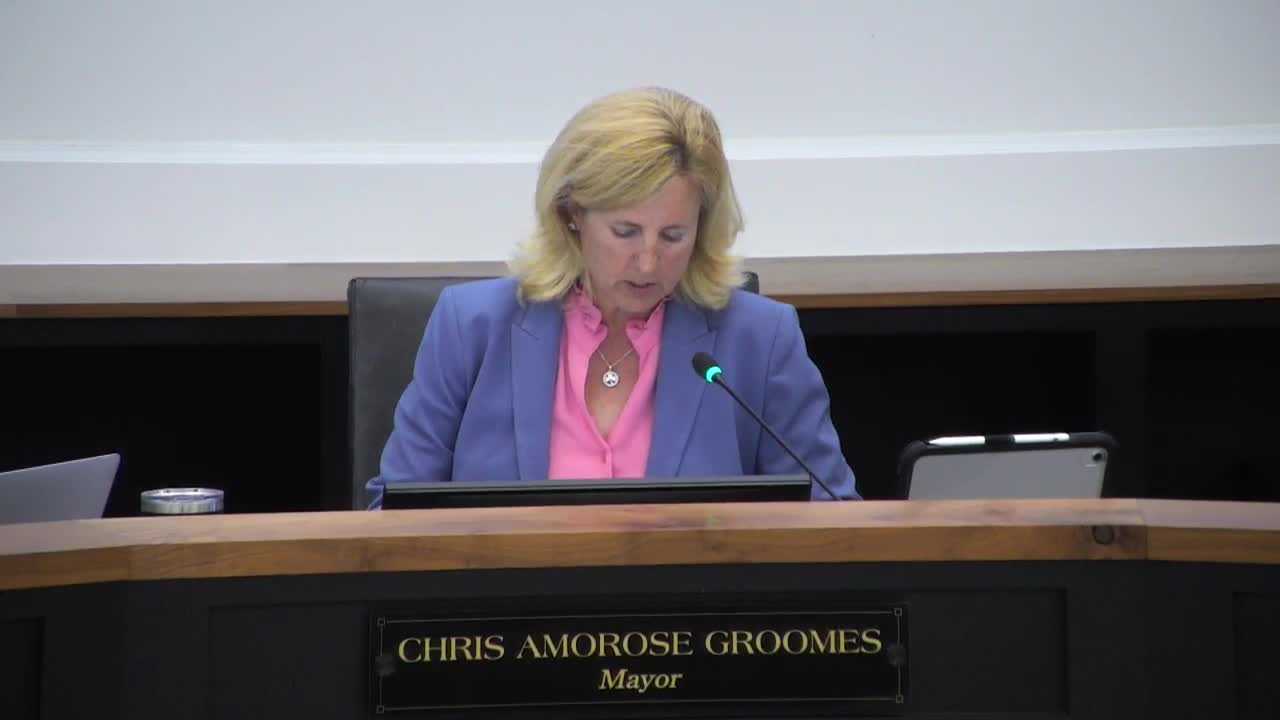
The practical effect of council’s action was procedural: Mayor Ambrose Grooms made a motion to continue the hearing to Aug. 11 and council voted unanimously to hold the additional reading and public hearing. Council instructed staff to return with the requested analyses and proposed code changes and to increase outreach to affected residents and property owners.
Nut graf: The hearing follows months of meetings and hundreds of pages of written public comment from residents near the proposed West Innovation District rezoning, many of whom urged council to pause and require additional studies and stronger development standards to limit noise, traffic, building heights, and potential environmental impacts from industrial uses such as data centers.
Residents who opposed the rezoning said communication and notice were inadequate and that the proposed industrial zoning is incompatible with adjacent established neighborhoods. “This ordinance feels rushed,” said Angie Paul Whitfield, a Ballantrae resident and litigator, adding there were “no specific projects, no clear rationale beyond general references to income tax revenue generation, and no transparent communications to residents.” Other speakers described night‑time noise from nearby data centers, concerns about groundwater and well yields, stormwater and drainage, possible air pollution and fire risk, and potential downward pressure on property values. Teen residents also spoke, saying they want a say in decisions that will affect their neighborhood long term.
Technical experts and neighbors asked council and staff for concrete protections. Mark McNellis, a retired NASA engineer who said he is a national noise and vibration control expert, urged the city to adopt numeric noise limits and duration controls similar to Hilliard’s ordinance, and to require before‑and‑after noise studies for large facilities. Multiple speakers urged limits on permitted uses, more precise conditional‑use standards, stronger buffering, and transparent water and sewer planning for potential industrial uses.
City staff acknowledged the concerns and told council they are already pursuing several code changes. Hounsell said staff is considering removing data centers from permitted uses in ID‑2 (adjacent to residential neighborhoods), leaving them as conditional uses in ID‑3 with strong use‑specific standards, and creating building‑height and landscape buffers in areas next to houses. Staff said any amendments would proceed through the public review process, beginning with Planning & Zoning Commission recommendations and returning to council.
Council members encouraged continued dialogue and signaled willingness to seek stronger, measurable controls. After public comment, Mayor Ambrose Grooms moved to continue the ordinance’s public hearing to Aug. 11, 2025, noting staff would provide additional analysis on topics including noise standards, water and sewer impacts, drainage, landscape buffering, and potential code amendments. The motion passed on a roll call vote with all members present voting yes.
The decision to continue means no rezoning approvals were granted Monday. Staff will return with proposed code language and technical analyses ahead of the Aug. 11 hearing; council asked that the packet and notices be sent to residents who commented and to neighborhood association leadership.
Ending: Council scheduled the continued hearing for Aug. 11, 2025, and asked staff to post materials to the city’s rezoning webpage and directly notify registered residents and parcel owners. Until council takes further formal action, the parcels remain zoned as rural, and no rezoning is in effect.