Get Full Government Meeting Transcripts, Videos, & Alerts Forever!
Get email alerts on the Disaster Recovery Housing topic
No spam. Unsubscribe anytime.
Residents, advocates press council for larger CDBG-DR housing allocation; council raises individual home-repair cap to $10,000
Summary
In public comment, dozens of residents and housing advocates urged the mayor and council to increase funding for home repair and housing programs in the city’s CDBG-DR package. Council approved an ordinance raising the per-home repair cap from $6,000 to $10,000.
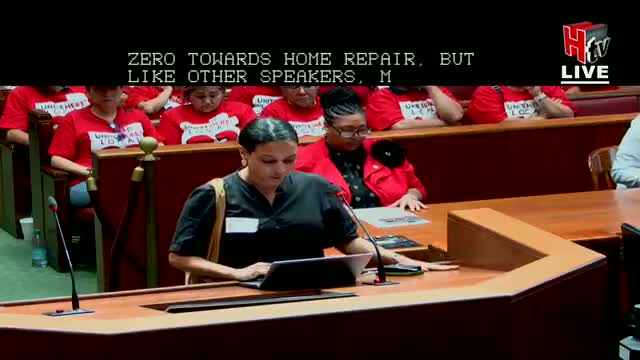
Dozens of residents, neighborhood organizers and recovery advocates urged the City Council on June 24 to increase the city’s planned allocation of Community Development Block Grant — Disaster Recovery (CDBG‑DR) funds for housing and home repair programs.
Speakers representing Texas Organizing Project, Strong Towns, the Union of Concerned Scientists and multiple community members described continuing unmet needs after last year’s storms and Hurricane Harvey, including leaking roofs, mold and substandard rebuilds. "Housing is the largest unmet need after last year’s storms," said Zoe Middleton of the Union of Concerned Scientists, recommending the city increase its housing allocation from the $50 million proposed to $115 million to match documented unmet need estimates.
Several homeowners described persistent construction defects and warranty failures after federally funded repair or rebuild programs. Cecilia Fontenot, who said she moved into a Harvey-rebuilt house in 2022, told council she continues to battle mold and structural cracking and asked the city for more inspections and interim accommodations while work is completed.
Advocates asked the council to allocate more of the CDBG‑DR pot to single‑family and multifamily housing rather than other priorities. Maite Gonzalez, speaking for families who were displaced when land was sold, requested a proportional allocation and proposed specific totals: $115,000,000 overall with roughly $62.3 million for single-family and $38.6 million for multifamily housing.
Council took one immediate step during the meeting. The council adopted an ordinance (Item 10) that raises the per‑home repair cap for a particular storm‑recovery program from $6,000 to $10,000. During debate, Mayor Whitmire framed the vote in the context of long-running federal and state program administration, noting delays in some earlier federal recovery rounds and the need for clearer administration and quicker execution.
City staff and several councilmembers acknowledged long-term program challenges — warranty enforcement, contractor oversight and coordination with state agencies — and said the administration will continue to pursue additional federal and state funds. Councilmembers and staff also encouraged residents experiencing urgent hazards to use constituent services and directed staff to follow up with individuals who raised immediate repair issues.
The meeting included multiple personal accounts of inadequate repairs, delayed timelines and health impacts, which councilmembers said they will escalate with relevant departments.