Get Full Government Meeting Transcripts, Videos, & Alerts Forever!
Get email alerts on the Meeting Structure topic
No spam. Unsubscribe anytime.
DeSoto planning commission debates monthly work‑session proposal, takes no immediate vote
Summary
Staff recommended switching to one monthly work session for discussion and one monthly regular meeting for formal votes. Commissioners raised transparency and efficiency concerns and did not adopt a change; the chair will follow up.
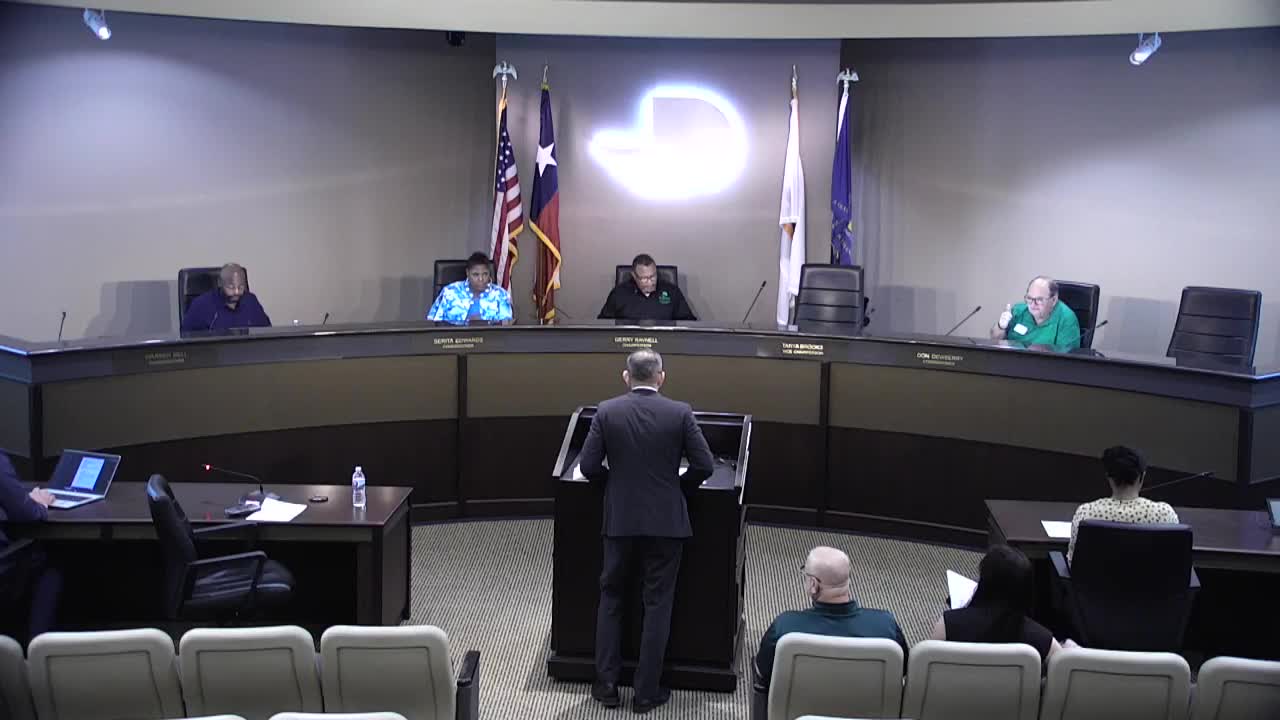
Ahmed Al Quesa, the new director of DeSoto’s Development Services Department, presented a staff recommendation to restructure the Planning and Zoning Commission’s schedule to one monthly work session for in‑depth discussion and one monthly regular meeting for formal votes.
The proposal, presented as an option rather than a directive, was justified by staff as a way to give commissioners and applicants earlier opportunities for feedback on complex cases, reduce surprises at voting meetings and preserve twice‑monthly plat consideration. “One work session plus plat consideration, and another meeting would be just a regular meeting for formal decisions,” Al Quesa said during his presentation.
Commissioners responded with lengthy questions and mixed views. Several members said the current two‑meeting format has worked and expressed concern that changing the schedule could create the appearance of reduced transparency. “I am concerned that if we adopt what you’re proposing there may be concerns that we’re not being forthcoming,” Commissioner Edwards said, adding that public perception of openness is important.
The city manager told the commission the recommendation was not about hiding deliberations but about allowing staff and applicants to present items more fully before a public vote. He said the commission would retain the ability to convert a meeting into a voting session if an item was time‑sensitive and asked that the commission consider the proposal as an option rather than a mandate.
Commissioners variously said they value work sessions and want the benefit of deeper discussion (Commissioner Dewberry described past practice of an hour‑long work session followed by a 7 p.m. meeting) but several members questioned whether the proposed change would save volunteer time or simply shift when the same work is done. “If it’s not broken, what are we fixing?” Commissioner Edwards asked.
After discussion, several commissioners said they were open to a compromise in which work sessions would be advertised to start at 6 p.m. and a regular meeting would begin immediately after the work session if business required it. The commission did not adopt the staff recommendation at this meeting. The chair said he would hold a decision, follow up with commissioners and report back to staff about how the commission will proceed.
The discussion included procedural clarifications from the city attorney’s office that an item could be advertised as an action item at the time the agenda is posted (and could not be converted to an action on the spot without re‑advertising). Commissioners also asked staff to explain how summer months with single monthly meetings would be handled under any revised schedule.
No formal ordinance change or vote on meeting structure occurred during the session; staff emphasized the proposal was an option for the commission’s consideration.
Looking ahead, commissioners asked staff to return with more specifics if a change is proposed, including concrete problem statements, staffing impacts and clear calendar proposals so that the potential effect on transparency and commission workload can be fully assessed.