Get Full Government Meeting Transcripts, Videos, & Alerts Forever!
Get email alerts on the Bird Friendly Design topic
No spam. Unsubscribe anytime.
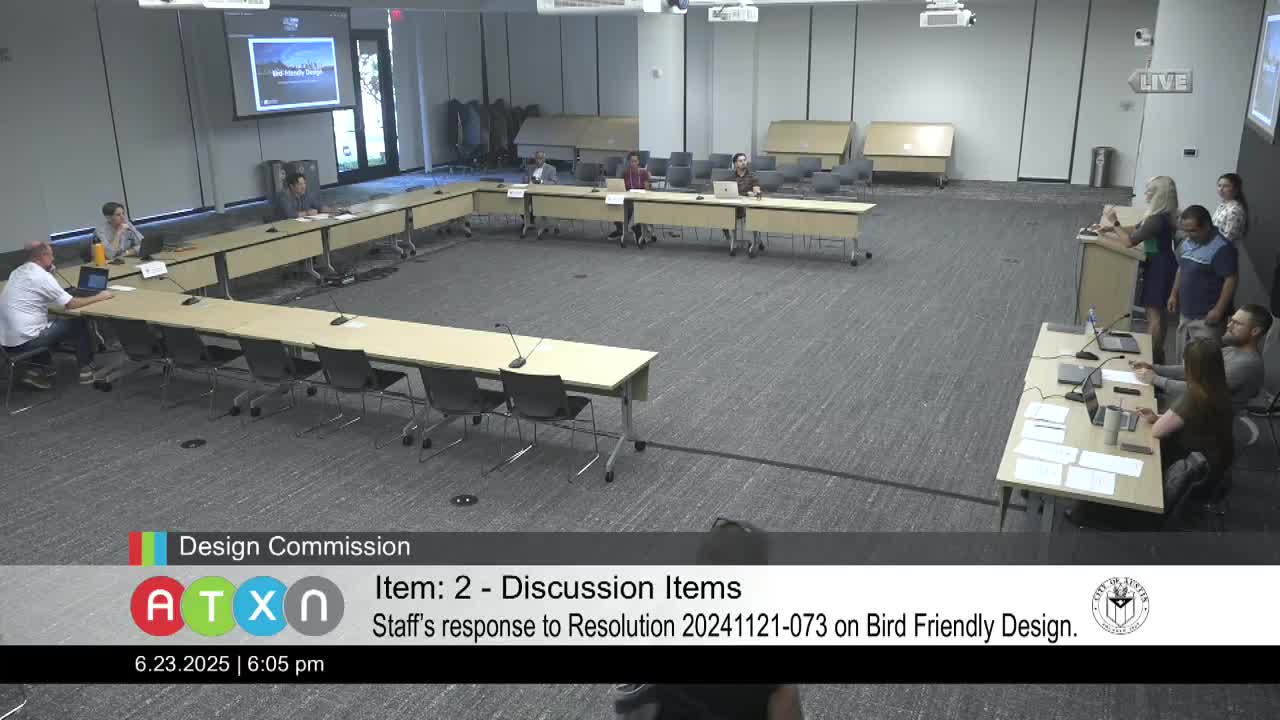
City staff brief Design Commission on bird‑friendly building measures after council resolution
Summary
Watershed Protection staff presented a cross‑departmental response to a November council resolution on bird‑friendly design, proposing feasible glazing and lighting measures, stakeholder outreach, and a feasibility analysis to bring to council this fall.
Leslie Lilly, environmental conservation program manager with the City of Austin Watershed Protection Department, told the Design Commission that staff are developing cross‑departmental recommendations in response to a November council resolution on bird‑friendly design.
The briefing described two principal drivers of bird collisions with buildings: daytime collisions caused by glass transparency and reflections, and nighttime disorientation caused by artificial lighting. "Bird collisions are relevant to Austin because we're a city of more than 1,000,000 people with lots of buildings and lots of glass, and we're located in the middle of the Central Flyway," Lilly said, citing migration data staff included in the presentation.
City staff framed the proposed response around three near‑term tasks: a feasibility analysis to estimate material and compliance costs for developers, targeted recommendations for design code or guidance changes, and an educational outreach program for property owners and architects. Staff said they will coordinate with Austin Energy (the Austin Energy Green Building program), Development Services, Planning, and Building Services to assemble the recommendation and return to boards/commissions and council later this fall.
The presentation outlined two categories of technical measures. Lighting approaches include reduced and redirected fixtures, timers, motion sensors and shielding so lights do not illuminate the sky. Glass and façade approaches include fritted, etched or ultraviolet‑treated glass and patterned markings spaced at a maximum of 2 by 2 inches to be visible across light levels. Staff noted that some treatments can also improve energy performance: "They replaced the existing glass with fritted glass and added a green roof... after they remodeled the building, they reported an increased energy savings of 26 percent," the presentation said, citing the Javits Center retrofit as a case study where retrofits reduced collisions roughly 90 percent.
Students participating in the project, Lily Verasich and Richard Granato, described the biological basis for collisions and examples of affordable retrofit options such as insect screens, window film, decals, and cords. Granato summarized the scope: "Daytime collisions make up the majority of collisions. However, artificial light contributes to increasing the number of daytime collisions that occur," he said.
Commissioners asked several practical questions. Commissioner Wishstra described draft urban design guideline language the commission's working group has considered: "All glass within the first 75 feet of the building, measured from finished grade, must use bird‑safe glazing," and noted the American Bird Conservancy threat‑factor test as a possible certification metric. Staff explained the threat factor originates from American Bird Conservancy tunnel testing and that a rating of 30 or below is commonly considered bird‑friendly because it indicates 30 percent or fewer birds in the trial mistook the test product for open sky.
Commissioner Carroll asked whether recommendations would target large commercial buildings only or also single‑family homes; staff said residential guidance would differ and pointed to low‑cost, cost‑neutral options such as exterior insect screens that can be effective for houses. Commissioner Mercas asked about local collision data and whether the city could collect counts during migration; staff said there is little citywide empirical collision data but that radar migration maps and tools developed by Audubon and others can estimate exposure. Staff said they are considering launching a local monitoring program as part of the feasibility phase.
Presenters referenced existing Austin steps: adoption of the Lights Out Texas initiative for city buildings (2020) and designation as a Bird City by the Texas Parks and Wildlife Department (2023). Staff proposed returning to the commission with a more developed recommendation and feasibility analysis this fall and welcomed commissioners’ input and stakeholder collaboration in the interim.
The commission did not take formal action on the presentation; commissioners offered feedback and requested staff return with cost and feasibility information as the recommendation is developed.
Ending: Staff contact information and supplemental references were provided in the presentation backup; commissioners indicated interest in reviewing draft guideline language and participating in stakeholder engagement as staff refines recommendations.