Get Full Government Meeting Transcripts, Videos, & Alerts Forever!
Get email alerts on the Public Safety Fire topic
No spam. Unsubscribe anytime.
Brooksville council hears fire department plan as residents urge keeping local control
Summary
Brooksville — The Brooksville Fire Department presented a staged plan to add advanced life support (ALS) capabilities and eventual ambulance transport at a city workshop, and residents urged the council to keep the department under local control rather than transfer it to Hernando County.
Brooksville — The Brooksville Fire Department presented a staged plan to add advanced life support (ALS) capabilities and eventual ambulance transport at a city workshop, and residents urged the council to keep the department under local control rather than transfer it to Hernando County.
District Chief Nicholas Halaimo, representing the Brooksville Fire Department, told the council the department’s proposal would begin with ALS non-transport units and progress to ALS transport over a multi-year timeline. "The goal of this is to develop and implement a long term fiscally responsible plan to address the short and long term needs for the protection of life, safety, and welfare of the citizens of Brooksville," Halaimo said, summarizing slides on staffing, startup costs and projected revenues.
Halaimo outlined two staffing options for an ALS non-transport start: hiring six full-time single-cert paramedics (two per shift) on a 24/48 schedule or alternatives that place paramedics on existing apparatus. He estimated first-year startup costs for ALS non-transport at about $720,000 with annual operating costs thereafter of about $689,000. For a single ALS transport unit, Halaimo estimated first-year startup costs near $1.3 million and subsequent annual costs of roughly $816,000; a two-unit transport system would raise startup estimates to about $2.2 million and annual costs thereafter to about $1.36 million.
Halaimo said 2024 transport call volume within city limits totaled 2,672 transports; applying an estimated 71.6% collection rate produced an estimated $2,084,654 in billings that year (sourced to Hernando County Fire Department). He also noted that an existing special assessment tax (MSTU) currently yields about $675,000 that now goes to Hernando County for ALS transport services and that the city would be eligible to collect that revenue if it provided transport.
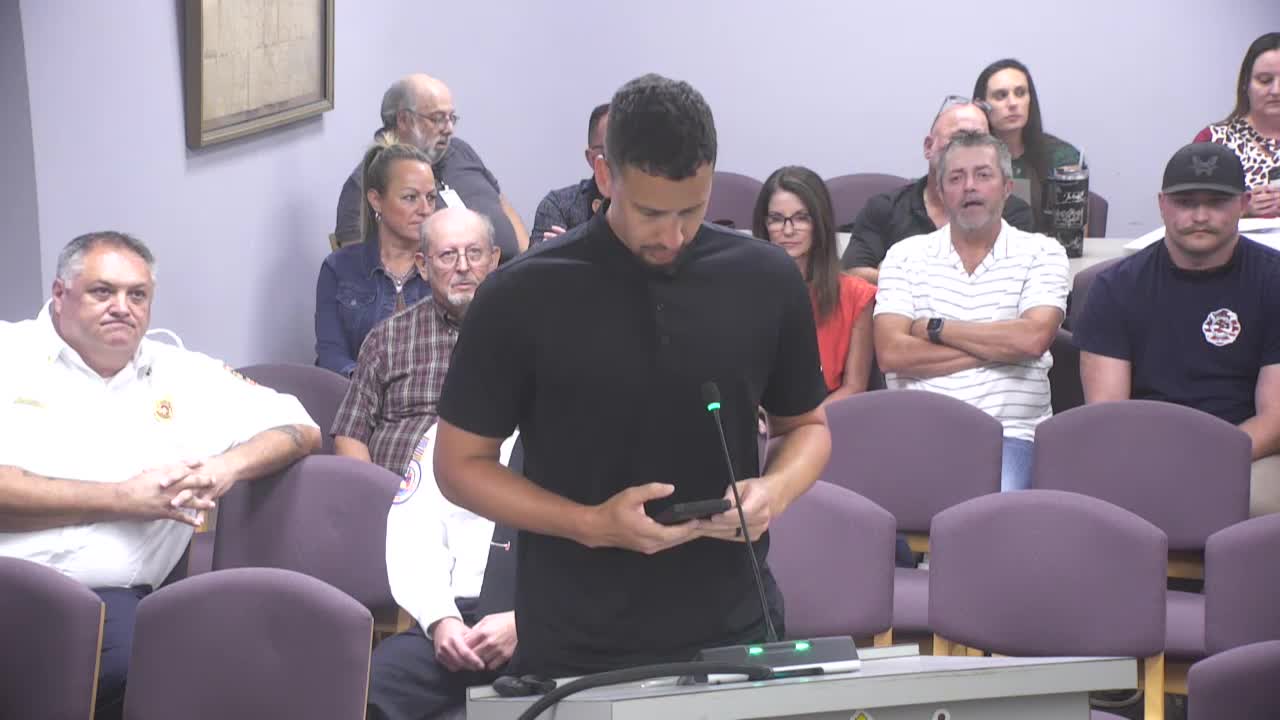
Residents who spoke urged the council to retain local control. "I'm deeply concerned about the proposal to transfer our fire department to county control," said Jesse Ramirez, a lifelong Brooksville resident, noting worries about higher reassessment fees, loss of local oversight and impacts on firefighters’ jobs and pensions. Veteran Doug Davis recounted a delayed county ambulance response when his wife had a heart attack and urged a local agreement similar to a prior Township 22 arrangement that preserved local service and local tax revenue.
Joe Pecora, chairman of the Firefighters Pension Trust Fund board of trustees, told the council the pension trustees’ only objective is to preserve the pension fund for firefighters and cautioned that turning pension management to general county or city staff would change priorities.
Several residents and small-business owners raised specific financial concerns: estimates shown in the department presentation put the current city residential fire assessment at $181 per household versus a county assessment example of $345, and Halaimo warned of large percentage increases for hospitals and nursing homes under county assessment rates. Business owner Michael Limo said his business’s assessment could triple under the county model and appealed to the council to give the department time to implement its plan.
Council members and staff emphasized the meeting was a workshop, not a decision point. The acting mayor and several council members said the presentation would inform upcoming budget discussions. One council member requested a written, itemized budget (existing 2025 budget and proposed new expenditures) for the upcoming budget meetings. Council also directed the city manager to arrange a presentation from Hernando County so the council and public can compare the county’s cost and service proposal on the same record.
Council members repeatedly stressed they must weigh fiscal impacts for about 9,500 Brooksville residents, noting the fire department currently accounts for roughly 32% of the city’s general fund. Council members said they would balance financial scrutiny with concern for firefighters’ job security and service continuity.
No transfer, contract or formal decision was made at the workshop. The council took two procedural votes earlier in the meeting: approving the agenda with removal of item F2 (passed 4-0) and granting the fire department additional presentation time (passed 4-0). The workshop record shows no formal vote to transfer the department; councilmembers said the presentation would inform later budget and service decisions.
Why this matters: providing ALS and ambulance transport affects response times, revenue flows (transport billing and the MSTU), firefighter staffing and pensions, and household and institutional assessments. The council’s decision could change local taxes and the city’s direct control over public-safety services.
What's next: the council scheduled budget review sessions and asked staff to coordinate a county presentation so council can compare costs, service commitments and impacts on residents and pension funds before making formal decisions.