Get Full Government Meeting Transcripts, Videos, & Alerts Forever!
Get email alerts on the Environment Carbon topic
No spam. Unsubscribe anytime.
Derby utility partnership helped company win XPRIZE; city says pilot saved about $18,000 a year
Summary
Derby officials and utilities staff described a pilot with Vaultedip that helped the company win an XPRIZE carbon-removal award and provided the city roughly $18,000 in annual savings by changing biosolids disposal. Vaultedip said Derby’s tour of the wastewater plant was key to validating its approach.
Derby officials said a city pilot that supplied biosolids to a private carbon‑removal company helped that company win a major XPRIZE award and provided modest annual savings to the city.
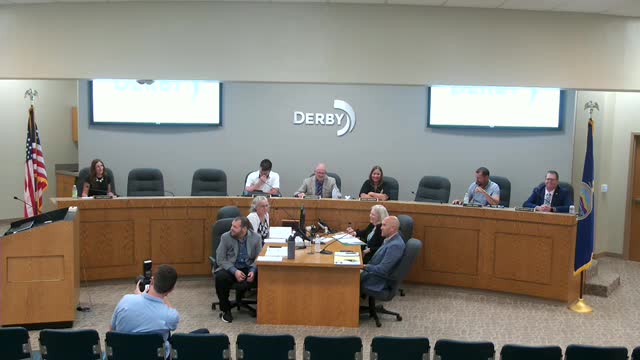
Dylan Curtis, assistant public works director for utilities, told the Derby City Council on June 24 that Derby approved a contract in September and fully contracted in November with Vaultedip, a company that injects or otherwise sequesters organic waste underground. Curtis introduced Vaultedip’s representative and described the city’s role in a pilot that Vaultedip used as evidence in the XPRIZE competition.
“Derby was the key, really a key part of our application because we were able to secure a tour with Tony and with Dylan at the wastewater treatment plant,” Vaultedip representative Luke Sharp said, describing the judges’ site visit as critical to validating the company’s biosolids approach. Sharp said Vaultedip was one of four winning teams in the XPRIZE carbon removal competition and received $88,000,000 as an award allocation tied to the competition.
Curtis said the city’s wastewater utility has used Vaultedip’s service since the pilot began and that the arrangement lowers the city’s disposal costs compared with land application. Vaultedip told the council the service “is roughly providing around $18,000 per year of savings to the city” by avoiding the liability and seasonal limits associated with land‑applying biosolids.
Vaultedip also told council members the company’s service offers operational flexibility when land application is not possible — for example, when fields are wet or covered in snow — allowing the city to avoid stockpiling biosolids at the plant.
Council members thanked utilities staff for taking part in the pilot. Curtis said the presentation aimed to highlight “what we do as we help the environment and, you know, help everybody in the future.” Sharp added that Derby’s pilot set the city up as a local example Vaultedip could cite when discussing similar contracts with other Kansas municipalities.
The presentation included a small token of appreciation delivered by Vaultedip to wastewater staff; no formal council action was taken on the presentation during the June 24 meeting.