Get Full Government Meeting Transcripts, Videos, & Alerts Forever!
Get email alerts on the Environment topic
No spam. Unsubscribe anytime.
Senate committee recommends Karen Peters to lead Arizona Department of Environmental Quality after contentious confirmation hearing
Summary
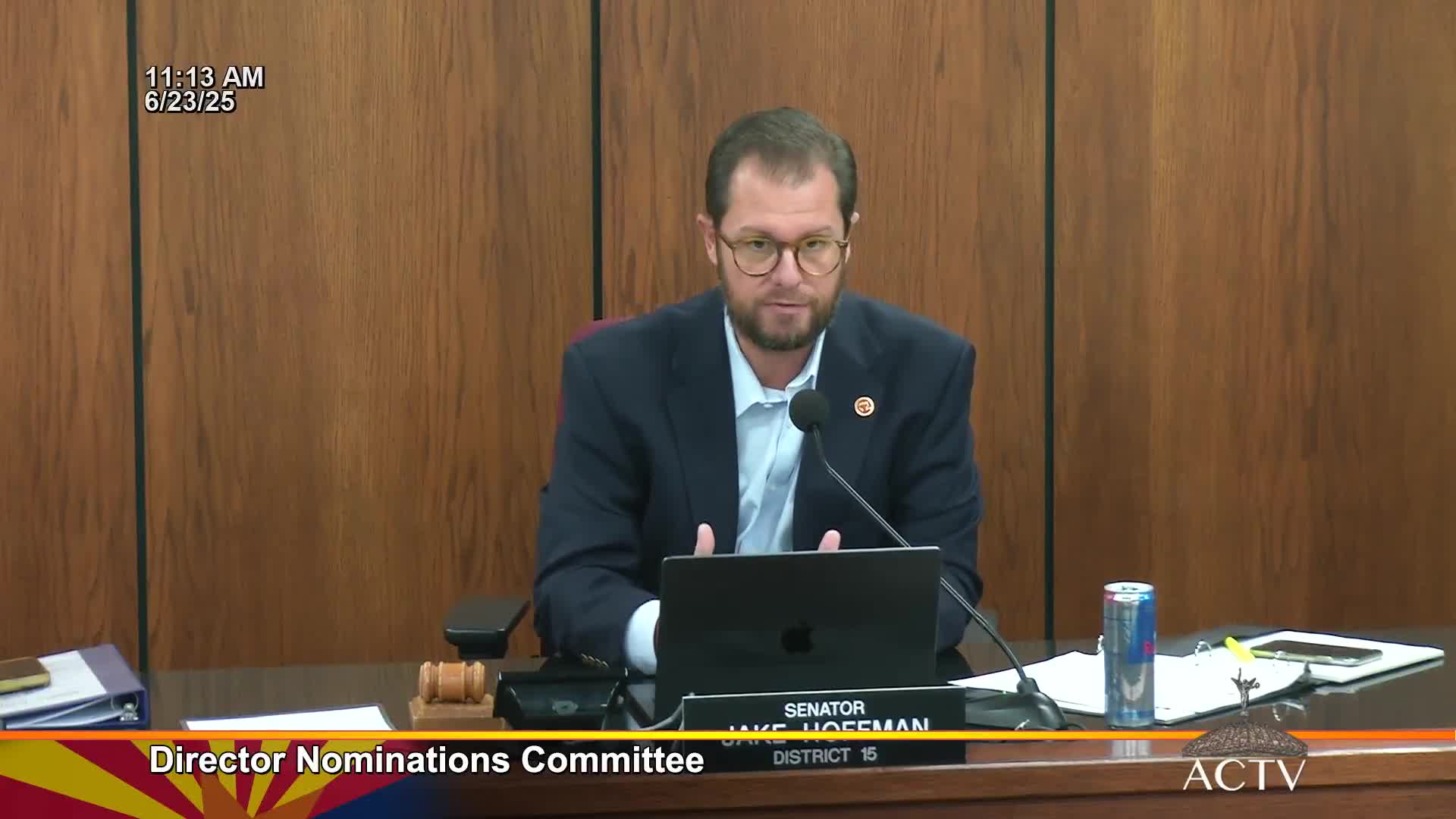
The Senate Committee on Director Nominations voted 3-2 to recommend Karen Peters as director of the Arizona Department of Environmental Quality after a lengthy hearing in which members questioned her handling of an avian-flu carcass burial, agency funding and priorities on air and water policy.
The Senate Committee on Director Nominations voted 3-2 to recommend Karen Peters for confirmation as director of the Arizona Department of Environmental Quality following a confirmation hearing that focused on water-quality emergency responses, air-quality research and state agency funding.
Peters, a lawyer and public-sector manager who has served as ADEQ director since February 2023, outlined priorities in an opening statement that emphasized stabilizing agency funding, improving community engagement and tackling water- and air-quality problems. “ADEQ delivers its mission of protecting public health and the environment by meeting and balancing all of these wants in accordance with state and federal laws,” Peters told the committee.
The hearing drew extensive questioning from committee members about three issues in particular: the agency’s response to the recent avian-flu outbreak at a Valley poultry facility and the burial of carcasses on private property; regional ozone pollution and ADEQ’s work with federal and regional partners; and ADEQ’s rulemaking on advanced water purification and direct potable reuse.
On the avian-flu incident, Peters told senators that a flock of egg-laying birds had been depopulated under federal direction and that ADEQ initially allowed burial as an approved USDA disposal method because the operator contacted state officials on a Saturday amid exigent circumstances. Peters said ADEQ later required landfill disposal and worked to protect groundwater. Committee members pressed her over whether the state should have allowed on-site burial before verifying depth-to-groundwater and soil conditions. Peters said the department issued a temporary 90-day waiver to allow site characterization and that the agency later ordered a halt to further burial and pivoted toward landfilling.
Committee members and public commenters raised several contested details: Peters described the initial depopulation as involving millions of birds; later discussion identified more than 2 million birds buried at the specific site in question. A news report cited during the hearing said the emergency landfilling cost the state up to $1.5 million. Peters told the committee that USDA indemnity payments are a separate federal program and that the department was evaluating whether cost recovery against the operator was appropriate.
On air quality, Peters described a research initiative she convened — referred to in testimony as the Ground Level Ozone Research Project — involving ADEQ, the Maricopa Association of Governments (MAG), Maricopa County and EPA scientists from Region 9 and federal partners, including NASA. The research aims to quantify ozone formation drivers in the Phoenix-Mesa region, including wildfire impacts and long-range transport. Peters said the work is intended to give MAG and the region better data to prepare state implementation plans under the Clean Air Act and to support any demonstration that transport or exceptional events affect attainment obligations.
Multiple senators pressed Peters about ADEQ’s communications and level of engagement with EPA under the current federal administration and whether the state had supplied evidence to support transport-related demonstrations. Peters said MAG prepared transport analyses submitted to EPA and that EPA had acted to prevent reclassification of the region by rescinding certain limiting interpretive policies, allowing MAG’s submittal to be accepted.
Peters also described ADEQ priorities on water: a planned inventory of known illegal cesspools (she said there may be as many as 80,000 still in use), oversight of more than 1,500 public water systems (many small and rural), work identifying PFAS impacts, and use of technical assistance and funding tools to bring small systems into compliance. She told the committee ADEQ has developed predictive analytics for drinking-water systems to identify likely contaminant exceedances and is seeking greater data interoperability with the Arizona Department of Water Resources.
Lawmakers additionally questioned Peters about ADEQ’s rulemaking to implement a legislative directive to allow advanced water purification and direct potable reuse (DPR). Peters said the rules are voluntary for water providers, require pilot testing that can take more than a year, and include “enhanced source control” and expanded monitoring beyond existing Safe Drinking Water Act requirements. She told the committee that real-time monitoring is an operator requirement and that the data are reported to ADEQ, but are generally self-reported by the water system rather than generated by a state-run, continuous live feed.
Public testimony at the hearing was sharply divided. Industry groups including Freeport McMoRan, Salt River Project, the Arizona chapter of the Associated General Contractors and the Salt River Project urged confirmation, praising Peters’s experience and stakeholder engagement. Several residents and activists opposed confirmation, citing the carcass burial episode, concerns about DPR (which opponents characterized as “sewage to tap”), and broader skepticism of agency policy on climate and transportation. One commenter urged the committee to reject the nomination, calling Peters’s record “poor judgment” on water safety.
After roughly four hours of questions and public comment, the committee moved to recommend Peters’s confirmation to the full Senate. The committee recorded a 3-2 recommendation to send the nomination to the Senate floor for a final vote.
The full Senate will now consider that recommendation; the committee’s action does not itself confirm the nominee. A final vote date was not set during the hearing.