Get Full Government Meeting Transcripts, Videos, & Alerts Forever!
Get email alerts on the County Budget Trt topic
No spam. Unsubscribe anytime.
Grand County commissioners review TRT cleanup, shifts funds to cover trails and weigh cuts after revenue dip
Summary
The Grand County Board of County Commissioners reviewed a proposed cleanup of Transient Room Tax accounting and debated how to cover a multi-line shortfall at a June 23 budget workshop, with staff directed to reconcile historical transfers and commissioners scheduling a follow-up workshop July 1 and a public hearing July 15.
The Grand County Board of County Commissioners reviewed a proposed cleanup of Transient Room Tax (TRT) accounting and debated how to cover a multi-line shortfall at a June 23 budget workshop, with staff directed to reconcile historical transfers and commissioners scheduling a follow-up workshop July 1 and a public hearing July 15.
Commissioner Winfield called the meeting to order and led a roll call that included Commissioner Nadine, Commissioner Hadler, Commissioner McCurry, Commissioner McGahn, Commissioner Martinez and Commissioner McCandless. Administrator Art Tyner, Clerk/Auditor Gabe Wojtek and finance staff member Steven Vowles were on the agenda to present budget amendments and clarifications.
Gabe Wojtek told commissioners that some 2023–24 reimbursements and transfers of TRT funds will be reflected in the county's financial statements rather than as part of the current-year budget amendment. Wojtek said the county needs the 2025 amendment to show activity to date and to move previously budgeted TRT-funded expenses for the Grand County Active Trails and Transportation program (GCAT) into the general fund: "we're still in the process of reviewing and drafting the financial statements for 2024," he said.
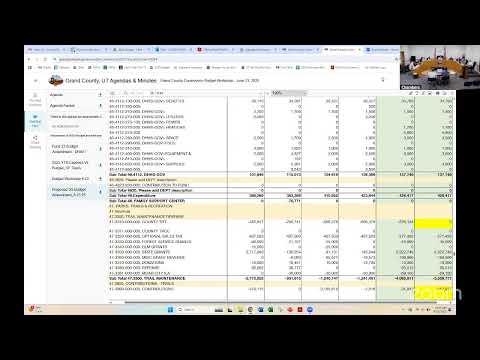
The amendment packet presented several specific changes: the paid-advertising line in Fund 23 (TRT promotion) was shown increasing by $1,100,000; a draw from fund balance in the general fund proposed in the approved 2025 budget (originally $1,100,000) would increase to $2,250,000 to balance the amended budget; and the amendment shows $526,134 budgeted in the general fund for GCAT, of which $162,286 had been spent to date and would be reflected as general-fund activity for 2025.
Wovles and Wojtek discussed discrepancies between different schedule lines for Fund 23 and Fund 47 (GCAT). Commissioners pressed staff for reconciliations of multiple numbers in the packet and for a clear audit trail of transfers into Fund 47. Wojtek said staff would follow up: "we'll definitely look into it and and by as promptly as we can."
The workshop also focused on revenue projections and the impact of a statutory change referenced in the packet (HB 456) that affects TRT mitigation dollars. Staff presented two frames of revenue outlook: a three-year rolling-average projection showing a roughly 1.5 percent contraction for the year and a more immediate view showing sales-and-use revenues running about 6.1 percent under budget year to date. Vowles explained the choices for forecasting: "My 3 year model... That's why I stick to it," he said, while others on the panel urged prudence given a current six-month shortfall.
Commissioners discussed how to cover the shortfall without disrupting essential services. The packet named law enforcement, solid waste and search and rescue as mitigation-funded "essential services." Several commissioners indicated a preference to use general fund money this year to avoid interrupting those services and to treat coverage of GCAT's prior TRT support as an interim general-fund expense. One commissioner summarized the immediate planning steps: hold a two-hour workshop before the next meeting for department presentations, present both forecasting methods to the board, and decide a percentage target for countywide cuts if needed.
Staff flagged capital items and other details for follow-up: a capital-project general fund reserve balance was reported around $6.9 million at the close of 2024 (subject to adjustment as year-end entries are finalized); recent quarter-two capital outlays include HVAC replacements and improvements at county facilities; and several planned capital projects were discussed, including the CJC facility transaction and a proposed pickleball/parks package (total project figures were cited in the packet and will be verified by staff). Wojtek said the county would supply updated reconciliations of the 2023 and 2024 transfers so auditors can close the books.
Commissioners directed staff to: reconcile the Fund 23/47 numbers and provide corrected accounting entries for 2023 and 2024 financial statements; prepare a one-page comparison of the 1.5% (three-year rolling average) and the 6.1% (current-year variance) revenue scenarios for use in department planning; and prepare a packet by Friday with department presentations for a July 1 workshop (presentation PDFs to be submitted in advance). No formal motions or final votes on budget amendments were recorded at the workshop; commissioners set a public hearing and possible adoption vote for the July 15 meeting.
The workshop closed with commissioners agreeing to compile a prioritized list for the July session: (1) essential services (law enforcement, solid waste, search and rescue), (2) nonessential programs and projects (including GCAT and paid media changes), (3) capital-project prioritization (CJC, Star Hall, pickleball/playground packet), and (4) existing open position hiring decisions for the remainder of 2025. Staff committed to providing corrected numbers and to returning with a clean proposed amendment and supporting schedules.
The meeting adjourned at 10:47 a.m.