Get Full Government Meeting Transcripts, Videos, & Alerts Forever!
Get email alerts on the Fire Ems Staffing topic
No spam. Unsubscribe anytime.
Venice council asks staff to model funding options for hiring six firefighter‑paramedics
Summary
After a presentation from the fire department, the council asked staff to analyze ways to fund six new firefighter‑paramedic positions that would staff a fourth 24/7 ambulance. Staff estimated the recurring cost at about $780,000; councilors discussed possible offsets including pension contributions and interest revenue assumptions.
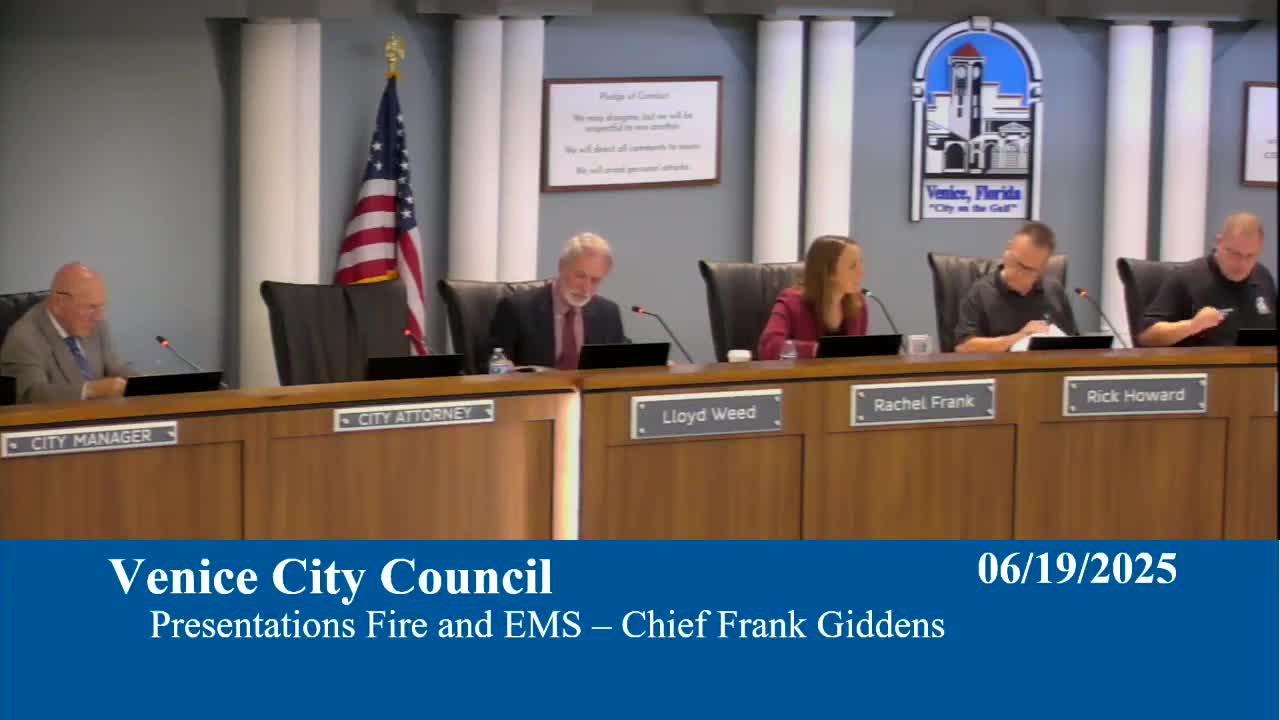
The Venice City Council asked city staff Wednesday to model ways to pay for six new firefighter‑paramedic positions after the fire department said the hires are needed to staff a fourth full‑time ambulance.
The request followed an on‑the‑record presentation from Assistant Fire Chief Kyle Hartley, who told the council the six hires (two per 24‑hour shift) are not intended to add engine personnel but to place a dedicated 24/7 ambulance into service. "These six people are for us to put a full time 24/7 ambulance in service," Hartley said.
Council members focused on how to pay for the recurring costs. City staff estimated the FY26 recurring cost for six firefighter‑paramedics at about $780,000, including salary, benefits and start‑up training. City Manager LaValley and Finance Director Linda Seni told the council they could return with options, and Seni said some partial offsets could come from pension funding choices, interest income assumptions or targeted reallocations in the proposed budget. Seni cautioned the council that the administration had taken a conservative approach to interest earnings in the proposed budget and that recurring costs should not be funded with one‑time or volatile revenue sources.
Council discussion emphasized service and risk. Several members described the proposal as a way to preserve response time and service quality as the city grows. The city manager said the original decision to provide municipal EMS years ago was driven by a desire to reduce response times and increase on‑scene medical capability; staff said municipal ambulances typically arrive faster than mutual‑aid units from outside the city.
Councilmember Smith pressed for clarity on where the money would come from and said he did not want to commit to hires before staff brought back specific budget offsets. Councilmember Frank, who joined other council members in urging staff study funding scenarios, said she favored the additional staffing but preferred recurring revenue be identified before final approval. Several council members suggested the staff examine reducing or reprioritizing an extra discretionary contribution to the fire pension that appears in the proposed budget as one possible offset.
After the discussion, the council gave staff consensus direction to analyze funding options and return with a specific recommendation. The city manager and finance director said they would present possible offsets and a cost‑benefit summary at an upcoming meeting so the council could decide whether to incorporate the six positions into the adopted FY26 budget.
The council and staff noted follow‑up items: (1) staff will provide a budgeted cost breakdown (salary and benefit line items, training up‑front costs estimated by the department at roughly $70,000), (2) staff will model scenarios showing how the positions could be funded without increasing the millage rate (including pension contribution adjustments and use of one‑time revenues), and (3) staff will estimate timing for hires and projected transport revenue that could partially offset costs. The council did not adopt a final budget amendment or motion Wednesday; it gave consensus direction to staff to return with options.