Get Full Government Meeting Transcripts, Videos, & Alerts Forever!
Get email alerts on the Jail Bond Financing topic
No spam. Unsubscribe anytime.
Cochise County supervisors review jail bond financing options, enter executive session on ballot language
Summary
Stifel Public Finance presented bond scenarios ranging from $100 million to $130 million and staff discussed amortization, pledged revenue from a proposed half‑cent sales tax and a $6.3 million maintenance‑of‑effort contribution. The board voted 3‑0 to go into executive session to discuss ballot language under A.R.S. §38‑431.03.
Bisbee, Ariz. — Cochise County supervisors on June 20 heard a presentation from Stifel Public Finance on options to finance a proposed new county jail and voted 3‑0 to go into executive session to discuss ballot language. The public portion of the meeting laid out possible bond sizes, amortization terms and the revenue the county could pledge to service debt if voters approve a half‑cent transaction privilege (sales) tax.
The county’s retained municipal banker, Mark Reeder of Stifel Public Finance, told the three supervisors the firm would assist with structuring any bond issuance and with voter pamphlet materials. “We’re your investment bank… and ultimately, at the end of the day, if the election is successful, our job is to raise capital for you through the issuance of Cochise County Jail District revenue bonds,” Reeder said.
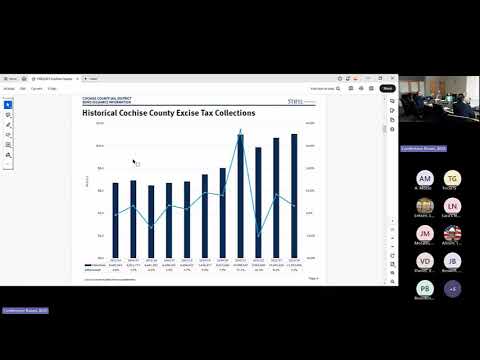
Reeder summarized the county’s draft assumptions: estimated construction cost planning numbers in the $120 million–$130 million range; a proposed half‑cent sales tax likely to generate roughly $10 million annually; and a county maintenance‑of‑effort contribution of about $6.3 million per year that could be pledged to bondholders. Under those assumptions, he presented sample amortizations and debt‑service schedules for different terms and bond sizes, including a $100 million illustrative issue and scenarios stretching to $120 million–$130 million.
Why it matters: the sales tax revenue stream is economically sensitive, county staff and Stifel said, so amortization length, call provisions and reserve policy change both annual cash requirements and total interest costs. Supervisors discussed tradeoffs between shorter terms (higher annual payments, less interest over time) and longer terms (lower annual payments, more interest but greater protection against revenue shortfalls). Reeder noted that Arizona jail‑district statute allows amortization up to 25 years but said Cochise County was unlikely to use the full 25‑year maximum.
Key financial points presented
- Revenue sources: the presentation assumed roughly $10 million per year from a proposed half‑cent TPT (transaction privilege tax) and an approximately $6.3 million county maintenance‑of‑effort contribution; together those pledged revenues were modeled at about $16.3 million annually.
- Bond sizing and interest: scenarios modeled a roughly 4.5% market rate for municipal bonds in the near term and showed a $100 million issue with annual debt service the county could cover under base assumptions. Reeder cautioned that market rates and revenues could change and said Stifel would return with updated pricing before sale.
- Investment of proceeds: bond proceeds would be invested as they are drawn for construction; Reeder estimated interest earnings on invested proceeds could be in the low single digits and produce several million dollars on a multiyear drawdown, money that could offset interest costs or be applied toward principal or overruns.
- Early payoff and call features: the board discussed including a callable feature with no penalty so the county could redeem bonds early when excess revenues permitted. Reeder said such a feature is negotiable with investors but typically carries a slight premium in the interest rate.
- Reserve and management recommendations: Stifel recommended holding a management reserve (Reeder suggested approximately $10 million as an example) during construction for contingencies, then applying excess cash to the bonds when appropriate.
Other discussion items and constraints
- State funding: Reeder said the county believes a $20 million state set‑aside exists in the House budget but that the Senate budget did not include the same set‑aside; county staff said reconciliation and negotiation between chambers would determine whether that funding is available.
- Credit and issuer structure: if voters approve the tax, the issuing entity would be the Cochise County Jail District, a political subdivision; investors will evaluate the jail district’s credit in the context of county management and finances. Reeder said a separate bond rating for the jail district would be developed when the county accesses the capital markets.
- Timing: the presentation used an illustrative timeline in which the election would be held in November 2025 and, if approved, the Department of Revenue would begin collections in July 2026. Reeder estimated bond sale and drawdown timing would follow final design, engineering and contractor selection—roughly 12–18 months after a successful vote, depending on the county’s schedule.
- Organizational outcome: Reeder noted county intent to dissolve the jail district after full repayment of the bonds; he said there are technical and legal steps to effect dissolution that counsel would advise on.
Board action
The board voted to enter executive session to discuss ballot language under A.R.S. §38‑431.03 (privacy of executive session matters). The motion passed unanimously, 3‑0. Supervisors returned from executive session later in the meeting and adjourned. The board did not take a public vote on bond issuance or on final ballot language during the open portion of the meeting.
What to expect next
Staff and Stifel agreed to return with updated financial models, specific amortization scenarios and suggested ballot language for legal review. The presentation materials showed multiple options for term length, reserve policy and early payoff mechanics that the board said it would consider alongside the county budget and other priorities (roads, pension contributions and general fund obligations).