Get Full Government Meeting Transcripts, Videos, & Alerts Forever!
Get email alerts on the Library Budget topic
No spam. Unsubscribe anytime.
Appleton trustees briefed on library funding, calendar for 2026 city budget
Summary
Board received a trustee-training overview of how the Appleton Public Library is funded, key budget figures for 2025, and the schedule that leads to the city's November budget adoption.
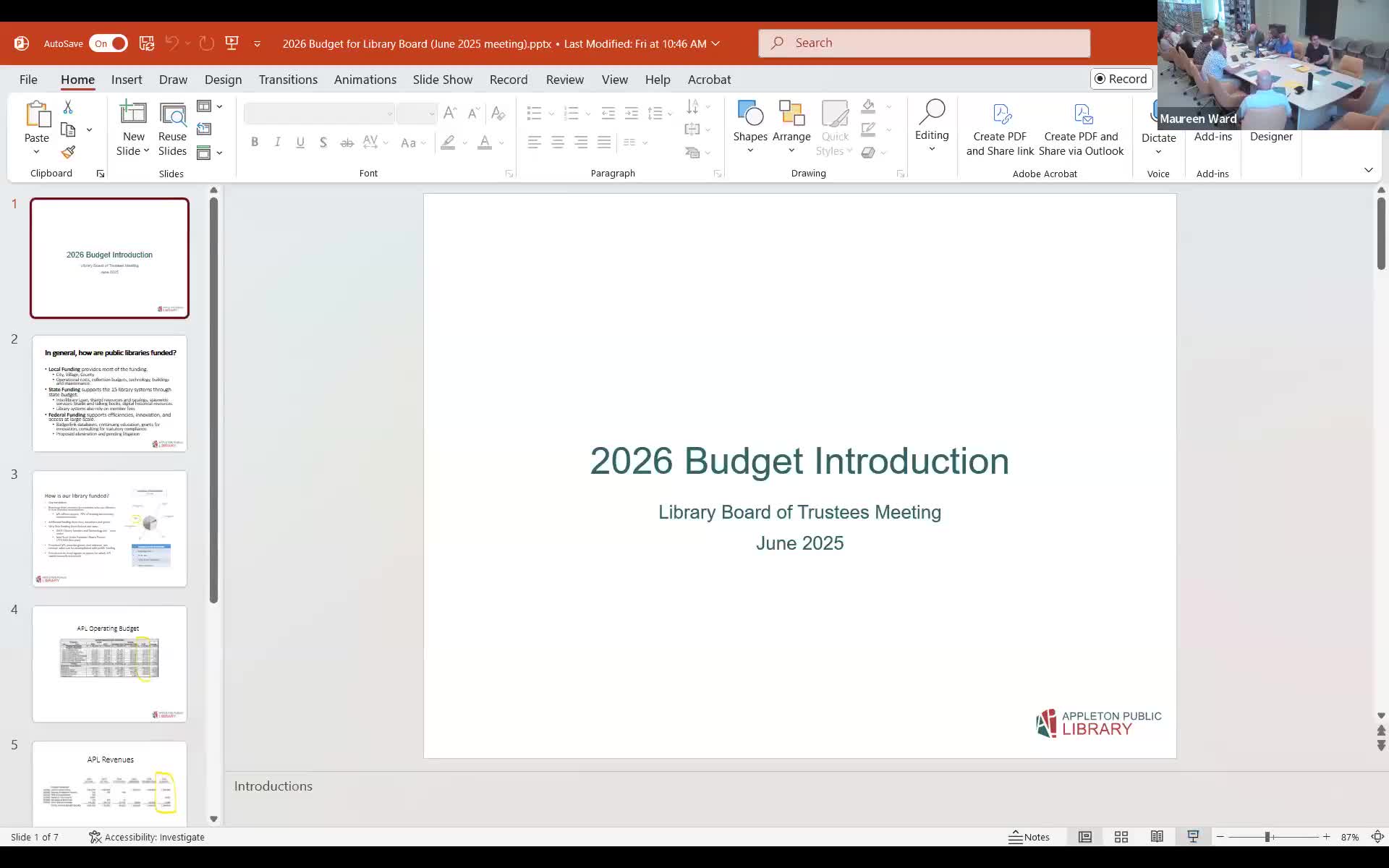
Trustees of the Appleton Public Library received a trustee-training briefing on June 17 that explained how the library is funded, summarized the library's 2025 operating budget and set out the calendar for the city's 2026 budget process.
The presentation described local tax dollars as the library's primary revenue source, noted the library's 2025 total operating budget as $5,200,000, and said the library accounts for roughly 7% of the city's $72'$73 million general fund. County reimbursement revenue was described as offsetting about 20% of the library's funding; the transcript identified the top revenue line for library grants and aids at "1.2 plus million dollars." Staff also said the library expects to record roughly $15,000 in meeting-room rental revenue in 2025.
The session explained capital-project rules used by the city: assets costing $10,000 or more with an expected life of three years are treated as capital projects; expenditures over $25,000 are routed into a separate capital-improvement (CIP) request. The board was reminded that the council cannot bind future councils to multi-year commitments; council approval is annual.
Trustees were briefed on the overall municipal budget calendar. The library's proposed budget will go first to the board's finance committee before the August board meeting, then to the full board in August. The city executive budget is published in October. The city's Budget Saturday is scheduled for Nov. 1, followed by a public hearing Nov. 5 and final adoption on Nov. 12, according to staff.
The presenter outlined federal and state roles in library funding. State funding primarily supports regional library systems rather than individual libraries, and federal funding is described as limited and targeted to large-scale access programs (BadgerLink databases were named as an example). The Institute of Museum and Library Services and the Library Services and Technology Act (LSTA) were cited as sources of competitive grants and system support; staff noted litigation related to proposed changes to those federal supports.
The board was told the library receives additional revenue from donations, Friends group fundraising and occasional state grants used for the building project. Staff said some revenues (donations, memorials) cannot be precisely forecast during budget preparation and are incorporated later via budget amendments.
Questions from trustees included whether the mayor had signaled an increase or decrease in the city budget; staff responded it was too early to say and noted state budget uncertainty. The presentation ended with an invitation for trustees to attend a finance-committee meeting before the August board meeting to review the proposed library budget in more detail.