Get Full Government Meeting Transcripts, Videos, & Alerts Forever!
Get email alerts on the Roadless Rule topic
No spam. Unsubscribe anytime.
Wyoming lawmakers, counties push changes to federal 'roadless rule' to ease forest management and reduce wildfire risk
Summary
U.S. Rep. Harriet Hageman (R-Wyo.) told the Select Federal Natural Resource Management Committee that the 2001 Forest Service roadless rule constrains routine forest management across millions of acres, contributing to insect outbreaks and large, destructive wildfires in the Interior West.
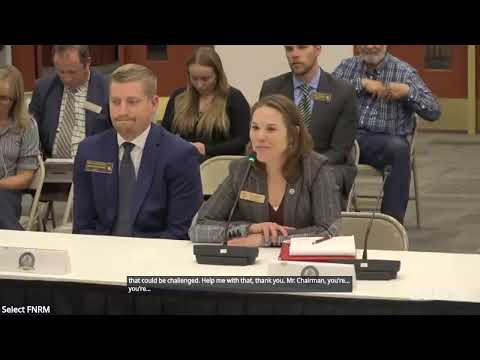
U.S. Rep. Harriet Hageman (R-Wyo.) told the Select Federal Natural Resource Management Committee on Oct. 26, 2025, that the U.S. Forest Service’s 2001 ‘‘roadless rule’’ has blocked routine management across millions of acres of national forest and contributed to insect outbreaks and catastrophic fires in Wyoming and the Interior West.
Hageman, joining the committee by Zoom, recounted that she was hired by the state of Wyoming as a special assistant attorney general to challenge the rule, won a preliminary nationwide injunction in federal court before Judge Brimmer, and argued the rule violated the National Environmental Policy Act (NEPA), the Wilderness Act and other statutory requirements. "It was the roadless rule that made it so that the Forest Service could not properly manage these resources," she said.
Why it matters: Committee members, county commissioners and forestry officials said the rule constrains access and long-term timber contracts, limits managers’ ability to reduce hazardous fuels and has been embedded in forest plans and resource management plans (RMPs). Committee witnesses described options that range from local technical corrections to maps, to state- or Congress-led rule changes, to targeted statutory exemptions intended to allow road building and timber harvest in limited circumstances.
Hageman said the 2001 rule designated roughly 58.5 million acres of national forest land as inventoried roadless areas and that about 3.2 million acres were in Wyoming. She argued the rule was prepared quickly, relied on outdated maps produced during the Forest Service’s 1970s inventory, and was implemented without the level of site-specific NEPA analysis typically required for large federal land decisions. The congresswoman described Judge Brimmer’s ruling in Wyoming as finding NEPA and Wilderness Act violations, and she said that a subsequent nationwide injunction was vacated after the state withdrew its challenge under political pressure.
Committee discussion and local testimony focused on three tracks for change: 1) targeted, forest-by-forest technical corrections to the roadless inventory where maps are demonstrably incorrect; 2) state-level approaches such as a Wyoming-specific roadless rule (noting regulatory limits in 36 CFR 294.12 and the missed governor-request deadline in 2005); and 3) federal legislative or administrative action to create exemptions and longer timber contracts to support industry capacity.
Micah Christiansen, natural resource counsel for the Wyoming County Commissioners Association (WCCA), summarized the practical problem with the underlying inventory and mapping: "Right now in Wyoming, we have numerous areas with poor or incorrect roadless inventory. We have state highways, county roads within roadless areas," he said, citing the Brigder Teton and Bighorn National Forests as examples. Christiansen described four avenues counties are pursuing, including technical corrections (the Bridger-Teton National Forest removed 13,092 acres by technical correction in 2021), continued casework and local collaboration, and longer-term regulatory or congressional solutions.
Wyoming State Forester Kelly Norris told the committee counties and state agencies can and do perform fuels mitigation and wildlife work in some inventoried roadless areas because the rule limits building new roads and commercial timber sales, not all forest treatments. "You still can do quite a bit in roadless. You just can't build roads," Norris said, noting that maintenance of existing roads, fuels reduction, and aspen and wildlife treatments remain possible in many locations.
Logging contractors and local commissioners described market and infrastructure constraints that limit the ability to use removed timber. Joe Lansdale, a logging contractor in Buffalo, said the state needs larger, diversified processing facilities — chips, firewood, rail access or local mills — to turn additional forest product volumes into saleable material. "You either need transportation or bring the facility," he said, explaining why many small operators cannot absorb a large, sudden increase in timber supply.
County officials described local collaboration and specific target areas where technical corrections or limited access could meaningfully reduce risk. Lincoln County Commissioner Kent Conley identified the Grays River area in the Bighorn National Forest as a high-risk, high-priority area where access, trail maintenance and selective harvest are critical to defend adjacent communities. "The Grays River is a tinderbox," Conley said.
Several committee members and witnesses discussed the draft congressional language attributed to U.S. Sen. Mike Lee that had recently surfaced in reconciliation discussions. Hageman described the provision as intended to allow the Bureau of Land Management (BLM) and the Forest Service to identify certain small urban-proximate parcels for disposal or conveyance to meet housing needs, subject to exclusions and local-state input. She said the draft would limit Forest Service identifications to lands within roughly one mile of an urban area and BLM identifications to lands within about five miles of urban areas; grazing leases, ski areas and active oil-and-gas leases would be excluded. Hageman added states would have right of first refusal. She and others cautioned the text was evolving and that public confusion has been fueled by third-party maps and advocacy statements.
Participants repeatedly emphasized the practical limits of any change: mapping and RMPs have embedded the roadless designation into local forest planning; technical corrections can be slow and resource-intensive; a state-specific rule would require regulatory or statutory fixes because governors missed an early regulatory window; and successful forest restoration at scale will also require industry capacity and long-term timber contracts. Hageman said congressional proposals under consideration also aim to require the Forest Service to enter into longer (20-year) contracts to provide market certainty to timber operators.
What the committee can do: Witnesses urged continued collaboration among counties, the state forester and local forest supervisors to pursue technical corrections and pilot projects; legislative engagement in Congress to create targeted statutory exemptions or new authorities for managers; and local economic development to rebuild processing capacity. Micah Christiansen provided a short list of near-term actions counties can pursue, including (1) submitting technical-correction packages where maps are evidently wrong, (2) using ‘‘good neighbor’’ authorities and other intergovernmental tools, (3) exploring a state-specific rule only if the regulatory window and statutory pathway are clarified, and (4) pressing Congress and the Forest Service to expand manager tools where public-safety or forest-health risks are identified.
Committee Chair Bob (addressed as "Chairman Bob" during the meeting) and co-chair Representative Wharf thanked witnesses and urged continued engagement between local stakeholders and the congressional delegation.
Ending note: No binding votes or formal committee directives were recorded during the session; speakers framed next steps as a mix of technical corrections, state and local collaboration, and possible congressional or administrative changes. The committee opened the floor to public commenters after Hageman’s remarks and heard detailed local accounts about mill capacity, trail and road maintenance, and high-risk drainages.