Get Full Government Meeting Transcripts, Videos, & Alerts Forever!
Get email alerts on the Parks Sdc topic
No spam. Unsubscribe anytime.
Oregon City delays decision on parks system-development charges after public hearing; commissioners ask for revised numbers
Summary
After a presentation and public testimony, the commission voted unanimously to continue consideration of a resolution to adopt a revised parks SDC methodology to a July meeting so staff can model alternatives and clarify the projected share for an aquatic center.
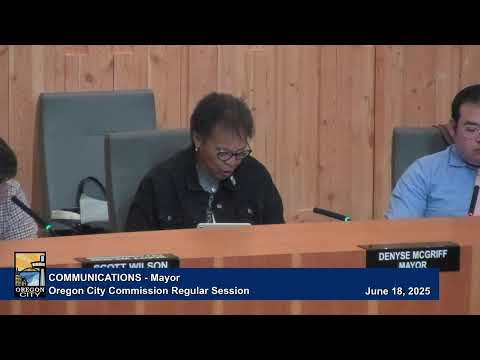
The Oregon City Commission held a public hearing June 18 on a proposed resolution to adopt a revised system-development charges (SDC) methodology for parks and recreation facilities and then voted to continue the matter to the second meeting in July.
Scott Archer, the city's parks and recreation director, introduced the topic and turned the presentation to Deb Gallardi of Gallardi Rothstein Group, the consultant who helped produce the updated methodology. Gallardi said the updated SDC methodology ties charges to projected costs for growth-related improvements identified in the parks master plan and moves the single-family residential charge to a tiered schedule based on dwelling size.
Gallardi told the commission that the updated methodology identified roughly $50 million in capital costs related to future growth and that the reimbursement (growth-credit) component is about $8 million. The consultant said scaled residential SDCs would range from roughly $8,700 for the smallest tier (under 800 square feet) to about $15,000 for the largest tier. For nonresidential development, Gallardi said the cost basis is roughly $707 per employee (updated regional data) with a proposed floor of $200 per 1,000 square feet for some land-use categories.
Public comment included a pair of speakers. William Gifford, an Oregon City resident, urged the commission to weigh development costs against the economic benefits of parks and trees. Developer Seth Henderson said that in other cities comparable SDCs range widely and that the proposed changes could push total SDCs for multifamily units above $28,000 per unit with the roughly 30% bump currently proposed. "With this bump which is about 30% for each multi family unit you're going to be over $28,000," Henderson said, arguing higher SDCs could affect project financeability and the mix of units built.
Commission discussion focused on two central questions: (1) whether the methodology should include a proposed aquatic and recreation center (the consultant's list assumed a contribution of roughly $9.1 million from SDCs toward a larger proposed facility), and (2) whether multifamily units should be tiered or scaled by bedrooms to better reflect occupancy differences. Commissioners asked staff to model the effect on SDC rates if the aquatic facility portion were reduced (for example to $5 million or $0) and to provide options for tiering multifamily units by bedroom count or unit size.
After those requests, a motion to continue consideration of Resolution 25-19 to the second meeting in July passed unanimously.
Ending
The commission left the record open for further modeling and asked staff to return with revised rate scenarios that show the SDC impact of removing or reducing the aquatic facility component and of applying a tiered approach to multifamily units.