Get Full Government Meeting Transcripts, Videos, & Alerts Forever!
Get email alerts on the Transportation topic
No spam. Unsubscribe anytime.
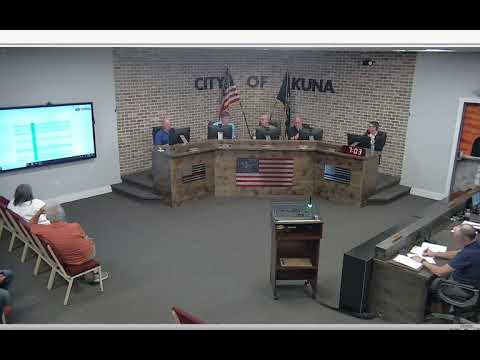
ITD presents Highway 69 corridor study proposing seven-lane section, raised medians and multiuse paths
Summary
Idaho Transportation Department staff and consultants told the Kuna City Council that traffic on State Highway 69 could more than double by 2050, and presented a vision that would widen the busiest stretch to seven lanes, add raised medians and 10-foot multiuse paths while noting major funding and right‑of‑way constraints.
Idaho Transportation Department (ITD) staff and consultants presented a traffic study of State Highway 69 to the Kuna City Council, projecting large traffic increases and outlining a corridor ‘vision’ that would widen the busiest segment to seven lanes, add an 18‑foot raised median, and install buffered 10‑foot multiuse paths.
The study, presented by Mark Wazdahl of ITD District 3 and Megan Romanescu of DKS Associates, found existing north‑end volumes of about 37,000 vehicles per day and projected that those volumes could reach about 77,000 vehicles per day by 2050. Romanescu said, “the existing traffic is about 37,000 vehicles per day. And by 2050, those numbers are expected to more than double and be around 77,000 vehicles per day.” The consultants said those projected north‑end volumes would exceed current traffic on Eagle Road.
The presentation summarized safety history and proposed cross sections. The study team reported 579 crashes on the corridor from 2019–2023, including five fatalities; three of the fatalities involved a drug‑ or alcohol‑impaired driver. The majority of crashes were concentrated at intersections, the team said, and 47% of crashes on the corridor were classified as serious (injury or fatal), compared with an Idaho statewide rate of 31% for 2023.
For the north–south segment (Overland Road to Kuna Road), the study’s preferred cross section would be three 12‑foot travel lanes in each direction, 8‑foot shoulders, an 18‑foot raised median and 10‑foot multiuse paths buffered by an 8‑foot (minimum) landscape strip on each side. That design would convert many half‑mile intersections to right‑in/right‑out only, while preserving full access at major mile intersections; right‑turn lanes would be added widely. The consultants said the minimum right‑of‑way needed is about 122 feet and that the corridor’s existing right‑of‑way ranges from about 125 to 140 feet, so additional easements or property takings would be required in some locations for drainage and turn lanes.
The project team said it had modeled three access alternatives (full access; partial right‑in/right‑out with left‑in at half‑mile intersections; and right‑in/right‑out only at half‑mile intersections) and found similar performance among them for travel times. With the proposed improvements, the study forecasts slightly better commute travel times than today — for example, a northbound AM commute of about 14.8 minutes versus a modeled “do‑nothing” northbound AM of as much as 42 minutes in 2050.
Funding and permitting constraints featured heavily in the presentation. The study was scoped as a traffic analysis and did not include structural design or detailed topographic surveys needed for overpasses; ITD staff said pursuing vertical interchange solutions would require separate contracts and studies. The presenters noted several funding processes and opportunities: an ITD STAR agreement (developer‑funded improvements under ITD oversight) was under consideration with a not‑to‑exceed figure of $35 million mentioned by staff; a separate preliminary design by a private developer was reported at roughly $30 million at this stage. The presenters said the final traffic study report was expected in July 2025 and that a hot‑seal contract on Highway 69 would begin the week of July 11 (38 calendar workdays).
Public comment and council questions highlighted operational and access concerns. Michael Rocco, a Kuna resident, asked for more specificity about why an expressway option was judged infeasible. Chief of Police Mike Fortusco asked whether the project would add turn lanes where drivers currently use shoulders; Fortusco said crashes related to shoulder use were a pressing concern for the department. A representative from the local fire department had previously submitted a comment that raised concerns about medians affecting emergency response. Several council members and residents raised the compatibility of a raised median with farm equipment and larger agricultural vehicles.
The project team identified special considerations at the Kuna Curve and Overland Road intersections and said that if a high‑capacity intersection is needed at Overland, it would likely require a vertical solution (overpass) and therefore an additional project scope and budget.
Next steps: ITD and consultants said they will finalize the traffic study, continue coordination with Kuna, Meridian and regional partners (Compass), and monitor funding opportunities through ITD’s programming processes and the ITIP public comment period starting July 1. The consultants emphasized that the traffic study is a planning document to guide future design and funding — it is not final design or construction authorization.