Get Full Government Meeting Transcripts, Videos, & Alerts Forever!
Get email alerts on the Environment Pollinators topic
No spam. Unsubscribe anytime.
Bellevue proclaims June as Pollinators Month; volunteers urge native planting and pesticide reduction
Summary
Mayor Rusty Hite proclaimed June National Pollinators Month and Nebraska Pollinator Week at the June 17 Bellevue City Council meeting. Volunteer leaders described ongoing local efforts and gave residents specific steps to support pollinators.
Mayor Rusty Hite on June 17 read a proclamation declaring June as National Pollinators Month and recognizing Nebraska Pollinator Week, marking Bellevue’s commitment to pollinator habitat and conservation.
The proclamation, presented during the Bellevue City Council meeting, notes that pollinators such as bees and butterflies play a “vital role in maintaining healthy ecosystems and supporting food production” and cites Bellevue’s designation as the first Bee City USA in Nebraska.
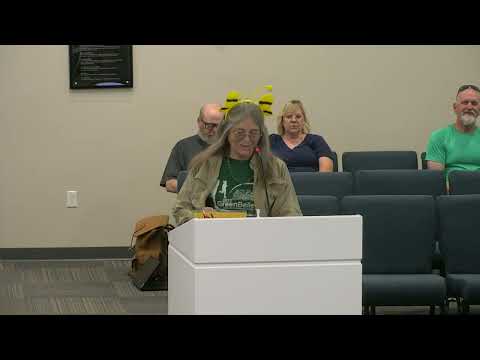
Nancy Scott, a horticulturist of 51 years and co‑chair of Bellevue’s Bee City USA committee, spoke after the proclamation and outlined steps residents can take to help pollinators. “Nearly 90% of flowering plants depend on pollinators for reproduction,” Scott said. “About 35% of the world’s crops — that’s about a third of the food on your plate every day — requires pollinators.”
Scott, who identified herself as a Nebraska certified nursery professional and a longtime volunteer with Green Bellevue and the Bellevue Tree Board, described local activities that supply native plants and public education. She said volunteers grow native plants at her home and at Bellevue University’s greenhouse, give plants away at the weekly farmers market, and run free gardening workshops aimed at increasing pollinator habitat.
She urged specific actions residents can take: plant native species that provide blossoms across the growing season; provide shallow water sources with stones or marbles so insects can drink without drowning; avoid pesticides where possible; and leave portions of gardens undisturbed to provide nesting habitat. “Avoid pesticides,” Scott said. “You probably already know that. Pesticides can harm pollinators, so try to opt for organic practices whenever possible.”
Scott thanked the council for supporting Bellevue’s Bee City USA designation in 2021 and named local partner organizations active in pollinator work, including the Bellevue Garden Club, Bellevue Native Plant Society, Milkweed Matters and PATH (Pollinator Alliance of the Heartland).
After remarks, the council invited members of Green Bellevue and other volunteers forward for a photo. The proclamation and Scott’s presentation comprised the meeting’s special presentations; no formal council action was required to recognize the proclamation.