Get Full Government Meeting Transcripts, Videos, & Alerts Forever!
Get email alerts on the Land Use topic
No spam. Unsubscribe anytime.
Sacramento County supervisors approve West Jackson Highway master plan for 5,913-acre redevelopment
Summary
The Sacramento County Board of Supervisors on June 11 unanimously approved the West Jackson Highway master plan, certifying the final environmental impact report and adopting a package of general plan, community plan and zoning changes — including a four‑fifths override for homes inside Mather Airport’s 60–65 dB noise contour — to allow redevelopment of roughly 5,913 acres in the Vineyard and Cordova communities.
SACRAMENTO — The Sacramento County Board of Supervisors on June 11 unanimously approved a package of entitlements to adopt the West Jackson Highway master plan, certifying the final environmental impact report and approving related general plan and community plan amendments, zoning changes, financing and water‑supply actions for the roughly 5,913‑acre project area in the Vineyard and Cordova communities.
The vote clears a slate of actions recommended by county planning staff: certification of the final EIR and adoption of the related findings and mitigation monitoring program; amendments to the county general plan and the Vineyard and Cordova community plans; adoption of a master plan zoning ordinance and rezones for applicant‑controlled properties; adoption of a public facilities financing plan and an urban services plan; approval of two water‑supply assessments and an amendment to the Zone 40 water supply master plan; and adoption of two applicant‑proposed affordable‑housing strategies. The motion also included a board override of the Mather Airport land use compatibility plan for single‑family residences within the airport’s 60–65 community noise contours, a provision that requires a four‑fifths vote and was included in the approved motion.
Why it matters: The land use proposal would convert an area dominated by surface mining and scattered industrial and rural residential uses into a large planned community that county staff and applicants say is intended to provide housing, jobs, parkland and new multi‑modal connections in the Jackson Corridor. Staff and the applicants described the plan as one of the county’s largest infill reuse opportunities and said the project is designed to meet county climate and connectivity policies.
Project scope and commitments
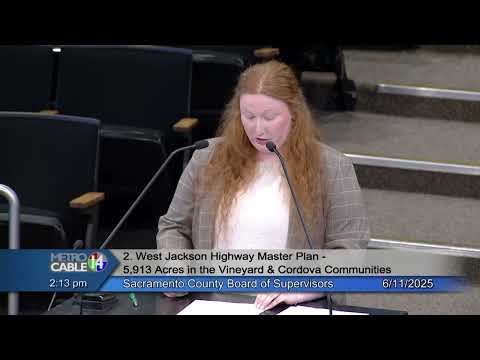
Emma Carico, the county associate planner and project manager, told the board the plan area “encompasses approximately 5,913 acres” and that the proposed land‑use map would allow up to 16,484 residential dwelling units, 11,500,000 square feet of commercial and employment uses, 2,000,000 square feet of industrial space and roughly 2,100 acres of parks and open space at full buildout. Carico said the circulation plan designates several roads as six‑lane, four‑lane or two‑lane collectors and includes both on‑street bike lanes and two types of off‑street trails.
Applicants and project proponents described additional commitments. Yascha Saber, project manager for Granite Construction, said Granite controls about 1,000 acres in the plan area and described approximately 145 acres of residential and mixed‑use development on Granite property that would produce about 1,100 dwelling units, 250 acres of employment/industrial land and roughly 630 acres of parks and open space on Granite‑owned parcels. Mike Ile, representing Stonebridge Properties (and Tigert/Teichert interests described in the hearing record), emphasized the long planning timeline and said the applicants expect multiple implementation phases, including infrastructure financing and district formation after master plan approval.
Affordable housing and water supply
Carico and staff described two separate affordable‑housing strategies prepared with the Sacramento Housing and Redevelopment Agency (SHRA): one from Granite (described as the “Granite strategy”), which relies on payment of affordability fees for the small portion of residential property Granite controls, and one from Stonebridge (the “Stonebridge strategy”), which proposes meeting up to 50% of Stonebridge’s obligation through fee payment, with the remainder fulfilled through land dedication or construction of units triggered by development thresholds. Staff recommended approval of both strategies. Planning staff said the Stonebridge strategy averages dedication ratios used in other Jackson Corridor master plans and that SHRA had suggested using the 2017 fee calculation used on a prior project; the difference would equal the equivalent of about 61 housing units under the two methods, according to staff.
Two water providers required water‑supply assessments, and staff recommended approval of those assessments and an amendment to the Zone 40 water supply master plan as part of the entitlement package.
Environmental review and unavoidable impacts
Staff released the draft environmental impact report for public review on July 25, 2024, and the final EIR was released May 27 (document year in record). The final EIR identified six categories with significant and unavoidable impacts — aesthetics, agricultural resources, air quality, cultural resources, noise and transportation — while listing other categories as less than significant or less than significant with mitigation. Carico said the project meets county General Plan performance criteria LU‑1.20 by demonstrating a vehicle‑miles‑traveled performance metric (alternative 2) and that the project will achieve carbon neutrality through measures including an all‑electric building requirement for later nonresidential projects, energy efficiency, and a project‑wide fair‑share contribution mechanism.
Airport compatibility and noise
A portion of the project lies within the 60–65 community noise equivalent level contours of Mather Airport. Carico told the board applicants prepared detailed noise contour mapping, identified construction techniques to achieve a 45‑decibel interior standard and agreed to a noise monitoring plan with the Department of Airports. Applicant representatives confirmed the project will record navigation easements for the entire project and include enhanced acoustic treatments for homes inside the 60–65 dB contour. Supervisor comments noted the potential for future buyer confusion and resale issues if navigation easements and disclosures were not recorded; staff and applicants said easements and specified acoustic and design treatments are required.
Transportation, trails and parks
Applicants described a multi‑modal circulation plan with transit routes along South Watt Avenue, Jackson Highway, Bradshaw Road, Rock Creek Parkway, Kiefer Boulevard and Excelsior Road, and proposed a 28‑mile “loop” of on‑ and off‑street trails that would connect the project to adjacent master plans and regional trail systems. The applicants also emphasized on‑site stormwater detention capacity and off‑peak pumping as a resiliency measure for downstream properties along Morrison Creek.
Public comment and concerns
One member of the public, Roxanne Fuentes of Sacramento, spoke in opposition during the public‑comment period, urging the board not to approve the plan and raising concerns about loss of prime farmland, impacts to special‑status wildlife and plants (her remarks cited golden eagle, giant garter snake, tricolored blackbird, burrowing owl, western pond turtle, several vernal pool shrimp species and multiple listed plant species), and the county’s airport land‑use compatibility policies. Fuentes said the no‑project alternative would retain grasslands, agricultural habitat and tribal and cultural resources and reduce air, noise and light pollution relative to the proposed project.
Board action and next steps
A motion to adopt staff recommendations was made and seconded on the record; the board then voted unanimously (5–0) to approve the package of entitlements and the airport land‑use override. The board chair and county staff noted that implementation will require subsequent infrastructure planning, district formation, development agreements and phased entitlements, and that significant work remains between master plan approval and construction.
The board’s approval begins a multi‑year implementation process that county staff and applicants said will include further hearings, infrastructure financing decisions, and negotiated development agreements or conditions addressing topics such as commercial corridor improvements, trail phasing and affordable‑housing implementation.