Get Full Government Meeting Transcripts, Videos, & Alerts Forever!
Get email alerts on the Education Scholarships topic
No spam. Unsubscribe anytime.
Adams County weighs options after state cuts to scholarship program; ACEC to pursue competitive application and seek county support
Summary
Adams County commissioners heard on Tuesday that the state is restructuring the Colorado Opportunity Scholarship Initiative (COSI) and sharply reducing the matching funds that have supported the Adams County scholarship program since 2016.
Adams County commissioners heard on Tuesday that the state is restructuring the Colorado Opportunity Scholarship Initiative (COSI) and sharply reducing the matching funds that have supported the Adams County scholarship program since 2016.
The change will move COSI away from county allotments toward a competitive grant model for nonprofits and institutions of higher education, and reduce the frequency and size of state matches. Alicia Friendina, executive director of the Adams County Education Consortium (ACEC), told the board the redesign will mean smaller annual awards from the state and that state matching dollars may be available only once every four years.
Why it matters: Adams County has used money from its portion of the marijuana sales tax since February 2016 to match state scholarships and to fund wraparound student supports; commissioners and ACEC officials said those local funds have produced higher completion rates than the statewide average and that the state changes put that leverage at risk.
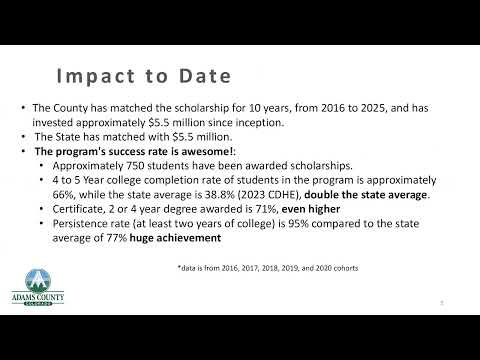
ACEC outlined how the county’s approach differed from the prior state model. “The county took an unusual approach — the only one in the state — to fund all four years,” Friendina said, describing a cohort model that prioritized completion over the larger but shorter-term distribution of single-year awards. The consortium said that approach reduced the number of annual recipients but raised completion: ACEC reported a four-to-five year completion rate of about 66 percent compared with the state average of 38 percent, and a certificate-or-degree completion rate of about 71 percent.
County staff laid out the finances and the problem. Lindsay Monke, chief of staff, summarized the marijuana sales tax account that has supported the match: the county paid approximately $589,109 as the match at this year’s banquet, and ACEC reported a remaining fund balance in the marijuana sales tax fund of $930,495. Monke and ACEC staff cautioned that the state is changing administrative and program rules that will affect how those funds can be used and what they will leverage in state matches.
Friendina described the state changes as threefold: ending county-specific allocations, moving to a competitive process (separate applications for nonprofits and institutions of higher education), and reducing funding frequency so state matches would be available at most every four years. “The new program to match these dollars is only available once every four years instead of every year. So this is an 84% reduction from the state in money coming into this program,” Friendina said.
ACEC also said the state is narrowing program priorities to two named streams — described in the presentation as Achieve (for new students) and Career Launch (for re-engagement and high-demand credentialing) — and making wraparound support a required part of grants. Under the new rules, a portion of grant dollars must go to student supports such as case management and navigation rather than only to tuition and fees.
Commissioners pressed for clarity about how the changes were decided and who at the state steered the redesign. Commissioner Pinter said she was surprised by the scope and timing of the cuts and asked what opportunities the county had had to advocate. County staff and ACEC said the redesign followed a multi-year strategic planning process run by COSI and a third-party contractor, with stakeholder interviews, but that the concrete funding cuts and the accelerated timeline were very recent. Friendina said the COSI executive director (identified in the discussion as Cynthia Armand) and a strategic-planning contractor informed changes; staff said they would follow up with more detail on who participated and when.
Commissioners also discussed program operations and alternatives. Staff recommended ACEC submit a nonbinding “pre-pre-application” that COSI was accepting in the short term and then a formal application by September. Friendina recommended the county consider a one-time county match of up to $700,000 to cover the overlap of existing cohorts while ACEC applies for the new competitive round, and flagged a $120,000 pilot (described as Career Launch match money, roughly $60,000 per year for two years) that the county could choose to match in the short term.
Board members generally agreed to allow ACEC to proceed with the pre-application and to return to the board with a recommendation and more specifics before the September deadline. Commissioners asked staff to form a working group to develop a one-year timeline and to clarify what role Rocky Mountain Partnership and other partners would play in advocacy and information sharing.
ACEC presented program metrics to support its request. Over roughly ten years, the county and state each invested about $5.5 million into the program, ACEC said, and approximately 750 students had been awarded scholarships in total. ACEC told the board it currently supports about 250 students in multi-year cohorts (at a peak of roughly 320) and that the average scholarship amount previously paid was about $3,000 per student per year. ACEC also explained administrative changes: the allowable administrative portion of grants was increased to 5% (county portion about 2.5%), up from a previously lower percentage.
Next steps: staff said COSI was taking a short pre-application (due in the coming weeks), a formal application is expected in September, and COSI intends to announce awards in December for the next funding cycle. County staff and ACEC said they will return to the commissioners before September with a proposed working group, precise budget scenarios (including the proposed one-time up-to-$700,000 match and the $120,000 Launch match), and more detail about who at the state made the program decisions. Staff also agreed to provide periodic updates to the commission during the application period.
Quotes used in this story come from the meeting transcript and are attributed to named speakers from the room.
The county did not take a formal, recorded vote on funding during the meeting. Commissioners and staff agreed to proceed with the pre-application and to bring a recommendation back to the board before the September application deadline.