Get Full Government Meeting Transcripts, Videos, & Alerts Forever!
Get email alerts on the Public Safety Remote Areas topic
No spam. Unsubscribe anytime.
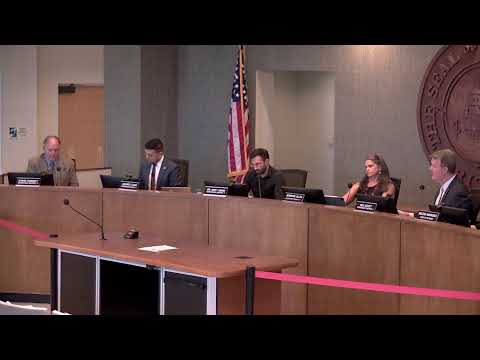
Residents press Pima County for better public safety and connectivity in remote areas; county to pursue connectivity and range‑deputy options
Summary
Residents from Redington and other remote communities told the Board of Supervisors that limited cell coverage, confusing ZIP‑code routing and long response distances create real safety hazards; county staff proposed range‑deputy pilots, mutual‑aid SOPs and pursuing federal connectivity grants.
Residents of remote Pima County communities urged the Board of Supervisors to act on public safety gaps that leave people isolated on poorly‑served roads and with limited 911 connectivity.
Public comments and findings: at the board’s time‑certain presentation, county staff summarized a short study focused on Redington, Arivaca (spelled Ara ̄baca in staff remarks), Sasabe and Sonoita. The chief findings were consistent: long travel distances to sheriff and fire resources, spotty or non‑existent cell phone signals that can prevent 911 access, and road‑condition and navigation challenges that increase response times. Several residents testified about recent violent incidents and a fatal pedestrian crash described by JP Sabatierra; resident Christina Clifford — who lost a spouse in the Redington area — described the community’s safety concerns and asked for concrete action on connectivity and response.
County recommendations: staff presented a suite of options including (a) expanding or formalizing “range/ranch” deputies assigned to rural routes so officers know the roads and can be dispatched more effectively, (b) lobbying and pursuing federal grants to improve cellular and broadband connectivity (including non‑Starlink satellite options), (c) formalizing mutual‑aid standard operating procedures or intergovernmental agreements so the “closest available responder” principle is codified, (d) supporting community organization and neighborhood watch programs run with sheriff auxiliary volunteers, and (e) exploring pilot technologies such as Buckeye‑style camera systems or drones as they mature. Staff also recommended pursuing ZIP‑code boundary fixes (to correct cases where mail and 911 routing place remote residents in other counties) and to work with congressional offices to seek postal code changes.
Board direction and community next steps: the board asked staff to continue community outreach, coordinate with the sheriff and with adjacent counties (Santa Cruz, Cochise, Pinal) to develop mutual‑aid protocols, and to engage the county’s Office of Digital Inclusion to pursue federal connectivity funds. Administrator Jan Lesher said the county would also pursue a parallel path with the board and congressional staff on ZIP‑code changes that residents said interfere with emergency response and access to county services.
No formal votes were required; the board asked county staff to return with options and to report back on implementation progress and funding opportunities.
Ending: County staff said they will follow up with a written plan and timeline and will report to the board on potential grant sources for connectivity and on possible pilot deployments of range deputies and mutual‑aid SOPs.