Get Full Government Meeting Transcripts, Videos, & Alerts Forever!
Get email alerts on the Zoning Merger Adus topic
No spam. Unsubscribe anytime.
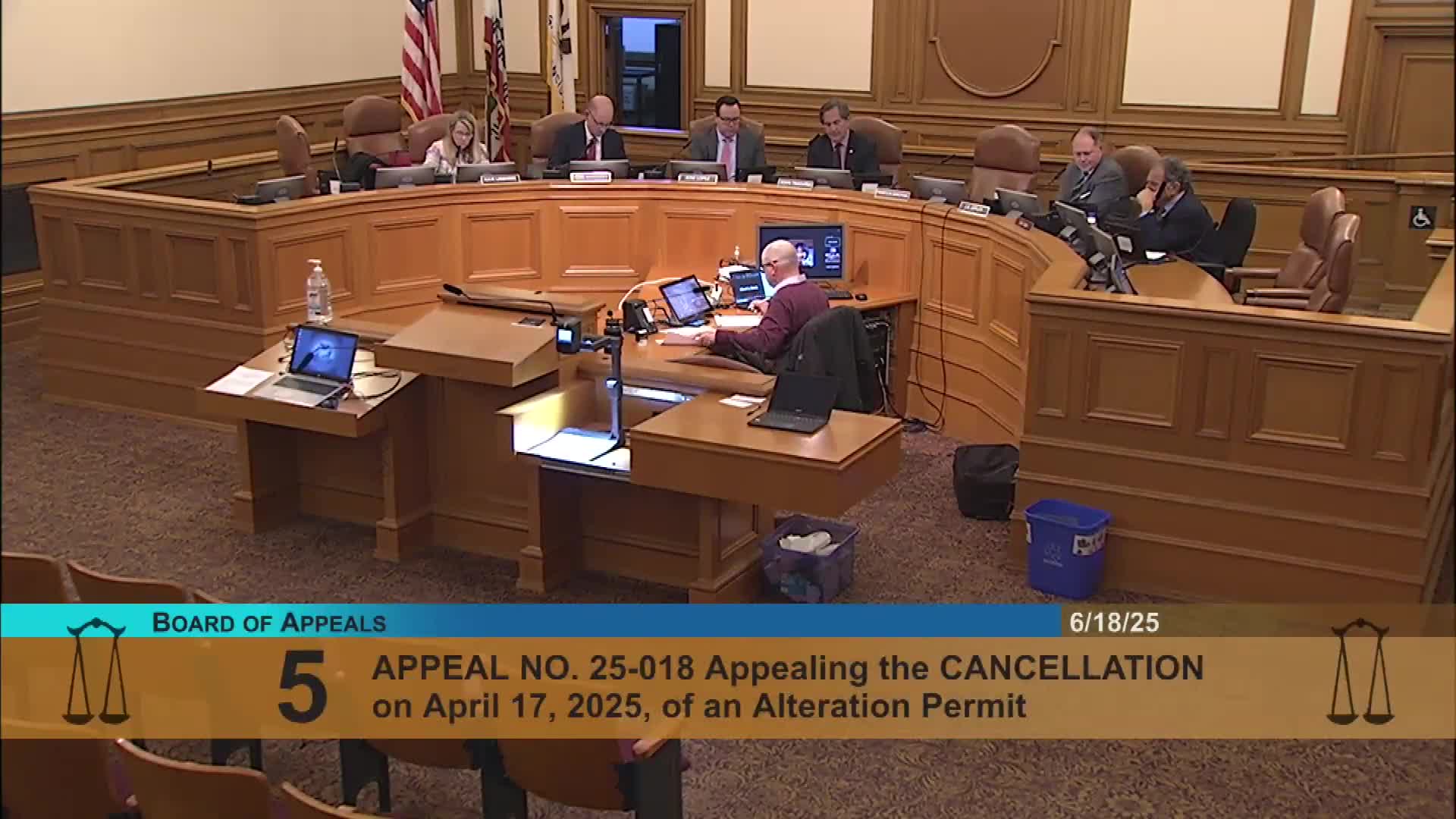
Board upholds Planning Department cancellation of permit to legalize ADU at 80744 Fourth Avenue; homeowner urged to seek reasonable modification or CUA
Summary
The Board of Appeals on June 18 upheld the Planning Department—s cancellation of a permit to legalize an accessory dwelling unit at 80744 Fourth Avenue, concluding that an interior stair linking the two floors would create a merger under the Planning Code unless a disability accommodation or a conditional use authorization is obtained.
The San Francisco Board of Appeals on June 18 upheld the Planning Department—s cancellation of a building permit that would have legalized an accessory dwelling unit (ADU) at 80744 Fourth Avenue, ruling the revised plansthat kept an interior stair between the upstairs and downstairs units would produce a "merger" under the Planning Code and thus required a conditional use authorization (CUA) or a reasonable modification for disability accommodation. The board voted 4-0 to uphold the department—s disapproval.
Homeowner Ling Law appealed the Planning Department—s April 17 cancellation. Law told the board the interior stair has existed since the house was built, that both floors have separate kitchens and entrances, and that the stair is a "lifeline" for her 95-year-old, mobility-impaired father who relies on caregivers. "This staircase is really a lifeline," Law said during her presentation and in a short walkthrough video she provided to the board.
Why it matters: the decision addresses two recurring issues in San Francisco housing enforcement: how internal connections between floors affect whether two spaces are treated as independent dwelling units, and how disability-accommodation procedures interact with zoning rules.
Planning department position and legal basis Corey Teague, zoning administrator, described a longstanding zoning-administrator interpretation (dating to 1993) that treating an internal connection between the interiors of two dwelling units as a merger is appropriate because the connection makes it functionally simple to use the building as a single unit. Teague told the board that the revised permit proposed an "interior connection" and that, under the Planning Code and the ZA interpretation, the department could not approve the permit as amended. Teague noted two administrative pathways available to the homeowner: (1) file a reasonable modification (a disability accommodation process that is evaluated in consultation with the Mayor—s Office on Disability) or (2) seek conditional use authorization to remove the UDU altogether.
Safety and building-code concerns Joe Aspatel, senior building inspector for the Department of Building Inspection (DBI), warned that the plans as amended lacked required fire separation between separate units and that adding an interior stair without meeting fire-and-life-safety upgrades could create unsafe conditions. "A fire separation does not exist between the two units," Aspatel said, and he explained that walls, horizontal assemblies and doors shared by two independent units would need appropriate fire-rating to meet code.
Applicant—s account and options Law described frequent caregiver trips up and down the stair to do laundry, retrieve medical supplies and respond in emergencies, and she said removing the stair or forcing an outside route would create unsafe conditions for her father. She told commissioners she attempted to apply for what she called a reasonable accommodation but that staff requested a fee payment before the department processed the application; Law said she could not immediately pay the fee ($887 as cited in the hearing) and asked the board to consider her circumstances.
Board deliberation and vote Commissioners explored the technical distinctions between common-area circulation (where a common laundry or vestibule might be reached without traversing another unit) and an interior stair that opens directly into unit living space. Commissioners and staff agreed that the plan as drawn would allow the two floors to operate as a single dwelling, which triggers the merger interpretation and the requirement for a CUA unless a reasonable modification is granted for a qualifying disability.
Commissioner Jose Lopez moved to deny the appeal, saying the Planning Department disapproval was consistent with the code and interpretation and noting the alternative paths available to the homeowner. The board recorded a 4-0 vote to deny the appeal and the department—s cancellation of the permit stands. The board chair and staff advised the homeowner that the reasonable modification process can be administratively reviewed by Planning with referral to the Mayor—s Office on Disability and that conditional use authorization is the separate path if the owner instead elects to remove the UDU.
Clarifying details - Property/permit: record lists permit 202309227235 for legalization of an ADU (one-bedroom, one-bath) and references a code enforcement NOV in the file (NOV number referenced in the record). - Code citations: Planning Code section 3.17 (definition and treatment of UDUs/merger) and Planning Code section 3.05.1 (reasonable-accommodation provisions referenced by appellant). - Fees and process: the board was told a reasonable-modification application fee of approximately $887 is required at present; Planning staff noted fee-schedules are set by ordinance and updated periodically. - Safety: DBI said required fire-separation assemblies would be required between two independent dwelling units; an interior stair that connects unit living spaces would trigger higher fire-protection requirements.
What the homeowner can do next Planning staff and DBI advised the homeowner of three paths: (1) file a reasonable modification application (disability accommodation) and request review/waiver of fees if eligible; (2) revert the building permit plans to the earlier scheme that removes the interior stair and pursue legalization consistent with separation requirements; or (3) pursue conditional use authorization with the Planning Commission to remove the UDU. Planning staff said reasonable-modification requests are often referred to the Mayor—s Office on Disability for eligibility review and can include conditions (including time-limited accommodations) if granted.
Speakers and attribution Direct quotes and attributions in this article are drawn from the hearing transcript and come from the following participants: Ling Law (homeowner/appellant), Corey Teague (zoning administrator, Planning Department), Joe Aspatel (senior building inspector, DBI), and members of the Board of Appeals (President John Trezwina, Vice President J.R. Epler, Commissioner Rick Swig, Commissioner Jose Lopez).