Get Full Government Meeting Transcripts, Videos, & Alerts Forever!
Get email alerts on the Housing Permits topic
No spam. Unsubscribe anytime.
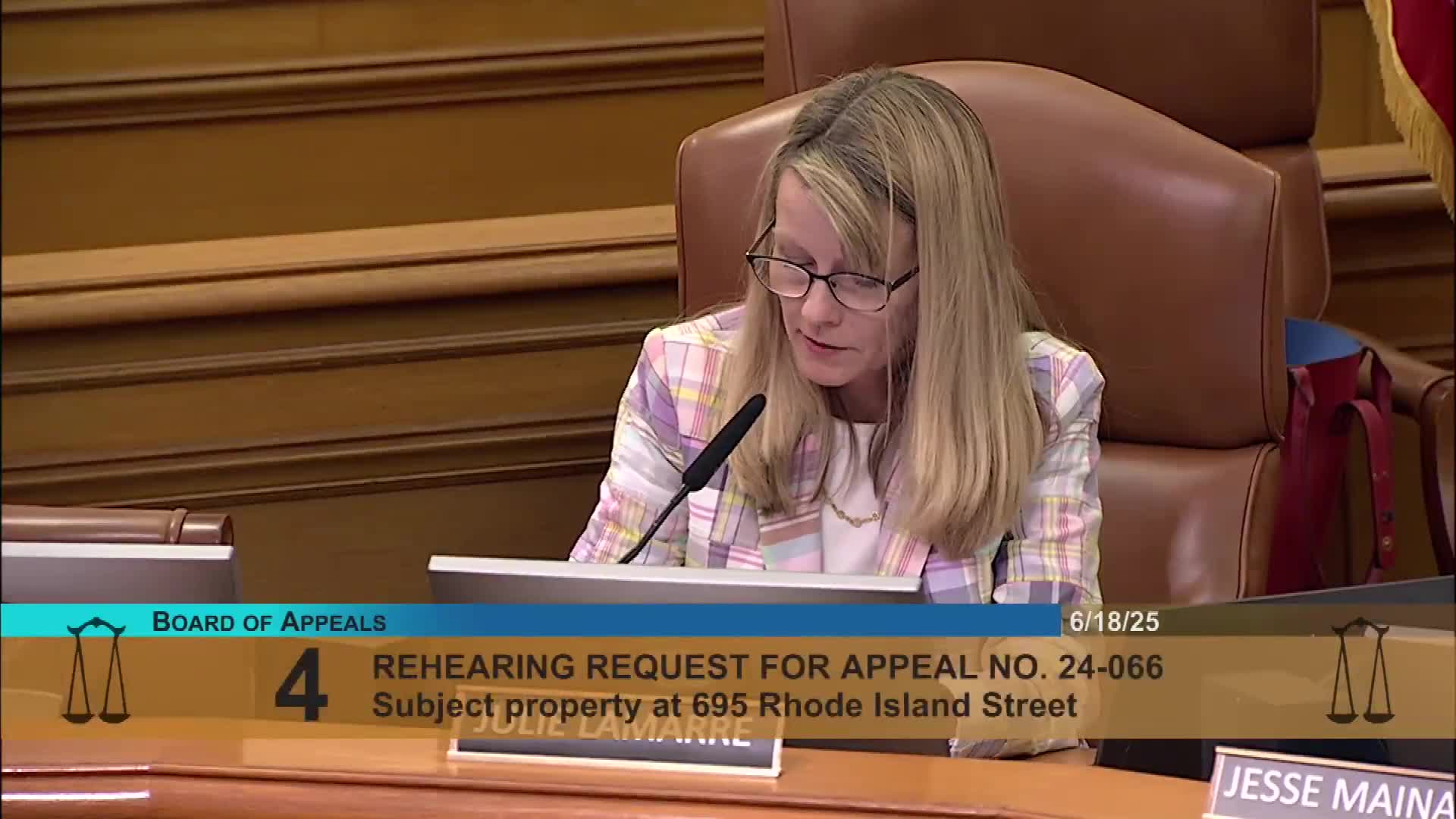
Board of Appeals denies rehearing request on 695 Rhode Island remodel; planning evidence deemed insufficient
Summary
The San Francisco Board of Appeals on June 18 denied a rehearing request on an appeal over renovations at 695 Rhode Island Street, finding newly submitted documents did not meet the Planning Department—s standard for proving an unauthorized dwelling unit.
The San Francisco Board of Appeals on June 18 denied a rehearing request for appeal No. 24-066 involving 695 Rhode Island Street, voting 4-0 to uphold the permit issued for a multi-level remodel and vertical addition. The rehearing request was filed after the board—s May 21 decision to deny an earlier appeal and uphold the permit.
The board—s action keeps in place permit No. 201912200232, described in the record as a remodel of an existing two-story, two-unit residence with a new rear horizontal extension on the first and second floors, a new third-floor vertical addition, and facade and driveway changes. Dan Feldman is listed in the record as the party requesting the rehearing; his side presented affidavits and additional documents they said were new evidence of residential use of a lower-level space.
Why it matters: the rehearing centered on whether the Planning Department—s zoning administrator (ZA) should treat a lower-level space as an unauthorized dwelling unit (UDU). A finding of a UDU can trigger legalization or removal processes and can change how a property is permitted and inspected.
Planning department standard and new evidence Corey Teague, zoning administrator for the Planning Department, told the board that the department applies a two-part test for UDUs: a physical separation of the space and evidence that the space was actually used as a separate living unit. Teague said the department seeks a "high level of evidence" and that certain documents (rent board records, leases, separate utility accounts or clear unit-addressing on public records) are preferred. "One thing we absolutely do not use on its own are affidavits," he told the board, adding that affidavits can be part of a cluster of evidence but are not sufficient alone.
Appellant representatives said they had submitted two sworn affidavits from former occupants and later provided a voter-roll printout and a broker marketing sheet. The board admitted the city voter-roll document into the record but declined to admit a private investigator—s declaration and a newspaper/blog excerpt. Michael Morrison, who spoke for the rehearing requesters, said tenant affidavits and the newly submitted voter-roll item supported their claim the lower level had been used as a separately rented residence in the past.
Public comment and positions Speakers calling for the rehearing included members of the public who said tenants had lived in the lower-level space and that the Planning Department—s standard made it difficult to prove past occupancy. Alex Lau and Mayumi Fujio urged the board to reject the rehearing only insofar as it would delay the project; Pat Buckner and Leonard Young said the department—s approach to affidavits and other evidence could disadvantage tenants and urged a rehearing.
Board decision and vote Board President John Trezwina, citing the board—s standard for rehearing requests, said the key question was whether new facts, if known at the original hearing, could have affected the outcome. "As for me, right now, my standard has not been met," President Trezwina said. Commissioners Jose Lopez and Rick Swig voiced similar views during deliberations. Vice President J.R. Epler expressed some concern about whether tips or outside information might not be pursued fully by staff, but ultimately joined the majority.
Commissioner Rick Swig moved to deny the rehearing request on the basis that the new evidence would not have changed the original outcome. The board recorded a 4-0 vote to deny rehearing; the board chair said the decision letter would be distributed the following day and the permit would be unsuspended at that time.
Clarifying details - Permit: 201912200232 (remodel / third-floor addition to a two-unit residence). - Prior decision: May 21 board action had denied a prior appeal and upheld the permit (record cites an earlier variance decision as making the permit code-compliant). - Evidence admitted: city voter-roll document for a named individual; private declaration and a news/blog item were not admitted. - Governing standard: Planning Department requires corroborating records beyond affidavits (rent board records, leases, utility bills, clear unit-addressing) to determine a UDU.
What happens next With the rehearing request denied, the permit remains upheld and will proceed once the board—s formal decision is distributed and the permit unsuspension is processed. Any further administrative or judicial steps would depend on additional filings by parties in the case.
Speakers and attribution Direct quotes and attributions in this article are drawn from the hearing transcript and come from the following participants: President John Trezwina (presiding officer), Vice President J.R. Epler, Commissioner Rick Swig, Commissioner Jose Lopez, Corey Teague (zoning administrator, Planning Department), Michael Morrison (representative for the rehearing requesters), Victor Marquez (attorney for the permit holder), and members of the public who addressed the board.