Get Full Government Meeting Transcripts, Videos, & Alerts Forever!
Get email alerts on the Dbi Fees Sro Grants topic
No spam. Unsubscribe anytime.
Building Inspection Commission backs fee increase to restore code‑enforcement outreach funding after extensive public testimony
Summary
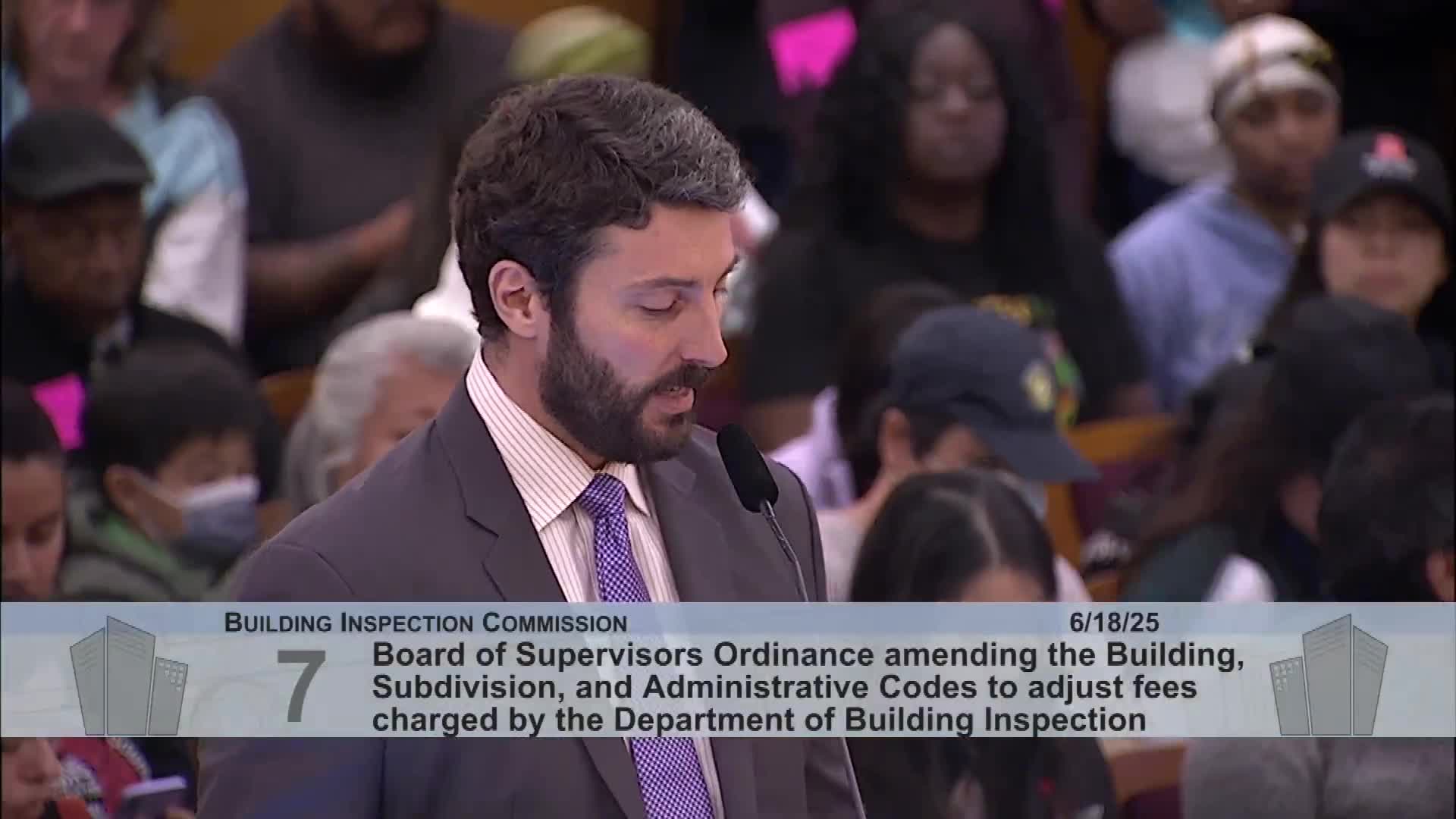
The Building Inspection Commission unanimously recommended that the Board of Supervisors advance Ordinance File 250592, a package of fee changes intended to stabilize DBI’s budget and restore funding for tenant‑facing code‑enforcement programs.
The Building Inspection Commission unanimously recommended that the Board of Supervisors advance Ordinance File 250592, a package of fee changes for the Department of Building Inspection (DBI) that the department says is necessary to stabilize operations and restore grant funding for tenant‑facing code‑enforcement outreach.
The recommendation came after a lengthy presentation from Alex Koskinen, DBI deputy director for administration, and more than two hours of public comment from tenants, tenant advocates and landlord‑industry representatives pressing the commission to restore funding for two community programs—the Code Enforcement Outreach Program (CEOP) and the SRO Families United Collaborative—used to assist tenants in unsafe or uninhabitable housing.
Koskinen told commissioners the department needs the fee increases in the budget it submitted to the mayor and the board and that the mayor’s office has proposed amendments shifting some costs. "We are collecting more revenue than was budgeted. We're spending slightly less than was budgeted," Koskinen said during the finance briefing, describing the larger budget context for the fee proposal.
Why it matters: DBI’s budget relies on fee revenue to operate largely fee‑supported services such as inspections and licensing. The proposed ordinance would adjust hourly inspection rates and license fees and create subfunds in the Building Inspection Fund to cover ongoing program costs. Tenant advocates said the change is urgent because the city’s recent budget moves removed most general‑fund support for community programs that document and follow up on building code violations in small and older housing.
What the ordinance would do: DBI presented a fee model that raises many inspection and service rates. As discussed with the commission, the administration and board were negotiating an additional, targeted $1.7 million in license‑fee revenue specifically to fund CEOP in FY 2026; discussions about an additional $3.1 million for SRO collaborative grants were ongoing between the mayor’s office, supervisors and community stakeholders.
Public testimony: More than 50 people, many of them tenants or tenant‑organizers from SROs and older apartment buildings, told the commission that community organizations funded by DBI grants had helped them secure repairs, stop hazardous work and obtain habitability fixes. Speakers described mold, rodent infestations, leaking ceilings and broken stoves; several said they had discovered these programs only when neighbors or organizers brought them in. Molly Goldberg of the San Francisco Anti‑Displacement Coalition and multiple tenant organizers urged the commission to recommend the fee changes and to seek full restoration of community grants.
Industry comment: The San Francisco Electrical Contractors Association urged caution on fee increases, saying higher fees and rising labor costs can deter downtown investment; its representative also praised DBI staff accessibility and asked for faster permit processing.
Commission action and guidance: Commissioners moved to recommend the ordinance, asking staff and City Attorney counsel to incorporate language that would permit the Board of Supervisors to amend the ordinance to restore community grant funding without requiring re‑referral back to the Building Inspection Commission and thus avoid delay. Deputy City Attorney Peter Mlynich advised that a broad written recommendation and a recorded discussion of the contemplated amendments would strengthen the commission’s case against any mandatory rereferral.
Roll call: The motion to recommend the ordinance with the discussed amendment passed unanimously on a roll call vote (President Alexander Toot: yes; Commissioner Kalamucci: aye; Commissioner Chavez: yes; Vice President Ming: yes; Commissioner Newman: yes; Commissioner Williams: yes).
Next steps: The Board of Supervisors will consider the ordinance and any amendments in committee and at full board. If the ordinance is adopted and signed by the mayor, fee changes would take effect 30 days after signature; the department said the earlier the measure is approved, the fewer months of revenue the department stands to lose.
Closing note: Commissioners repeatedly emphasized the urgency expressed by tenants in public comment and urged the mayor’s office and the Board of Supervisors to preserve grant funding for community outreach programs that assist tenants in enforcing building code standards.