Get Full Government Meeting Transcripts, Videos, & Alerts Forever!
Get email alerts on the Personnel And Labour topic
No spam. Unsubscribe anytime.
Brawley staff and unions flag staffing, pay as recruitment, retention challenges ahead
Summary
City HR presented staffing and vacancy data required by AB 2561; firefighters and police unions urged action on pay and career steps and asked council to use comp study data ahead of contract talks.
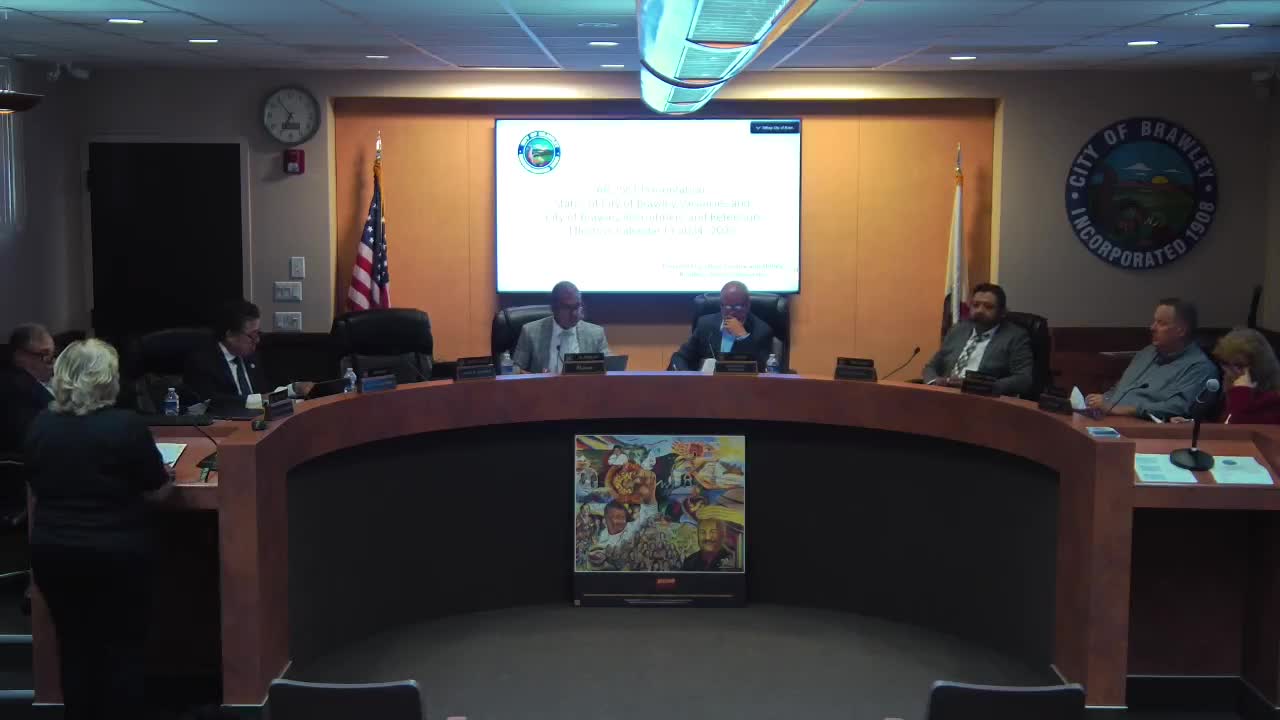
Brawley opened a statutorily required public hearing on June 17 to report workforce vacancy, hiring and retention data under Assembly Bill 2561 and Government Code section 3502.3, with human resources staff and bargaining-unit leaders detailing persistent shortages and pay-related turnover.
The city’s human resources administrator, Shirley Bonillas, told the council the city has 157 full‑time regular positions and 37 vacancies in fiscal year 2024–25 to date, producing an average vacancy rate of about 4% and a peak monthly vacancy of 11%. Bonillas said police sergeants briefly exceeded the 20% threshold that triggers extra reporting, noting “BPSA… 2 out of 6 makes it 33%,” and that overall turnover for the period was roughly 16.56%.
Those figures matter because recruitment and retention decisions affect public safety and day‑to‑day services, union leaders and council members said. Jonathan Sabater, president of the Brawley Firefighters Association, told the council, “Our salary schedule is not enticing enough,” and urged the city to consider adding intermediate ranks and targeted pay adjustments to keep firefighters from leaving for better pay elsewhere. Detective Javier Martinez, president of the Brawley Public Safety Employees Association, said experienced officers are choosing neighboring agencies because of higher wages: “It is difficult to recruit officers because they compare the Brawley Police Department wages to other local cities.”
Bonillas outlined the city’s hiring process and flagged several specific recruitment hurdles: required industry certifications (Class B, D1, water distribution and other technical certificates), relatively low hourly rates compared with nearby cities, and the importance of flexible work schedules. She said the city’s move to an online application system (NEOGOV) has increased qualified applicant volume, and noted steps such as hiring some candidates before they hold required certifications and extending probationary periods while staff complete credentials.
Councilmembers and staff discussed next steps. Several members suggested obtaining comparative compensation data from neighboring jurisdictions and using that information to inform bargaining. Bonillas and others described options ranging from piecemeal changes (longevity pay, sign‑on bonuses, focused salary adjustments) to a formal compensation study; the council asked staff to collect available data (MOUs and any recent comp studies from nearby agencies) and return with options ahead of 2025–26 negotiations. Sabater and Martinez emphasized that officers and firefighters are working extra overtime to cover staffing gaps and said that proposed state changes, including Assembly Bill 1309 (a pending legislative item discussed by union representatives), could widen pay gaps if Cal Fire and other large employers raise pay.
The public hearing closed after the union presentations and council discussion. City staff recorded the AB 2561 presentation in the administrative record and will include the data in budget‑season deliberations and upcoming meet‑and‑confer sessions.
The report supplied countable vacancy figures, promotion and recruitment metrics and highlighted the bargaining units’ immediate concerns; council direction focused on compiling comparative compensation and benefit data to inform contract negotiations and budget decisions.