Get Full Government Meeting Transcripts, Videos, & Alerts Forever!
Get email alerts on the Housing Affordability topic
No spam. Unsubscribe anytime.
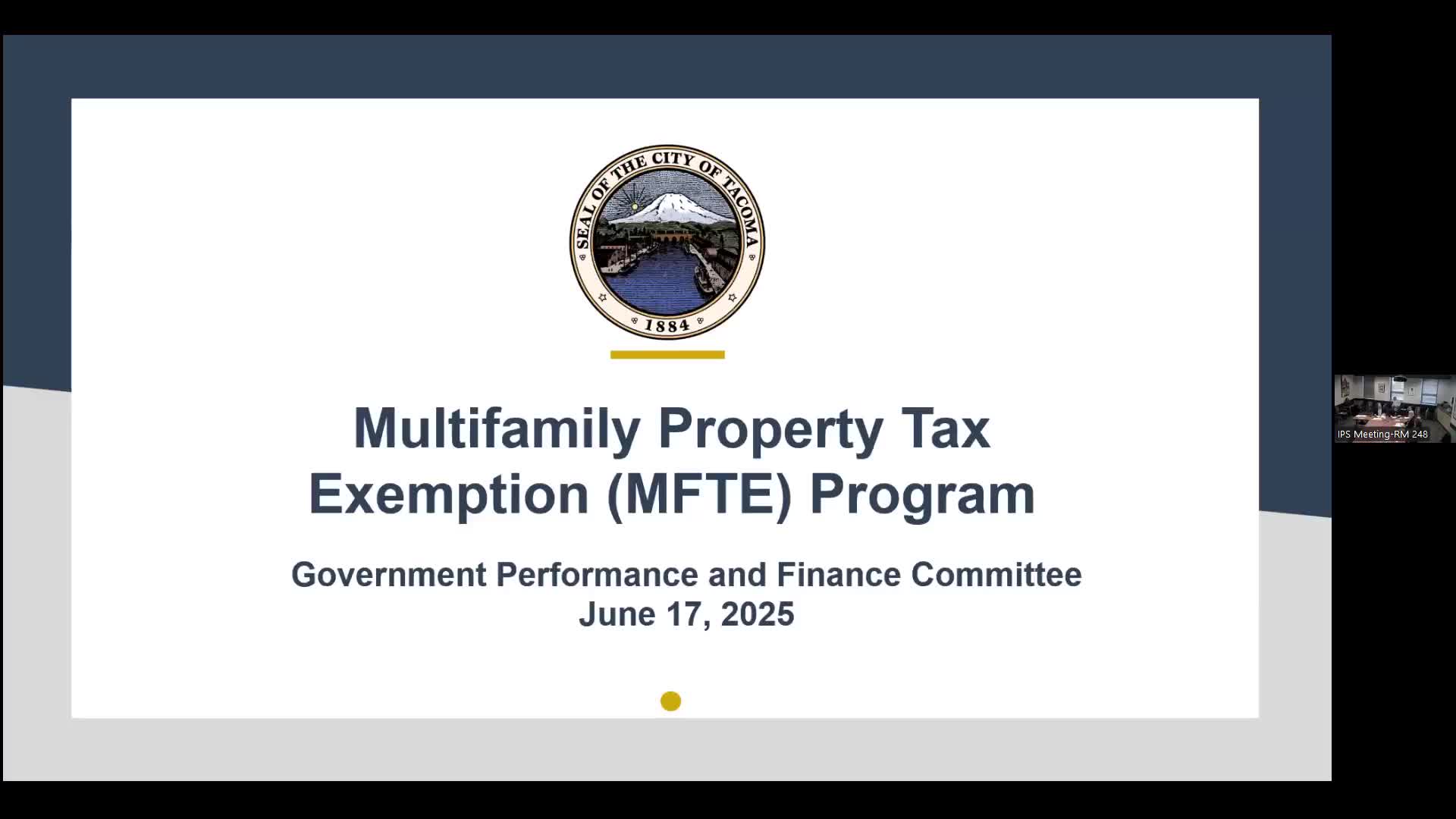
Tacoma committee weighs changes to multifamily tax-exemption program, delays vote
Summary
The City of Tacoma’s Government Performance and Finance Committee on a review of the multifamily property tax exemption program, hearing five proposed code changes and stakeholder concerns and deciding to return the item for further work rather than advance it immediately to full council.
The City of Tacoma’s Government Performance and Finance Committee on a review of the multifamily property tax exemption program, hearing five proposed code changes and stakeholder concerns and deciding to return the item for further work rather than advance it immediately to full council.
The proposals presented would: raise the minimum project size eligible for an 8‑year exemption from four units to 20; centralize outreach and tenant‑matching through the Community Economic Development (CED) department; allow households renewing leases to remain in income‑restricted units so long as earnings do not exceed 90 percent of area median income (AMI); require units seeking an extension to rent at least 10 percent below market rate; and schedule a formal program review in 2028.
Why it matters: the multifamily tax exemption is a major tool the city uses to encourage housing production that includes income‑restricted units. Committee members, housing stakeholders and developers said rising financing costs since 2021 have changed project economics, and council members pushed staff for clearer data about who occupies exempt units, vacancy patterns and how program rules affect unit size, family housing and geographic distribution.
Kit Burns, a Tacoma resident who spoke during public comment, questioned the income standard used for “affordable,” saying he’d left the clerk a copy of a legislative reference and asserting that, "that is 60% of AMI." Burns also criticized approvals for Procter Station, saying the project received multiple tax exemptions and urging the city to “look at the numbers a lot better.” The committee did not adjudicate Burns’s specific figures during the meeting.
Susan Calderon, the city’s Assistant Finance Director, briefed the committee earlier in the meeting on the State Auditor’s 2024 entrance conference for the financial audit and said the audit process is a routine review of the city’s financial statements and federal audit work. The auditor’s on‑site work and the committee’s exit review are expected in late summer.
Presenting the MFE update, the lead committee member framed the policy tradeoffs: "a 100% of 0 is still 0," arguing that overly strict requirements can prevent projects from moving forward. Staff and stakeholders said the primary near‑term constraint for many projects is higher borrowing costs since 2021; several developers told staff they want clarity and relatively simple rules rather than complicated, frequently changing provisions.
Stakeholder feedback that shaped the staff proposals included: - Difficulty finding qualifying renters who both meet income limits and can afford required debt‑to‑income tests; developers reported long vacancy periods for some restricted units. - A view among some developers that the MFE is not the right tool to force larger‑unit or family housing and that other program design or zoning tools are better fits. - Requests from housing providers for help matching income‑eligible households to units so affordable units do not remain vacant.
Council members asked staff for more data before finalizing changes. Several raised concerns that changing the 8‑year threshold from four to 20 units could discourage smaller infill projects or limit options in specific neighborhoods. One council member said downtown micro‑unit projects illustrated market mismatches: smaller units were slower to rent than one‑ and two‑bedroom units, and a downtown developer "knew they made a mistake because they built all these micro units... those are not the ones that are rented," a comment committee members cited as evidence the city should review unit‑size outcomes before adopting major shifts.
Staff recommended a limited package of changes as a starting point and proposed bringing a refined ordinance back to committee in July (staff suggested July 15 or, if scheduling required, August 5) for further review and then to full council for study session. Committee members asked staff to compile program data (occupancy, AMI levels of tenants, vacancies and rent comparisons) from the 12‑year projects and from the few extensions the city has already approved so members can see how proposed thresholds would affect both developers and tenants.
On the proposed household income threshold for renewals, staff said state law allows higher thresholds (staff referenced state guidance that can allow higher AMI caps), but the package suggested a 90% AMI limit for lease renewals to avoid disincentivizing income gains while ensuring units flow back to lower‑income households over time.
On extensions, staff proposed a starting point that extended affordability units must rent at least 10 percent below market rate — with the utility allowance increasing the effective affordability gap — to ensure extensions produce a measurable benefit compared with market units.
Next steps and outcome: committee members did not move the package directly to full council at this meeting. Instead they asked staff to prepare additional analyses and to return to the committee in mid‑July (or early August if necessary) with a more developed proposal and program data. The committee accepted that schedule rather than advancing an ordinance at this session.
The meeting adjourned after routine closing motions.
Ending: Staff said they will assemble the occupancy and rent data for existing MFE projects, refine the draft code changes and return them to the Government Performance and Finance Committee for additional deliberation before any ordinance or referral to the full City Council.