Get Full Government Meeting Transcripts, Videos, & Alerts Forever!
Get email alerts on the Comprehensive Plan topic
No spam. Unsubscribe anytime.
Plantation staff outlines proposed 2045 comprehensive plan updates focused on infrastructure, resilience and parks
Summary
City planning staff presented a draft of the proposed 2045 Comprehensive Plan that reorganizes the infrastructure element into subelements (sanitary sewer, potable water, stormwater, solid waste), adds a resiliency and sustainability element, and emphasizes smart growth, resilience and coordination with regional agencies.
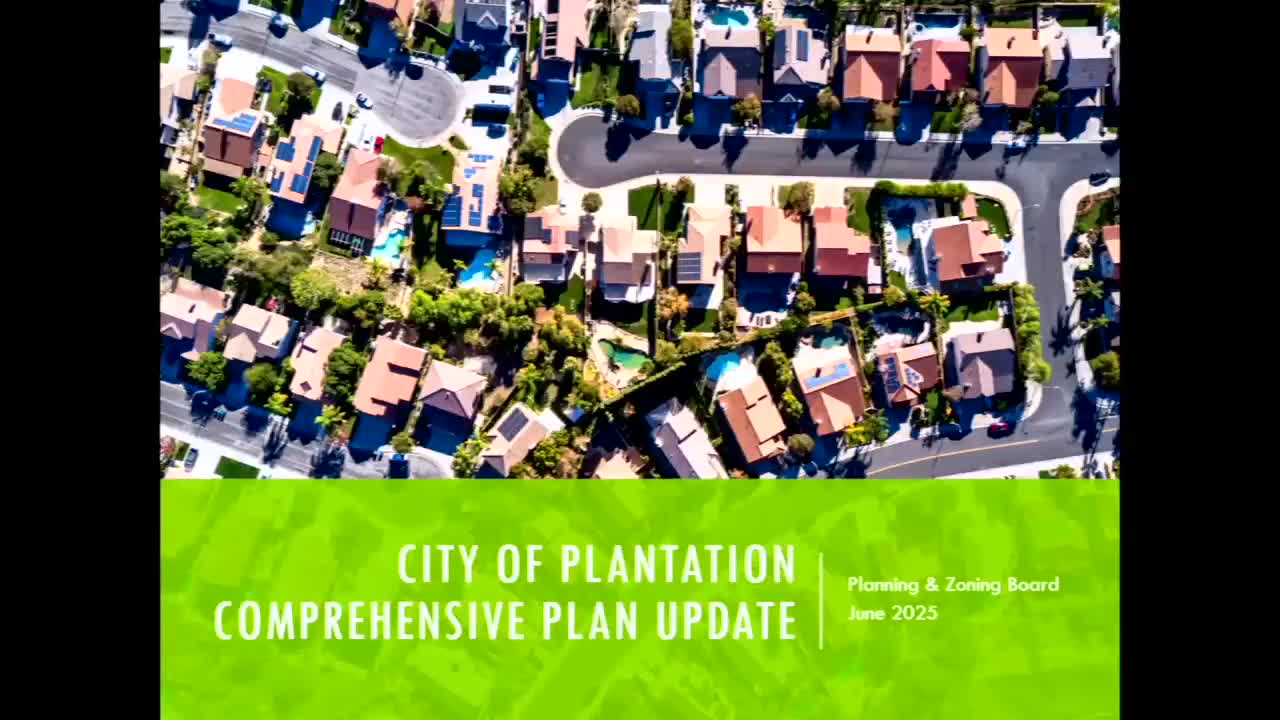
Plantation planning staff presented an extended preview of a draft 2045 Comprehensive Plan on June 7, describing reorganized infrastructure subelements and new policies focused on resilience, sustainability and coordinated utility planning.
Dan Holmes, Planning, Zoning and Economic Development Director, told the Planning & Zoning Board the draft reorganizes the old infrastructure element into separate subelements for sanitary sewer, potable water, stormwater, solid waste, plus updated conservation and recreation and open-space sections. "We are generally looking at smart growth, sustainability and resilience, and housing affordability," Holmes said during the presentation.
Holmes described key changes the draft would address: clearer objectives for utility planning and capital improvements; emphasis on regulatory compliance with state and regional agencies (including the South Florida Water Management District); and new resilience-focused policies for critical infrastructure. He said the stormwater subelement may require revisiting existing design and level-of-service standards because more severe rain events have been observed; staff is considering moving from a 25-year event design standard toward 50- or 100-year-event approaches where appropriate.
On sanitary sewer and potable water, Holmes summarized policies to guide system inventory, capacity planning and funding. "We have to look at capital improvement planning for these systems," he said, noting past development in Midtown has exposed mains and lift-station capacity issues that will require prioritization and potential system upgrades.
Board members used the session for detailed technical questions. Several asked how developer-built infrastructure (mains, lift stations) is accepted by the city and how long-term maintenance costs will be borne by the municipality. Holmes said developers' infrastructure typically is constructed to city standards and transferred to the city, but he acknowledged the need to coordinate utilities and master planning to avoid redundant installations and long-term maintenance inefficiencies.
Other queries addressed septic connections, state rules for when new development must connect to sewer lines, and opportunities for on-site reuse and gray-water strategies tied to state statutes. A board member referenced Florida Statute 403.892 (water reuse/benefits) and suggested incentives for on-site reuse that could reduce load on city infrastructure.
Holmes said staff will continue outreach to boards and committees including the Affordable Housing Action Committee, Sustainability Board, Midtown Board and Gateway Board and will incorporate feedback into a refined draft. He said the preliminary draft is long (roughly 249 pages in the current compilation) and additional workshops are planned before the draft returns to the Planning & Zoning Board and then to City Council for formal adoption.
Next steps: staff will solicit further board feedback, refine language (including level-of-service standards and resilience measures), and return with a final draft for recommendation to council. Holmes asked board members to submit written comments; members noted they had already sent detailed comments on prior elements and would continue to provide edits.
No formal action was taken on the comprehensive plan at the June 7 meeting; the board set future meeting dates to continue review and hearings.