Get Full Government Meeting Transcripts, Videos, & Alerts Forever!
Get email alerts on the Solid Waste topic
No spam. Unsubscribe anytime.
Spokane Valley staff outline $211,000 solid‑waste grant plan focused on homeless‑encampment cleanups and lithium‑ion battery safety
Summary
City staff recommended using the Local Solid Waste Financial Assistance (ELSWIFAA) grant (approximately $158,000 allocation; $211,000 total with match) for a pilot homeless‑encampment response program and to purchase fire‑rated lithium‑ion battery storage cabinets; council gave consensus to return with a formal motion.
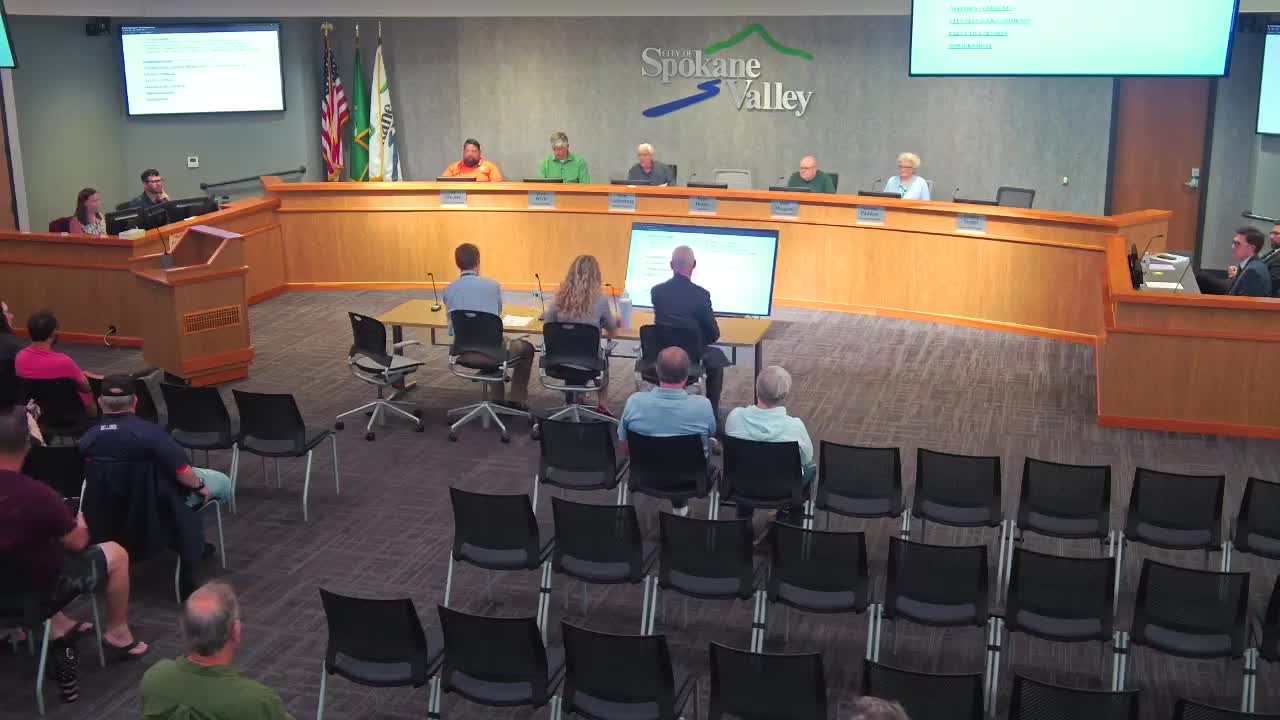
City staff presented a proposed phased plan on June 15 for the Local Solid Waste Financial Assistance grant (referred to in staff materials as ELSWIFAA) allocated to Spokane Valley for the 2025–2027 biennium. The grant allocation to the city is roughly $158,000; with the required 25% match the total proposed budget over two years is about $211,000.
Accounting and Finance Program Manager Sarah Farr and Public Works Director Robert Blagan described two year‑one priorities staff recommend for council approval at a future meeting: a homeless‑encampment response (HER) pilot and purchase of a fire‑rated lithium‑ion battery storage cabinet for the University Road transfer station.
Farr said the HER pilot (estimated $40,000–$60,000 in year one) would reimburse eligible costs under Ecology's program for cleanup labor, supplies, disposal and recycling related to homeless encampments on public property. Staff said the city could modify its existing homeless tracking app to capture cleanup locations and work time to support grant reporting. Staff noted Ecology confirmed reasonable visual estimates could be used to split mixed loads between homeless and non‑homeless waste for reimbursement.
Blagan described the battery safety proposal: a climate‑controlled, fire‑rated storage cabinet to receive and temporarily hold lithium‑ion batteries dropped at the transfer station before consolidation and shipment to third‑party recyclers. He said each basic cabinet costs about $10,000 plus installation and training; staff proposed buying one initially with options to purchase up to three during the biennium. Blagan noted cabinets must be replaced if they contain a fire, and replacement costs could be incurred if a cabinet is lost to fire. The proposal aims to reduce fire risk to staff, visitors and neighboring businesses and was developed in coordination with Spokane Valley Fire prevention staff.
Council members asked about alternatives such as more frequent transport of batteries offsite versus on‑site storage, the potential for increased shipping costs, and whether the grant funds are an appropriate match for the activities. Council members Ben Wicks and Tim Padden supported the proposal, noting the funds are restricted to solid‑waste uses and presented an opportunity to leverage state funds. Council Member Merkel asked staff to compare increased transportation frequency to cabinet purchase and to ensure the city is getting the most cost‑effective approach.
Council gave consensus for staff to return with a motion at a future meeting. Staff said they will continue vendor discussions and refine project cost estimates, scope and reporting methods for Ecology grant reimbursement.