Get Full Government Meeting Transcripts, Videos, & Alerts Forever!
Skagit County Planning Commission recommends Critical Areas Ordinance updates, forwards 17 recommendations to commissioners
Summary
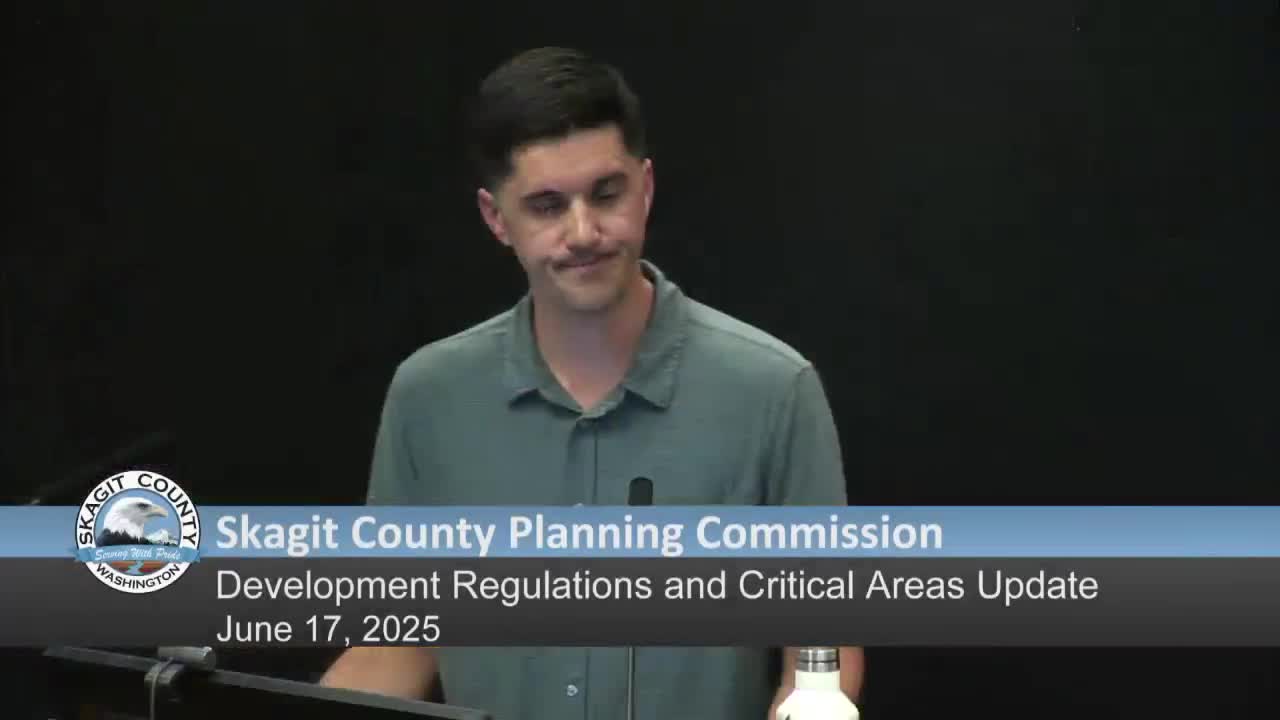
The Skagit County Planning Commission on June 17 recommended that the Board of County Commissioners adopt updates to Skagit County’s Critical Areas Ordinance, forwarding staff- and consultant-prepared edits and 17 specific recommendations that clarify definitions, drainage maintenance, habitat protections and reporting requirements.
The Skagit County Planning Commission on June 17 recommended that the Board of County Commissioners adopt updates to Skagit County’s Critical Areas Ordinance (CAO), forwarding a package of staff- and consultant-drafted changes and 17 specific recommendations that clarify definitions, drainage maintenance, habitat protections and critical-areas reporting requirements.
The commission’s recorded motion—moved by Commissioner Dade—asked the Board of County Commissioners to adopt the proposed CAO and “any recommendations that are attached to this ordinance by the planning commission.” The motion carried by voice vote after a final call for all in favor.
The recommendations largely clarify existing practice and respond to public comments. Senior staff and consultants told the commission the draft does not change the overall scope of the CAO but attempts to make duties, terms and review limits clearer. "Our stormwater code is designed to address water quality ... the critical areas ordinance is a site by site, project by project base," said Andy, a senior planner with Planning and Development Services, explaining why the department recommended not expanding the CAO’s standard review area beyond the current project-based limits.
What the commission approved - Scope and process: The commission supported the department’s approach to keep CAO review primarily project-based rather than expanding automatic upstream or watershed-scale review beyond existing stormwater regulations. Staff noted the standard review area is generally 200 feet from project areas for fish and wildlife habitat conservation areas and can be up to 300 feet for certain wetlands.
- Definitions…
Already have an account? Log in
Subscribe to keep reading
Unlock the rest of this article — and every article on Citizen Portal.
- Unlimited articles
- AI-powered breakdowns of topics, speakers, decisions, and budgets
- Instant alerts when your location has a new meeting
- Follow topics and more locations
- 1,000 AI Insights / month, plus AI Chat