Get Full Government Meeting Transcripts, Videos, & Alerts Forever!
Get email alerts on the Critical Areas Ordinance topic
No spam. Unsubscribe anytime.
Skagit County Planning Commission recommends Critical Areas Ordinance updates, forwards 17 recommendations to commissioners
Summary
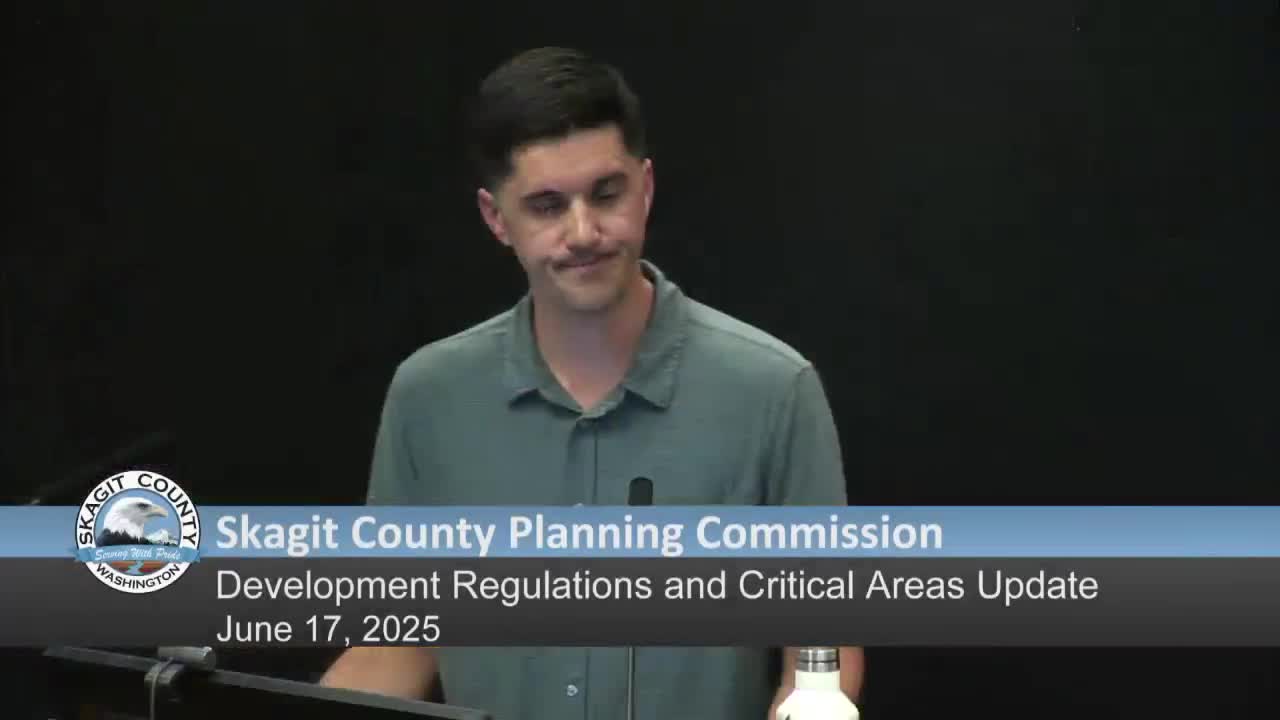
The Skagit County Planning Commission on June 17 recommended that the Board of County Commissioners adopt updates to Skagit County’s Critical Areas Ordinance, forwarding staff- and consultant-prepared edits and 17 specific recommendations that clarify definitions, drainage maintenance, habitat protections and reporting requirements.
The Skagit County Planning Commission on June 17 recommended that the Board of County Commissioners adopt updates to Skagit County’s Critical Areas Ordinance (CAO), forwarding a package of staff- and consultant-drafted changes and 17 specific recommendations that clarify definitions, drainage maintenance, habitat protections and critical-areas reporting requirements.
The commission’s recorded motion—moved by Commissioner Dade—asked the Board of County Commissioners to adopt the proposed CAO and “any recommendations that are attached to this ordinance by the planning commission.” The motion carried by voice vote after a final call for all in favor.
The recommendations largely clarify existing practice and respond to public comments. Senior staff and consultants told the commission the draft does not change the overall scope of the CAO but attempts to make duties, terms and review limits clearer. "Our stormwater code is designed to address water quality ... the critical areas ordinance is a site by site, project by project base," said Andy, a senior planner with Planning and Development Services, explaining why the department recommended not expanding the CAO’s standard review area beyond the current project-based limits.
What the commission approved - Scope and process: The commission supported the department’s approach to keep CAO review primarily project-based rather than expanding automatic upstream or watershed-scale review beyond existing stormwater regulations. Staff noted the standard review area is generally 200 feet from project areas for fish and wildlife habitat conservation areas and can be up to 300 feet for certain wetlands.
- Definitions and cross-references: Commissioners agreed to updates suggested by state agencies. Recommendation 3 updates references to the Washington Geological Survey and adds the Geological Information Portal for mine-hazard information; other edits align language with the state Drainage Fish Initiative and remove outdated references.
- Drainage and agricultural maintenance (recommendations 4–6): The commission accepted clarifying language that distinguishes county critical-area review from ongoing drainage and irrigation maintenance performed under state and federal permits. Staff and consultants said those managed watercourse activities (for example, maintenance that uses tide gates or pump stations) are primarily regulated by state and federal permits and are not generally subject to CAO review unless a new development or major new infrastructure is proposed.
- Wetland mitigation preference and compensation (recommendation 1): Staff added language clarifying when on-site mitigation is appropriate and when off-site mitigation remains allowed.
- Species lists and restoration tools (recommendations 7–9): The commission did not add new species to the formal list of species of local importance (staff said most of the suggested species are already referenced in priority habitat lists; beavers were noted as not currently included). The commission approved clarifying language that allows limited use of non-handheld equipment for restoration where appropriate, and it accepted expanded report requirements to consider indirect and cumulative impacts in critical-areas assessments.
- Habitat corridors (recommendation 13): The commission added a new section establishing habitat-corridor protections for land divisions and binding site plans. Commissioners debated scope and implementation: supporters said the change formalizes connectivity protections that in many cases are already created by overlapping buffers; several commissioners worried about effects on small plats and housing costs. The commission reached a consensus to include the corridor language while removing short plats from the mandatory corridor requirement and asked staff to allow flexibility (director-level adjustments and habitat management plans where appropriate).
- Riparian protections and buffer approach (recommendation 15 and related edits): The draft incorporates several Department of Fish and Wildlife suggestions, including use of the term “riparian management zone” in some places. Staff proposed (and the commission accepted) changes that remove size distinctions for some stream types and increase protections for certain smaller stream types, while keeping variance, buffer-averaging and reasonable-use mechanisms for site-specific implementation. Commissioners raised implementation concerns—how buffer increases would affect property owners and the cost of site-specific studies—and staff emphasized available tools (buffer averaging, habitat management plans and variance processes) and the need to balance ease of implementation with best available science.
- Critical-aquifer language and in-stream flow references (recommendation 17): The commission accepted cross-references to state in-stream flow rules and removed outdated "flow-sensitive basin" tables that have been superseded by state rules. Staff explained the county’s role is to confirm adequate legal water supply for permits while state rules govern withdrawal limits.
Votes and next steps The Planning Commission approved the recorded motion recommending adoption of the CAO update (moved by Commissioner Dade). The motion carried by voice vote; commissioners signaled support during the final call for the question. The department told the commission the Board of County Commissioners will hold a work session July 7, open a public comment period, hold a public hearing July 28, and may take action on the CAO package on Aug. 4.
Why this matters The CAO sets local requirements that affect land divisions, development near streams and wetlands, and maintenance of drainage infrastructure used for agriculture. The changes approved by the commission are framed as clarifications and implementation improvements, but several commissioners stressed the need for clearer mapping and better public access to information about where critical areas are likely to be located.
What commissioners asked staff to do The commission asked staff to: refine comma-placement and phrasing around dike/drainage language in consultation with local dike and irrigation districts; remove short plats from the habitat-corridor requirement; and improve publicly accessible mapping or guidance about where critical areas are likely to occur, "to the extent possible, while respecting private-property rights," (language requested by commissioners to clarify the recommendation).
The planning commission closed deliberations and moved to department updates and announcements, with the next tentative planning commission meeting scheduled for July 15 subject to cancellation if there is no business to consider.