Get Full Government Meeting Transcripts, Videos, & Alerts Forever!
Get email alerts on the Criminal Justice Restitution topic
No spam. Unsubscribe anytime.
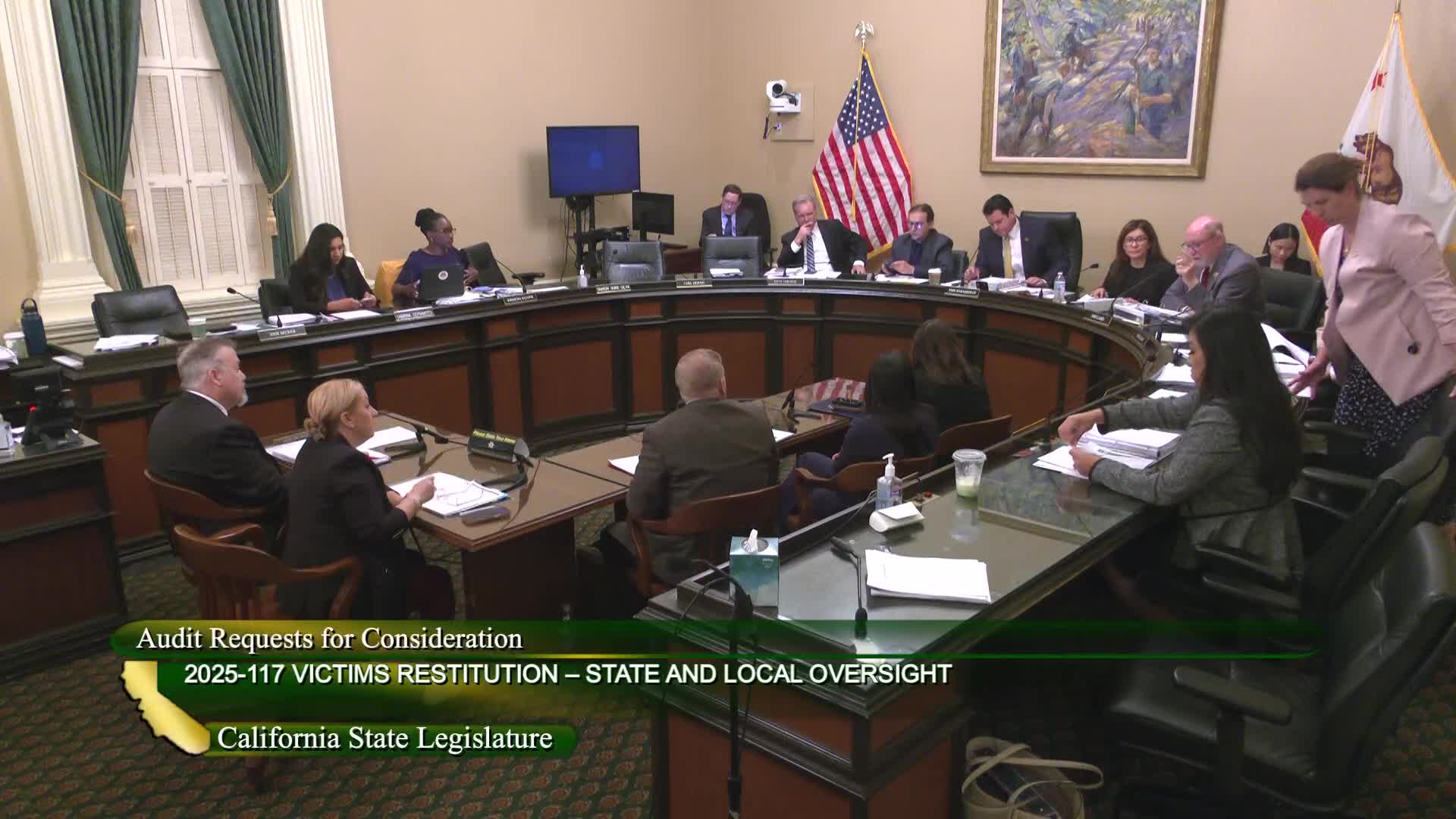
Committee places victims restitution audit on call after testimony from survivors and state agencies
Summary
Senator Ashby proposed an operational and fiscal audit of California's restitution systems to trace orders, collections and the portion of funds reaching victims; the committee voted but left the item on call for further review.
Senator Ashby asked the Joint Legislative Audit Committee on June 24 to authorize an operational and fiscal audit of California’s restitution systems, seeking to determine how much restitution has been ordered, what portion is collected, and how much ultimately reaches crime victims.
Why it matters: Witnesses, including a University of California law clinic and formerly incarcerated individuals, described a fragmented system in which victims often receive little of the restitution ordered in court. Researchers and advocates said statewide collection rates are low and that administrative fees, interest and multiple levies across agencies reduce funds reaching survivors.
Scope and objectives: The audit requested would examine state and county collection practices, distribution of collected funds (victims vs. administrative costs), demographic patterns among those ordered to pay, the role and solvency of the state restitution fund, and the process and outcomes for the Victim Compensation Board (CalVCB). The State Auditor estimated the work would require roughly 4,400 hours.
Testimony and agency responses: Delaney Green of the UC Policy Advocacy Clinic summarized research showing highly fragmented data and low collection rates, and urged a sample audit across counties to trace money flows. Esteban Nunez of the Anti‑Recidivism Coalition described personal difficulties tracking payments and said garnishments and fees have left balances barely reduced.
State agencies represented—CalVCB, California Department of Corrections and Rehabilitation (CDCR) and the Franchise Tax Board (FTB)—told the committee they would cooperate. CalVCB explained eligibility rules and said restitution orders and victim compensation are separate processes; CalVCB said it does not deduct an administrative fee for funds transferred from incarcerated persons’ accounts. FTB described its court‑ordered debt (COD) program and noted FTB limits recovery of collection costs to 15% of amounts collected and will not pursue incarcerated individuals except in limited refund offset cases.
Committee action: A motion to approve the audit was put forward and seconded; the roll call recorded votes but the matter was left on call and not advanced to immediate audit start. Members emphasized the audit’s public‑interest rationale and the need to understand how administrative costs and interest affect victims’ recoveries.
Next steps and implications: If the audit proceeds, it will need to coordinate county and state records across multiple agencies and consider demographic impacts of orders and collections. Advocates said a clearer accounting would inform legislative possible reforms to prioritize direct victim compensation and to reduce duplicative fees.