Get Full Government Meeting Transcripts, Videos, & Alerts Forever!
Get email alerts on the Street Sweeping topic
No spam. Unsubscribe anytime.
DPW defends Clean Corridors and street‑sweeping funds as advocates warn of stormwater and compliance risks
Summary
The Department of Public Works described the Clean Corridors pilot and a planned street‑sweeping expansion; environmental groups cautioned that moving stormwater‑related funds risks Clean Water Act compliance and called for clearer accounting.
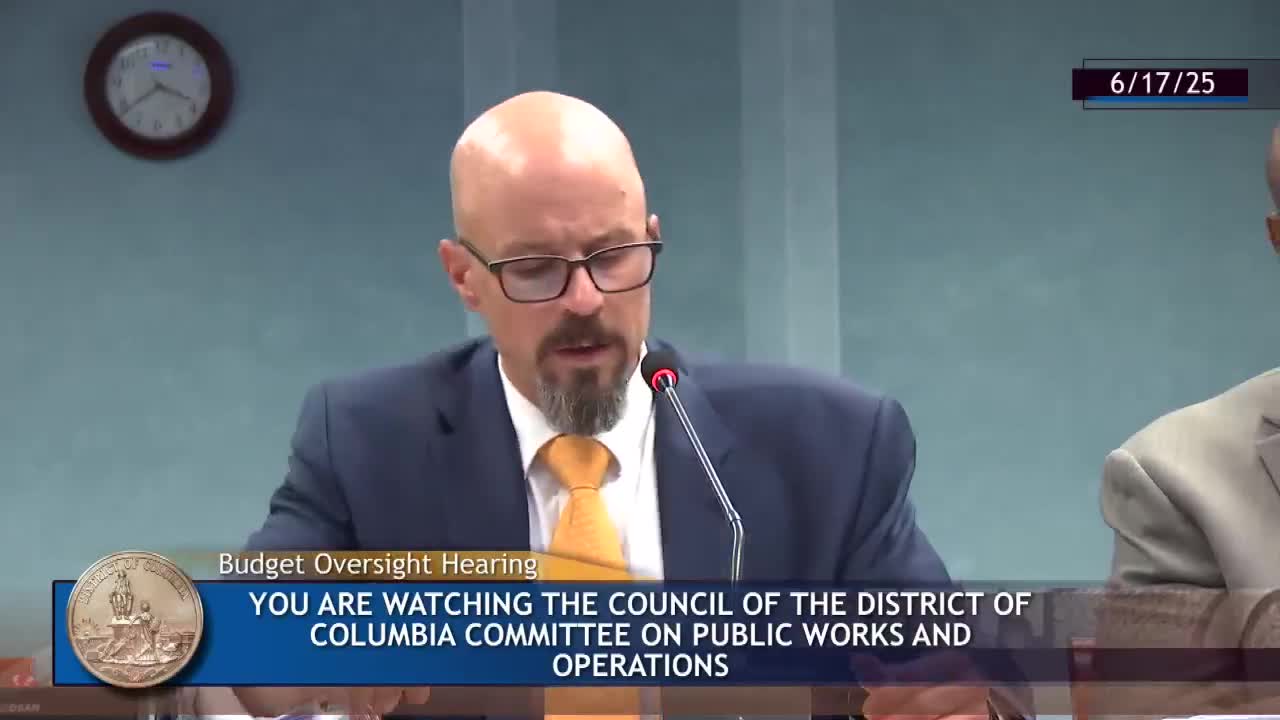
At a budget oversight hearing the Department of Public Works outlined the mayor's Clean Corridors initiative, an expanded street‑sweeping and beautification effort, while environmental advocates warned that shifting stormwater funds into DPW could risk the District's water quality obligations.
DPW Interim Director Anthony Crispino described Clean Corridors as a mayoral initiative focused on 15 main arterial streets, highways and graffiti removal. The mayor's proposed FY26 highlights for DPW included funds to keep about 80 temporary employees that support the Clean Corridors initiative on the payroll for the full year. "What the Mayor asked us to develop ... was born out of an action we took on Georgia Avenue," Crispino said, describing an intensive multi‑day cleanup that removed more than 70 tons of material and led to the program's expansion.
Environmental witnesses expressed broader concerns about the mayor's budget and environmental program cuts. Chris Weiss of the DC Environmental Network and other advocates urged the committee to restore or clarify funding they say was shifted from the Department of Energy and Environment. "This could pose a major risk to other programs in DC government and potentially put the district out of compliance with the Clean Water Act," an advocate told the committee during opening remarks.
DPW told the committee it received a $13,000,000 allocation from DOEE's stormwater permit fund and that budgetary entries in FY26 show a $9,200,000 placeholder on an IT line that will be applied to out‑year street‑sweeping staffing and operations. DPW explained the line is a carryover planning placeholder to fund future years of the street‑sweeping program. "That money will be used in the outlying fiscal years to budget for the FTEs for the street sweeping program," the director testified.
Council members asked for clarification on the accounting and whether moving those funds affects the District's MS4 permit obligations. Crispino said DPW and DOEE would coordinate to ensure obligations are met and noted DPW operations on its own lots have improved. Committee members also questioned whether the placement of funds on an IT line created public confusion and pressed DPW for a public explanation of the program map and routes.
Other operational details: DPW said its fleet includes approximately 72 sweepers with about 80% mechanical sweepers and 20% regenerative air sweepers; the agency described continuing efforts to optimize routes with Rubicon vehicle‑tracking software and to balance mechanical and regenerative types where appropriate. DPW told the committee there is a planned service request for bike‑lane cleaning with a six‑business‑day service level agreement that the Office of Unified Communications expects to implement at the start of FY26.
Litter can funding and rat management: Commissioner Bishop Henchman and others urged the committee to include an approviso that would prevent DPW from denying litter‑can placement requests on the ground that a location is in a residential area and to prioritize rat‑resistant cans. DPW said the line for new litter cans was roughly $300,000 and that adding more cans would eventually require more collection resources and trucks.
Ending: The committee pressed DPW for clearer public information on Clean Corridors maps and for coordination with DOEE on stormwater funds; DPW said it would provide additional documentation and work with the Office of Communications to publish program details.