Get Full Government Meeting Transcripts, Videos, & Alerts Forever!
Get email alerts on the Opioid Settlement topic
No spam. Unsubscribe anytime.
Eau Claire County board accepts three-year plan for opioid settlement funds, keeps task force intact
Summary
County board voted to accept a three-year framework for spending opioid settlement dollars focused on prevention, harm reduction, treatment and recovery; plan outlines pilot programs, lead agencies and hires and sets funding to return for committee-level approval before spending.
Eau Claire County supervisors on Tuesday accepted a three-year framework for spending roughly $5.1 million in opioid settlement funds, approving a plan that prioritizes harm reduction, youth prevention in schools, community outreach, law-enforcement training, expanded jail programs and recovery supports.
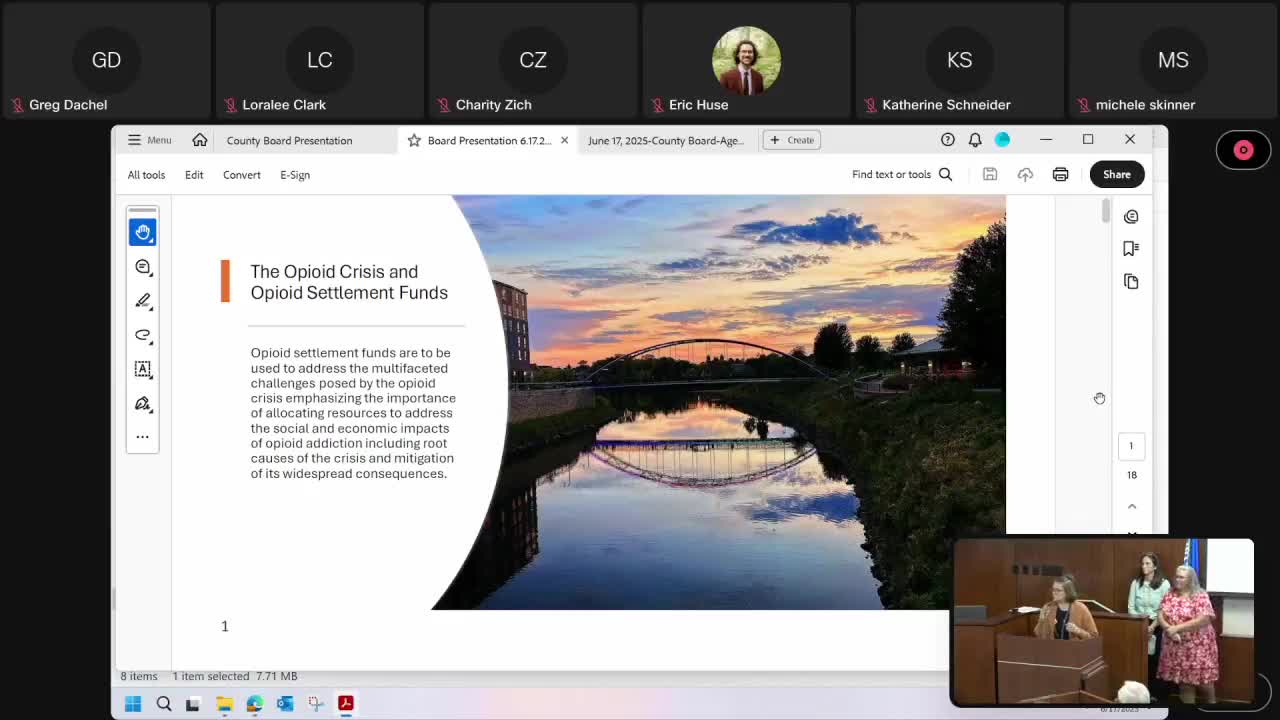
The plan, developed by the county's opioid task force after a countywide needs assessment, was presented by Sarah Dilvin Pospicell, who facilitated the assessment, and by staff from the Department of Human Services (DHS) and the public health department. The county has already received $1,500,000 for 2022'2024 and staff estimated another $3,400,000 will arrive between 2025 and 2038, for a projected total of $5,100,000 to be held in a segregated account and spent only on the approved strategies under state guidance.
The task force said the plan focuses on the full continuum of care, from prevention and harm reduction through treatment and recovery. It recommends countywide distribution of naloxone (Narcan), continued sharps-disposal boxes, school-based prevention programs and peer-support services, a community outreach and stabilization program to respond to nonfatal overdoses, two part-time peer court navigators for justice-involved people, expanded jail crisis staffing and other pilot programs meant to increase access to treatment and reduce future court or jail involvement.
"We want this funding to get out into the community as soon as possible. We wanna save lives," Sarah Dilvin Pospicell said during the presentation.
The plan assigns lead agencies to program areas so work can proceed through existing county departments or by contract; for example, the health department is identified as lead for youth prevention and harm-reduction efforts, and criminal-justice services is identified as lead for jail-related programs. DHS described a staffing proposal that would add a social worker and peer support specialist for community outreach, and one additional crisis worker in the jail to supplement an existing crisis worker who currently serves about 500 unique jail entrants annually. DHS staff emphasized those hires would follow traditional hiring processes and require subsequent committee and budget approvals before funds are released.
The task force and staff stressed that some spending has already been approved and implemented (peer-support training, harm-reduction items and a sharps-disposal rollout were cited as examples), and that the plan is intended as a living document. A major theme of the presentations and discussion was that the settlement dollars cannot be used to substitute for existing budget items and must align with state law and the approved strategies (referred to in the presentation as "Exhibit E").
Supervisors clarified several operational points during Q&A: the plan aims to respond quickly to nonfatal overdoses but set 72 hours as a pragmatic maximum target for outreach because of weekends and staffing realities; stabilization funds would be available to help people enter treatment (for needs such as transportation or short-term child care); and a medication-assisted treatment program in the jail (MAT) is currently funded with state opioid dollars rather than the county's settlement funds.
An amendment was adopted to retain the opioid task force as an ongoing oversight body rather than disbanding it after the plan was delivered; the board then voted to approve the amended framework. Supervisors were explicit that individual program expenditures, hiring and any budget amendments would return to the relevant oversight committees (Human Services, Criminal Justice, etc.) and Finance & Budget for approval before county funds are spent.
The board approved the amended plan by recorded voice vote after committee routing and discussion (final vote on the amended framework: 22 yes, 3 no). Several supervisors urged timely implementation; staff reiterated an ongoing commitment to seek complementary grants and to evaluate results.
The presentation included regional and local data the task force used to set priorities: the county lost 76 residents to fatal opioid overdose from 2018'2023; ambulance services reported 668 nonfatal overdoses from 2018'2024; hospitals recorded about 1,900 opioid-related encounters in that same period; and recent weeks in June 2025 included multiple suspected nonfatal overdoses, which presenters cited to underscore urgency.
The board directed staff to proceed with the plan and to route future staffing and spending requests through the usual committee and budget processes before any settlement funds are disbursed.
Ending: County staff said they will begin grant applications and targeted program rollouts where permitted under state guidance and would return to oversight committees before any additional spending decisions.