Get Full Government Meeting Transcripts, Videos, & Alerts Forever!
Get email alerts on the County Budget topic
No spam. Unsubscribe anytime.
Sacramento County adopts $8.9 billion FY25‑26 budget and $2.7 billion CIP after sharp debate over public‑safety cuts
Summary
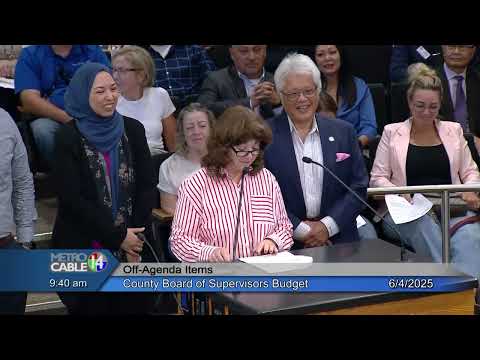
The Sacramento County Board of Supervisors adopted an $8.9 billion fiscal year 2025–26 budget and a $2.7 billion five‑year capital improvement plan on June 4 after hours of presentations and public comment, voting to restore several contested public‑safety, parks and community items by reallocating one‑time reserves.
The Sacramento County Board of Supervisors adopted the county's recommended fiscal year 2025–26 budget and a five‑year capital improvement plan on June 4, approving an $8.9 billion all‑funds spending plan and a $2.7 billion capital program after several hours of presentations, public comment and debate over proposed reductions in public‑safety programs.
The board's action follows county executive David Villanueva's and chief fiscal officer Amanda Thomas's presentation of a budget the administration called balanced but still reliant on one‑time funds. The recommended plan reduces projected structural imbalance while proposing $43 million in new or expanded programs across all funds, $9 million of which are net county cost (discretionary general‑fund dollars).
Why it matters
County staff told supervisors the recommended budget reduces reliance on one‑time fund balance but does not eliminate it. The general fund includes $1,021 million in net county cost, of which $71 million is estimated available fund balance (one‑time). County leaders warned that without new revenue or further structural changes later budgets will face shortfalls and diminished reserves: discretionary reserves under the recommended plan equal roughly 5.5% of general‑fund revenues, short of the board's 17% target.
Most important facts
- Total all‑funds appropriations: $8.9 billion, a 2.8% decrease from the prior adopted year. Net appropriations (net of transfers) are about $6.9 billion. General‑fund appropriations total roughly $4.0 billion. Discretionary general‑fund revenues are budgeted at $943 million.
- Net county cost: $1,021 million (the county's discretionary budget for programs funded by property and sales tax and other countywide revenues).
- One‑time fund balance: $71 million is budgeted to be spent in 2025–26, and department leaders and the CEO stressed this is not sustainable for ongoing costs.
- Reductions and restorations: The recommended general‑fund reductions included $4 million of categorical (dedicated‑revenue) reductions and roughly $14 million of other reductions; the county proposed $9 million of net‑county‑cost funded growth, mostly for court‑mandated obligations and critical programs. Departments reported $18 million of general‑fund reductions collectively, including deletion of 73 vacant positions in earlier drafts; the final adopted plan restores or reprioritizes several items after board discussion and public input.
Public safety and the Mays consent decree
A focal point of debate was funding tied to the Mays consent decree, the court settlement that requires improvements in jail medical and mental‑health care. Staff and the district attorney's office said compliance has added significant recurring operating costs. The adopted budget includes targeted growth to meet county obligations under the settlement: correctional health growth totals about $9 million across funds (including roughly $6 million in net county cost) for UC Davis contract increases, staffing and expanded psychiatric unit costs. The sheriff's recommended growth includes approximately $2 million ($1 million net county cost) for deputy escorts to off‑site medical appointments and partial‑year funding connected to the acute psychiatric unit expansion; county staff said those operating costs are likely to rise in the following fiscal year.
Debate over sheriff and district attorney funding
Elected law‑enforcement leaders and many public speakers urged restoring cuts affecting routine patrol, specialized units and community prosecutors. The sheriff testified that staffing declines over two decades have left the department understaffed for both jails and patrol and warned that reductions to homeless outreach (HOT) and problem‑oriented policing (POP) teams would reduce quality‑of‑life enforcement and lengthen 911 response times. The district attorney emphasized rising caseloads, fentanyl prosecutions and workforce losses and said a proposed $1.7 million reduction to his office would degrade prosecutorial capacity.
Board action and negotiated restorations
After extended discussion and more than 80 public speakers, supervisors reallocated some one‑time reserves to restore targeted programs. Changes added back or newly funded during deliberations include:
- Restoring the district attorney's reduction in misdemeanor trials staffing (the six positions that had been proposed for deletion) and adding a principal criminal attorney for a one‑year, county‑funded community‑prosecutor pilot focused on North Sacramento; the DA's restoration used a combination of projected salary savings, one‑time restricted revenue and a portion of set‑aside reserve funds.
- Restoring sheriff HOT and POP teams and the marine detail that had been recommended for reductions; the board financed restorations with a combination of the county's American River Parkway homeless reserve and a portion of the board's CBO capacity‑building reserve on a one‑time basis, while directing staff and the agencies to document outcomes and return with MOUs where appropriate.
- Targeted one‑time restorations for parks and community programs, including funding for Discovery Park and select restroom repairs, the Mather VernaI Pool preserve management shortfall, the Sacramento SPLASH environmental education program ($75,000), and CalFresh EBT access at farmers markets (one‑time amounts for specified markets).
What the board approved
The board voted to adopt the recommended FY25‑26 budget and the five‑year capital improvement plan as amended in the meeting. Supervisors also approved technical changes and one‑time transfers described above to preserve several local programs while meeting the county executives' overall budget directive.
Public response and next steps
Public comment was extensive and largely focused on public safety, homelessness, and community services. Business groups, property‑business improvement districts and chambers urged maintaining public‑safety staffing; social‑service providers and community‑based organizations urged preserving investments in shelter, youth services and community nonprofits. Supervisors directed staff to deliver MOUs or midyear performance reports for the items restored from reserves and to return with more detail on proposed fee changes (such as concealed‑carry permit fees), any proposed tax or revenue initiatives to close structural gaps, and the potential fiscal effects of the jail system master‑plan work going forward.
Ending note
County executives and department heads repeatedly told the board that the budget reduces one‑time reliance but does not fully close the county's structural gap. Supervisors were clear the board's longer‑term priorities remain rebuilding reserves, identifying revenue options, and aligning ongoing expenditures to reliable ongoing revenues.