Get Full Government Meeting Transcripts, Videos, & Alerts Forever!
Get email alerts on the Professional Licensing topic
No spam. Unsubscribe anytime.
Senator presses state officials on ASHA fee and Medicare implications as Tennessee advances speech‑language licensure and compact
Summary
NASHVILLE — State lawmakers pressed regulators on June 2025 about whether speech‑language pathologists must keep paying for a private credential from the American Speech‑Language‑Hearing Association (ASHA) after a recent Medicare clarification, and the Education, Health, and General Welfare Committee extended the state board that licenses those clinicians and approved an interstate compact for audiology and speech‑language pathology.
NASHVILLE — State lawmakers pressed regulators on June 2025 about whether speech‑language pathologists must keep paying for a private credential from the American Speech‑Language‑Hearing Association (ASHA) after a recent Medicare clarification, and the Education, Health, and General Welfare Committee extended the state board that licenses those clinicians and approved an interstate compact for audiology and speech‑language pathology.
The questioning focused on whether ASHA’s Certificate of Clinical Competency (CCC) is still required for clinicians who are licensed in Tennessee. Senator Watson raised the issue at length, saying clinicians “are basically paying for 2” credentials — a state license and the private ASHA certificate — and noted recent Medicare guidance that, he said, “will no longer acknowledge the provisional license and will not reimburse entities under Part B that are using provisional licenses.”
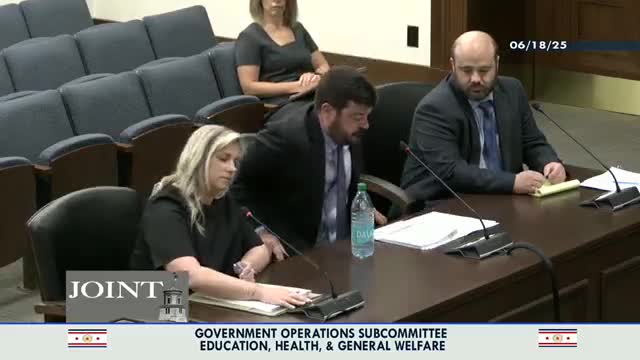
The exchange came during a presentation by Jennifer Putnam, assistant commissioner for health licensure and regulation at the Tennessee Department of Health, and Holt Witt, assistant commissioner for legislative affairs. Putnam told the committee that the board’s path to full state licensure requires either the ASHA certification route or, alternatively, a doctor of audiology degree from an accredited institution and passage of the required exam. On whether the CCC is required to renew a Tennessee license, Putnam said, “That is not a requirement for renewal for their licensure.”
Why it matters: the question affects the cost and Medicare reimbursement status for newly trained speech‑language pathologists and employers who bill Medicare. Lawmakers hearing the issue said it could create a financial barrier for clinicians and urged the board to provide written clarification for the committee as it considers statutory changes and interstate licensure policies.
Background and discussion
The Board of Communication Disorders and Sciences regulates speech‑language pathology and audiology in Tennessee, issuing licenses, investigating complaints and handling discipline. The board’s representatives said the board follows existing statute and that the ASHA pathway remains one route to licensure; they suggested the committee and stakeholders coordinate to determine whether statutory language should change.
Senator Watson said many states — he noted all but North Dakota, in his review — use provisional pathways and that Medicare’s position has pushed the issue into broader national discussion. “Medicare looks at that and says, you do not have full licensure,” he said, arguing that the dual‑fee model (state fees plus ASHA) imposes costs on clinicians. Watson encouraged committee members to request a formal written response from the board about whether the CCC is required for participation in any emerging interstate compact.
Jennifer Putnam and other Department of Health staff said they would follow up. “I’ll be happy to look into that and get back with you,” Putnam told the committee. Department staff also noted the board is complying with current statute and that the matter is under active national discussion; the Audiology and Speech‑Language Pathology Compact had meetings scheduled and will discuss related questions at upcoming sessions.
Formal actions
The committee took two formal actions tied to this topic: it recommended a five‑year extension of the Board of Communication Disorders and Sciences and an eight‑year extension for the Audiology and Speech‑Language Pathology Compact.
- The committee voted to recommend a five‑year extension of the Board of Communication Disorders and Sciences (motion by Chairman Jackson; second not specified). The motion passed on roll call in the Senate with multiple senators recorded as voting aye, and by voice vote in the House. (See actions[] for full roll call excerpt.)
- The committee voted to recommend an eight‑year extension for the Audiology and Speech‑Language Pathology Compact (motion by Chairman Jackson; second recorded). That motion passed on roll call in the Senate and by voice vote in the House.
What’s next
Senator Watson asked that the board respond in writing about whether the CCC will be required under the compact and to clarify how Medicare’s guidance affects Tennessee licensing practice. Department staff said they would distribute any follow‑up to committee members and noted the compact’s national workgroup would consider the issue at an upcoming meeting.
Ending
Committee members said they expect the written response and further discussion at the full government operations committee and during the 2026 legislative session if statutory change is recommended. The committee’s approval of the compact moves the matter forward for the state to join the multi‑state licensing framework if subsequent steps are completed.