Get Full Government Meeting Transcripts, Videos, & Alerts Forever!
Get email alerts on the Water Reuse topic
No spam. Unsubscribe anytime.
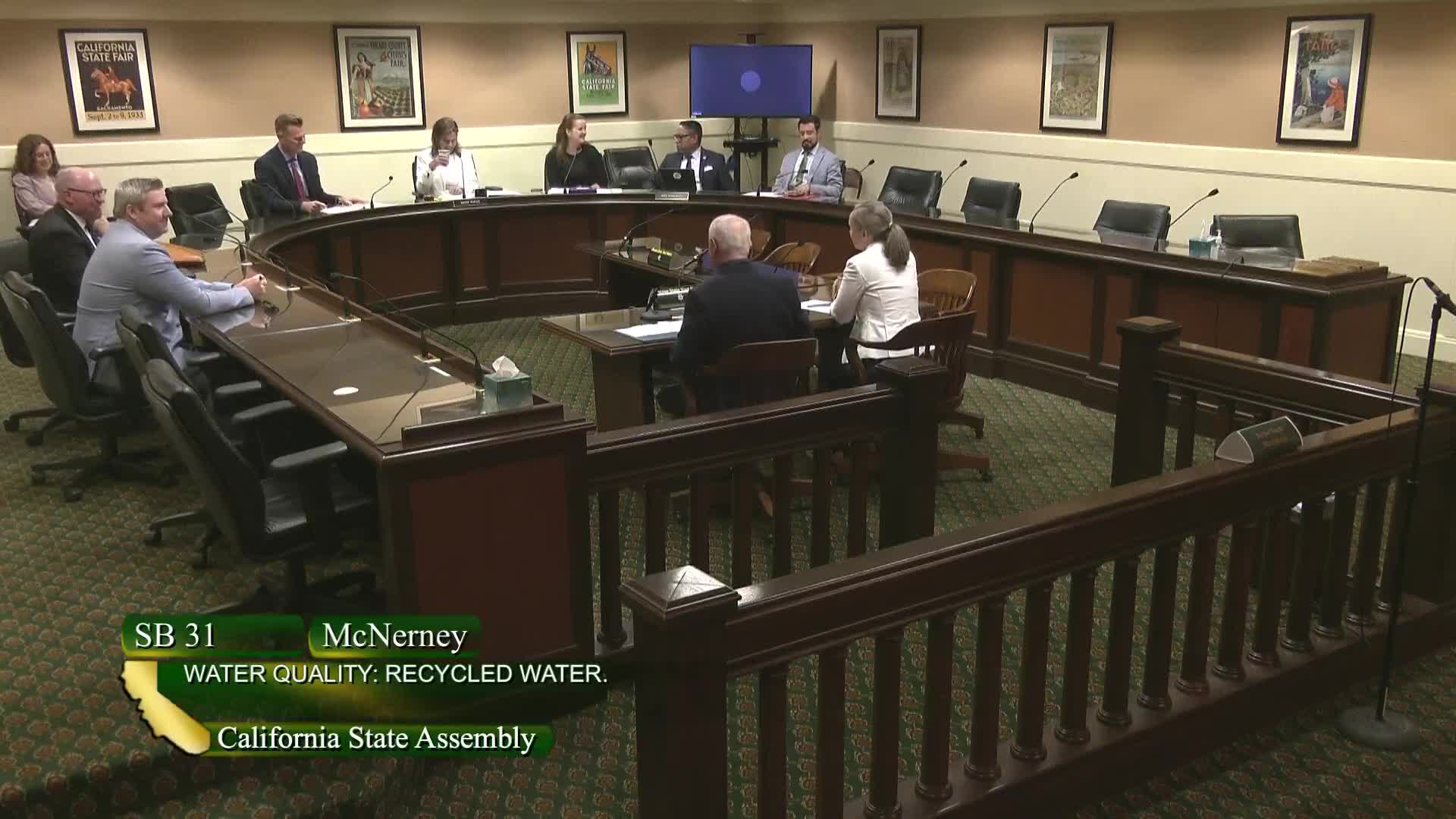
Assembly committee advances SB 31 to expand nonpotable recycled-water uses
Summary
The Assembly committee advanced SB 31, a bill to broaden allowable uses of tertiary-treated recycled water in California, including limited indoor nonfood areas, outdoor irrigation with restrictions, decorative lakes and relief from dual-plumbing requirements for some HOA common areas.
Senator McInerney presented SB 31 to the California State Assembly committee, saying the bill would expand uses of tertiary-treated recycled water to help offset projected declines in water supply.
The bill would allow tertiary (treated, nonpotable) recycled water for specified uses including toilet and urinal flushing in food-handling or processing facilities (limited to restroom areas), outdoor irrigation in parks subject to watering restrictions, decorative lakes and ponds, and irrigation of homeowners association common areas without requiring full dual plumbing of residences.
“Projections are 10% less water supply within the next decade,” Senator McInerney said, framing SB 31 as “a fairly small step, but nonetheless, a good step in the right direction.”
Beth Olaso, appearing for Water East California, said SB 31 makes targeted changes to Title 22 of the California Code of Regulations, which currently governs tertiary-treated recycled water. Olaso summarized the bill’s clarifications: treating certain conveyed treated water as recycled water rather than raw sewage for reporting and enforcement purposes; limiting indoor uses to restroom fixtures in food-processing facilities (not in food-preparation areas); restricting irrigation so recycled water is not sprayed when park users are reasonably present; permitting recycled water in decorative lakes and ponds; and allowing HOAs that irrigate common areas to avoid dual plumbing of individual dwellings.
Olaso said the bill’s intent is to reduce reliance on imported water and boost local drought-resilient supplies. She told the committee that the State Water Board has signaled interest in broader updates to Title 22 but that those rulemakings require staff time and funding the board may not have now; SB 31 would make narrower statutory clarifications in the interim.
Multiple water agencies and associations registered support during the hearing, including representatives identifying themselves as speaking for Padre Municipal Water District; Irvine Ranch Water District; the League of California Cities; Elsinore Valley Municipal Water District; the California Groundwater Coalition; the Dairy Institute of California; California Municipal Utilities Association; Contra Costa Water District; the Association of California Water Agencies; East Bay Municipal Utility District; Metropolitan Water District; Santa Clarita Valley Water Agency; the cities of Roseville and Thousand Oaks; Eastern Municipal Water District; Santa Margarita Water District; and West Basin Municipal Water District.
There were no witnesses in opposition. Because a quorum was not present earlier in the hearing, committee staff left the roll open; when a quorum was subsequently established the committee recorded a do-pass motion to the Environmental Safety and Toxic Materials Committee.
Votes at the committee recorded the motion to refer SB 31; the clerk announced members calling “aye” during the roll call. The motion was reported as passed and the roll was left open briefly for additional members.
SB 31’s sponsors said they are open to technical modifications and emphasized the bill’s limited scope: clarifying regulatory language in Title 22 to permit additional end-uses of tertiary-treated recycled water while maintaining protections (for example, limiting recycled-water use in food facilities to restroom flushing and imposing watering rules in parks).