Get Full Government Meeting Transcripts, Videos, & Alerts Forever!
Get email alerts on the Syria Political Transition topic
No spam. Unsubscribe anytime.
U.N. briefing warns Syria cannot withstand further escalation; urges inclusive political transition
Summary
At a U.N. Security Council meeting, Natchat Rushdie summarized Special Envoy Pedersen’s recent talks in Damascus and Lebanon, welcomed steps on detainee exchanges and returns, and warned that any wider regional escalation would endanger Syria’s fragile recovery.
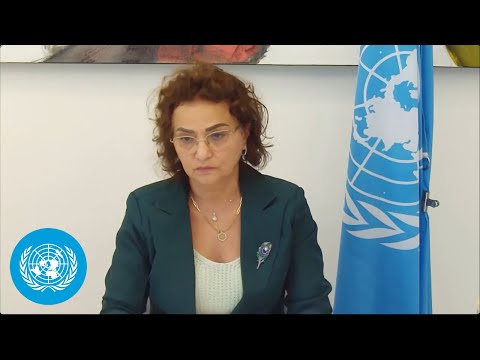
Natchat Rushdie addressed the United Nations Security Council to report on developments in Syria and to relay the findings of Special Envoy Pedersen’s recent visits to Damascus and Lebanon. She warned that “Syria simply cannot withstand another wave of instability” and said the risks of further regional escalation were “immediate” and “severe.”
Rushdie said Pedersen met senior interim Syrian officials — including the interim ministers of foreign affairs, interior and justice, the chair of the civil peace committee and the governor of the central bank — and described those talks as “constructive and cooperative.” She said discussions focused on prioritizing domestic affairs and advancing “a genuinely inclusive and credible political transition” in which all Syrians can participate.
Rushdie outlined steps taken toward a transition that the briefing characterizes as important next-step measures: the presidential decree establishing a supreme committee to supervise indirect elections for 100 of the 150 seats of a transitional People’s Assembly, the formation of new committees on transitional justice and missing persons, and agreed measures to allow students in the Northeast to register for exams under the interim ministry of education. She said the council should encourage the supreme committee to ensure “inclusivity, transparency and openness” and to enable meaningful participation by women and youth.
On security and humanitarian concerns, Rushdie reported sporadic violence in areas including Homs and Hama, cited attacks, kidnappings and infringements on liberties, and said interlocutors had expressed concern about targeted incidents against specific communities. She noted steps taken by interim authorities to ease tensions, including a fatwa prohibiting revenge killings and moves to reinstate judges removed by the former regime, while stressing that “further key steps will be needed towards the reinforcement of the rule of law and the independence of the judiciary.”
The briefing also described exchanges of detainees and the return of some Syrian families from the Al-Hol camp. Rushdie said urgent work is still needed on rehabilitation and reintegration of camp residents and that member states and relevant authorities should “significantly step up efforts on repatriations.” She welcomed the permanent closure of the Rukban camp and said the council should press for conditions that make returns sustainable, including housing, services and economic revitalization.
Rushdie criticized recent cross-border incidents and foreign strikes, saying, “These attacks are unacceptable and must cease,” and stressed that Syria’s sovereignty, independence and territorial integrity must be respected, along with the 1974 disengagement-of-forces agreement. She also reported ongoing attacks by ISIL, including on SDF positions, and reiterated that addressing the issue of foreign fighters remains a pressing but challenging concern.
On chemical weapons and technical cooperation, Rushdie said the briefing took note of recent missions by the Organization for the Prohibition of Chemical Weapons and described the cooperation as meaningful. She also reported recent economic and diplomatic developments cited in the briefing: a U.S. general license and a six-month waiver related to the Caesar sanctions, the lifting of certain EU and U.K. economic sanctions, and the signing of a commercial contract for construction of gas and solar energy plants that, when complete, are expected to supply more than half of Syria’s national electricity needs.
Rushdie said such economic steps could help reactivate the economy but that more will be required — including resolving remaining sanctions questions, creating a regulatory and financial framework and improving security and political conditions to attract investment. She said the World Bank and the International Monetary Fund had visited Syria and emphasized that substantial international support will be required for rehabilitation, humanitarian needs and rebuilding institutions and infrastructure.
The briefing closed with Rushdie saying she and the special envoy would shortly return to Syria to continue engagement with interim authorities and diverse Syrian society, and to support a fully inclusive transition “in line with the principles of Security Council resolution 2254.”