Get Full Government Meeting Transcripts, Videos, & Alerts Forever!
Get email alerts on the Terrorism Security Council topic
No spam. Unsubscribe anytime.
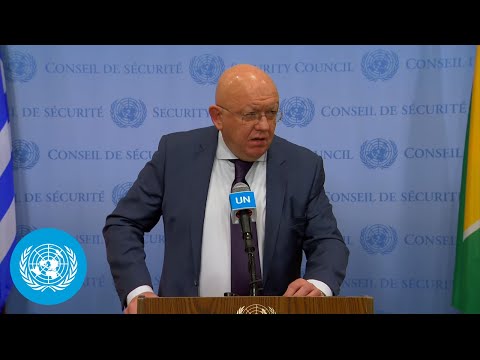
Russian envoy says Security Council blocked condemnation of passenger-train bombings, disputes claims of mass child abductions
Summary
A Russian ambassador told reporters the U.N. Security Council failed to adopt even a standard press statement condemning May bombings of passenger trains that killed seven and injured more than 100, and disputed wider claims that thousands of Ukrainian children were abducted, saying Moscow had handed the council a list of 339 names.
An ambassador speaking for the Russian delegation said the U.N. Security Council failed to agree on a condemnation of May bombings of passenger trains in the Bryansk, Kursk and Voronezh regions that he said killed seven civilians and injured over 100.
The envoy said a draft resolution — he said it was based on previously agreed Security Council language, including Resolution 1373, and grounded in the UN Charter and the 1999 International Convention for the Suppression of the Financing of Terrorism — was not supported by some delegations. “Any justification of terrorism is unacceptable,” the ambassador said, adding that even a minimal alternative, a standard press statement expressing condemnation and solidarity with victims, was blocked.
The Russian representative characterized opposition as politicization that linked the attacks to the broader Russia–Ukraine conflict and said some delegations questioned whether a passenger train bombing could be treated as a terrorist act. He called that position “unsubstantiated, inhumane, and cynical” and said it undermined counterterrorism cooperation within the council.
The envoy also said Russia sought adoption of a separate statement to welcome cooperation between Russia and Ukraine on reuniting Ukrainian children who lost contact with their families. He said Russia provided a list of 339 names that it said resulted from direct bilateral talks in Istanbul on June 2 and urged the council to welcome and encourage interaction between the parties on the issue. “We are talking about 339 names of the children, not tens of thousand as is falsely claimed,” the ambassador said.
He described those children as evacuated from battle areas for their safety, saying some had relatives and some were orphans, and that Russian authorities were working to reestablish family ties and to return children who wished to go back. He said the list was under scrutiny by Russian authorities and that Moscow would continue efforts to restore family contacts.
Reporters pressed the envoy on details. He declined to name the delegations that opposed the draft text and did not give further specifics about the draft’s language or which council members blocked the press statement. The Security Council took no formal decision on either matter during the briefing.
The lack of consensus prevented the council from issuing the kind of brief, unified public condemnation it has released previously in response to terrorist attacks, the ambassador said. No action or outcome was recorded in the briefing indicating that the council had adopted any new text on either the train bombings or the children’s list.
The remarks reflect a broader diplomatic impasse on Ukraine-related items at the Security Council, the envoy said, and highlight continuing disagreement among council members over how to characterize attacks that occur on territory involved in the armed conflict.
No formal Security Council vote or decision on the draft resolution or the proposed presidential statement was reported during the briefing.