Get Full Government Meeting Transcripts, Videos, & Alerts Forever!
Get email alerts on the Vmt Sb743 topic
No spam. Unsubscribe anytime.
STA hears introductory countywide VMT strategy briefing under SB 743; board asks staff for follow-ups
Summary
At an informational session, consultants and staff outlined SB 743 implementation challenges and options for countywide vehicle-miles-traveled mitigation — including impact fees, exchanges and mitigation banks — and the board asked staff for additional workshops, a comparison of pilot programs, and coordination with city and county agencies.
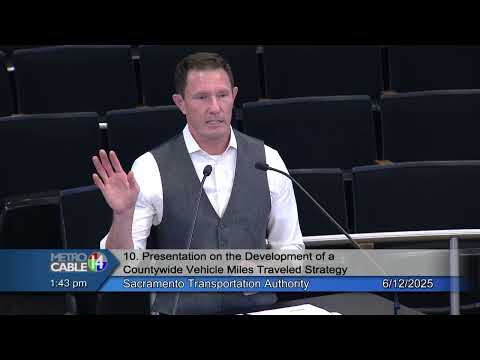
The Sacramento Transportation Authority received an introductory presentation on developing a countywide vehicle miles traveled (VMT) strategy under SB 743 at its June 12 meeting. Presenters described VMT's role in California Environmental Quality Act (CEQA) analyses, explained mitigation approaches now being explored statewide, and said a countywide program could streamline mitigation and direct funds to high-priority transit and active-transportation projects.
Consultants and staff framed VMT as a metric that multiplies the number of vehicle trips by the length of those trips and noted that, while simple in definition, the metric is applied in different ways for greenhouse gases, localized air pollution, safety, and land-use planning. Ron Milam (identified in the presentation) and other presenters described a menu of mitigation approaches: on-system mitigation built into projects, off-system mitigation in other projects or jurisdictions, programmatic solutions such as impact fee programs, and newer models labeled exchanges or banks that would allow project applicants to pay into a program that funds verified VMT-reducing projects elsewhere.
Milam told the board: "VMT in its most basic form... only involves two variables: number of vehicle trips multiplied by the length of those trips." Board members and the public discussed implications of using VMT as a proxy for greenhouse gases, particularly as vehicle electrification advances. Director Rick Dickinson (who said he managed SB 743 on the Assembly floor when it passed) summarized the statute's intent: move away from level-of-service measures and encourage mitigation that reduces travel and internalizes greenhouse-gas externalities. Dickinson asked whether mitigation banks or exchanges were being used elsewhere; Milam and staff said jurisdictions including Los Angeles have pilot programs and impact-fee or in-lieu fee approaches are in place in a few locales, but most efforts remain at the pilot stage.
Directors raised concerns and trade-offs: Director Kent asked how mitigation could account for long-distance commute needs and local economic activity; Director Hume noted that electrification affects greenhouse-gas calculations but said the board still needs measures tied to travel, safety and health. Executive Director Kevin Busey said acting locally could allow the region more control and offered examples in the county — Elk Grove plans for roadway projects and transit; Citrus Heights is pursuing bus rapid transit — where mitigation funding could be directed. Busey also noted a tolling example: on a Yolo 80 project, planners anticipate about $12,000,000 in annual toll revenue that could be used for VMT mitigation.
A public speaker, Dan Allison, supported program-level mitigation but urged attention to geographic equity, saying, "What if an upper income community gets bike facilities and a lower income community gets more VMT with auto pollution and traffic violence?" He also cautioned that very large freeway expansions may generate VMT that a bank could not fully offset.
Board members asked staff to return with more detail in future sessions: comparisons of regional pilot approaches (impact fees, exchanges, banks), verification practices from places that have piloted programs, and program-level options for Sacramento County. Directors also asked for a separate informational return from city staff on the Stockton Boulevard/Capitol Corridor project with county DOT participation and an update on any memoranda of understanding among agencies. Staff said this was the first of three workshops and anticipated bringing VMT mitigation program options back in August. The item was informational; no formal action was taken.