Get Full Government Meeting Transcripts, Videos, & Alerts Forever!
Get email alerts on the Homelessness Vehicle Dwelling topic
No spam. Unsubscribe anytime.
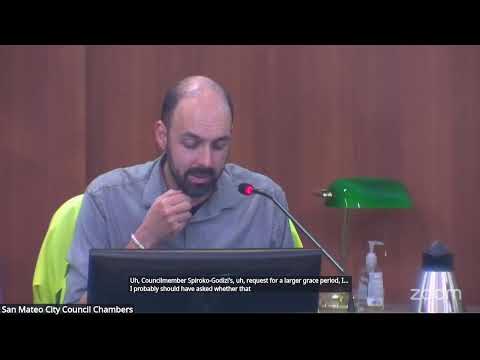
San Mateo council directs limited enforcement of vehicle-lodging code with 45-day grace period
Summary
The San Mateo City Council gave staff direction to implement a service-first enforcement approach to the city's prohibition on living in vehicles (San Mateo Municipal Code §1004.140), including multilingual outreach, a 45-day grace period before citations, and follow-up reports to council.
San Mateo — The San Mateo City Council on Monday night directed staff to resume enforcement of the city's prohibition on using vehicles for habitation (San Mateo Municipal Code §1004.140) under a service-first model that includes outreach and a 45-day grace period before citations would be issued.
Senior Management Analyst Zachary Bridal told the council staff had identified three options: (1) enforce the code with at least two outreach attempts before issuing a 24-hour warning and subsequent citation or enforcement; (2) strictly enforce the code without outreach; or (3) continue the current practice of outreach without citations. "Section 1004.140 ... states that it is unlawful for any person to use a vehicle for lodging in the city of San Mateo," Bridal said during the presentation.
The nut of the council's decision was balancing public health, safety and neighborhood concerns with efforts to connect people living in vehicles to services. Bridal said the Homeless Outreach Team (HOT) performs regular outreach and counted an average of about 50 vehicle dwellers per week; HOT also distributed 51 flyers in English and Spanish about the agenda item.
Public commenters urged a measured approach that included outreach before enforcement. "I support option 1, which is resume enforcement of the ordinance with outreach by the police twice prior to the issuance of a 24 hour warning," said Lori Watanucki (resident). Residents Julia and Sebastian Bonfiglio described neighborhood impacts including trash and overcrowded parking; Sebastian said increased enforcement in larger cities could push more RVs into San Mateo.
Several council members said they supported option 1 but wanted a longer public-notice period than the two-week grace period staff had proposed. "I was thinking initially closer to 45 to 60 days of a notice period, before we jump into, you know, issuing warnings and fining people," Councilmember Daniel said. Multiple members expressed support for 45 days as a reasonable compromise.
The council's discussion also addressed the limits of enforcement and the practical barriers to shelter and housing. The police chief explained how citations could be prosecuted, saying an infraction is "a fine only" while a misdemeanor is a criminal charge that would be rare; unpaid citations over time could result in warrants. A HOT team member said many people living in RVs are reluctant to give up their personal space for congregate shelter and that some do not respond to outreach.
Commenters and staff discussed alternatives used elsewhere in the Bay Area, including vehicle-buyback programs, safe-parking sites and temporary tow-away zones. Jeremy Levine (resident) recommended the city consider a safe-parking program as a medium-term option. City staff and councilmembers said the city has examined Redwood City's and Pacifica's models and noted operational and residency-challenge concerns.
Council direction included: implement option 1 (outreach-first enforcement) with a 45-day public-notice/grace period before enforcement; provide multilingual informational outreach (English and Spanish); explore county coordination on safe-parking options; examine a possible pump-out station near the wastewater treatment plant and potential voucher program; and provide follow-up written updates (a staff suggestion of a six-month update and a one-year report was accepted).
The council reached general consensus rather than a formal roll-call vote. Staff will proceed with the outreach-first enforcement plan as directed and report back to the council on the schedule discussed.
Members of the public, HOT staff and the police chief warned that enforcement alone would not produce immediate reductions in vehicle dwelling because service eligibility, residency and personal choice affect whether individuals accept shelter or housing offers. "Housing is the only long term solution for housing," said Jeremy Levine. The council asked staff to return with progress reports and to continue coordination with county partners on longer-term options.