Get Full Government Meeting Transcripts, Videos, & Alerts Forever!
Get email alerts on the County Budget Healthcare topic
No spam. Unsubscribe anytime.
Ventura County adopts $3.23 billion budget amid health‑care funding risks
Summary
The Ventura County Board of Supervisors on June 16 approved a $3.23 billion preliminary budget but staff warned the county's hospitals and behavioral health programs face cash‑flow and revenue risks tied to federal and state changes to Medi‑Cal and new Behavioral Health funding rules.
The Ventura County Board of Supervisors adopted a countywide recommended budget of about $3.23 billion and a general fund appropriation of roughly $1.5 billion at a special meeting on June 16, 2025, after a multi‑hour hearing focused on health‑care financing, behavioral health changes under Proposition 1, and local hospital capacity.
County Chief Executive Officer Dr. Johnson told the board the administration and departments prepared the plan as a "cautious budget" because federal and state funding decisions remain unsettled; "this is a living document," he said. The board voted 5‑0 to approve the budget and related resolutions.
The vote came after presentations from the County Executive Office, the Healthcare Agency and its divisions, the Ventura County Medical System (VCMS), public health and behavioral health. Presenters warned that a growing share of the county hospital system's revenue now comes through state and federal supplemental programs that are paid with a long lag and that proposed changes at the state and federal level could reduce future funding or increase administrative burdens.
Brian Friedman, Budget and Finance Division, summarized the recommended budget and the revenue picture: the countywide recommended budget is approximately $3,229,000,000 (about a 6.1% increase from the prior year), with general fund appropriations just under $1.5 billion and non‑general fund appropriations of roughly $1.727 billion. Friedman highlighted that intergovernmental revenue (federal and state) and property taxes are the two largest components of general fund revenue and that both contain elements of uncertainty going forward.
Healthcare Agency Director Dr. Teresa Cho and Ventura County Medical System staff described the county health network's finances in detail. Dr. Cho said the agency's mission is "to care for all people with compassion and dignity" while noting the system faces pressure from rising costs and uncertain supplemental payments. Michael Taylor, CFO for the Healthcare Agency, said nearly 40% of VCMS funding now comes through supplemental funding programs and that VCMS's reliance on receivables and advances creates cash‑flow pressure: accounts receivable tied to supplemental programs grew from about $171 million at the end of FY 2021 to nearly $288 million projected at the end of FY 2025, and the projected general fund advance was described in the presentations as roughly $260 million–$283 million by the end of FY 2025.
Presenters described the operational consequence: significant parts of the health system's revenue are earned now but received 12–24 months later, requiring large interim cash advances from the county general fund. Healthcare staff said the county is pursuing multiple mitigations, including negotiating rate adjustments with managed‑care plans (Gold Coast Health Plan was named as the largest payer), pursuing prospective payment rate resets at qualifying clinics, tightening contract and revenue‑cycle collections, and seeking earlier drawdowns of portions of certain supplemental payments to improve timing. Michael Taylor told the board a rough order‑of‑magnitude mitigation from a materially higher managed‑care rate would need to be tens of millions of dollars annually to materially change the general‑fund advance trend.
Behavioral health leadership described changes under CalAIM and Proposition 1 that will reallocate existing Mental Health Services Act funding into new Behavioral Health Services Act categories. Dr. Loretta Denning, behavioral health director, said the county's behavioral health budget is about $312,000,000 for the year and that Proposition 1 adopts new required buckets (including housing interventions and full‑service partnerships) with no new net dollars, reduces administrative shares taken at the top, and imposes a new, more complex integrated planning and reporting process. Denning also noted the county received two Proposition 1 infrastructure awards totaling about $93 million: roughly $59 million for a 38‑bed locked placement facility at the Lewis Road campus and about $34 million for a 16‑bed facility tied to a crisis stabilization unit in Simi Valley.
Public health Director Regal Vargas reviewed public health appropriations (about $67.3 million this year) and warned that several federal grants that support local programs (for example SNAP‑Ed/CalFresh Healthy Living and maternal/child public‑health programs) are vulnerable to federal funding changes under pending budget proposals. The Ventura County Healthcare Plan presentation showed enrollment declines and projected net losses (a net loss of about $4.5 million in the current year and a budgeted loss of about $2.4 million the coming year), driven by enrollment declines and rising medical and pharmacy costs.
The hearing included extended public comment on a separate but related issue: several East County residents and pediatricians urged the board to act after Los Robles Regional Medical Center announced it will close its inpatient pediatric unit on July 1. Pediatricians and community members said the change would leave large parts of East Ventura County with longer transport times for pediatric inpatients and urged county action or partnership to maintain local pediatric capacity. Mark Perryman, a Thousand Oaks resident, told the board: "Please don't stop until the needs of our children are met. Not 1 child should endure pain longer than medically necessary." Ryan Brown of the Ventura County Taxpayers Association urged the board to address the hospital system's general‑fund borrowing, saying, "There is no repayment plan. There is no debt reduction strategy." Those comments were recorded during the public‑comment portion of the hearing.
County staff told supervisors they will continue to monitor pending federal legislation and the final state budget, and planned to return with a first‑quarter budget update this fall (the staff timeline anticipates more definitive proposals to the board in the October–November timeframe once state and federal budgets are finalized and actuals for the new fiscal year begin to accumulate).
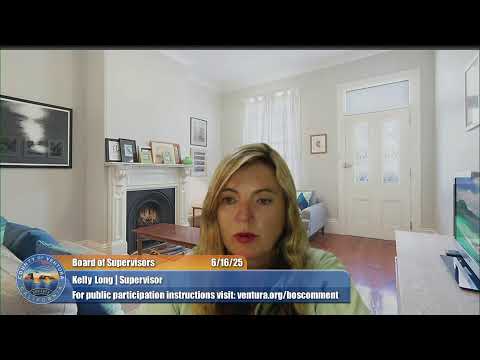
The board took several formal actions during the special meeting before adopting the FY 2025–26 budget: it approved emergency remote participation by Supervisor Long under Government Code section 54954.2(b)(4) (unanimous roll‑call), amended and approved the meeting agenda as modified (unanimous), and adopted the proposed budget and accompanying resolutions (5‑0).