Get Full Government Meeting Transcripts, Videos, & Alerts Forever!
Get email alerts on the Sign Ordinance Clarification topic
No spam. Unsubscribe anytime.
Danville board discusses clarifying sign rules after inconsistent interpretations and variances
Summary
Planning and zoning members discussed tightening the town’s sign ordinance language — especially how to measure a sign (painted façade vs. mounted sign) and the standard of 96 square feet or 10% of a building façade — after board members noted inconsistent variances and examples that appear to use a building’s entire frontage for signage.
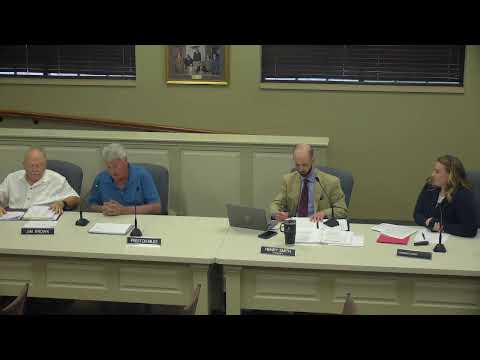
Members of the Boyle County Board of Adjustments and planning staff discussed possible clarifications to the town’s sign ordinance during new business, focusing on how the code measures sign area and whether painted building façades should count as signage.
Planning staff asked the board for input on revisions after the Planning Commission’s advisory subcommittee reviewed sign‑related variances granted in recent years. Hannah Gray said the subcommittee wanted guidance because the ordinance’s application had led to numerous variances and some inconsistent results.
Board members and attendees debated whether the ordinance’s standard — "96 square feet or 10% of the facade, whichever is greater" — needs revision or clearer definitions for what constitutes a sign. One board member noted a business that appears to use the full building frontage for advertising on the bypass; another pointed out it may be painted on the wall and not a separately mounted sign.
"96 square feet or 10% of the facade, whichever is greater," a board member restated while seeking clarity. Members suggested clarifying whether the calculation applies to painted signage, wall‑mounted signs, or other treatments and whether the code should specify borders or sign definition to avoid confusion.
Several members said the existing standard generally works but that clearer definitions could reduce the number of variance requests and the board’s workload. The conversation also covered enforcement: if a business appears out of compliance, board members said the proper response is a complaint through the planning office rather than ad hoc public naming during a meeting.
No ordinance change was adopted at the meeting. Planning staff was asked to bring suggested language revisions back to the Planning Commission and to the board if the board wanted to narrow or clarify definitions (painted wall art, mounted signs, measurements of façade area). Board members encouraged staff to pursue a complaint process where warranted.
The board’s discussion emphasized balancing consistent enforcement with retaining authority to grant variances where the specific circumstances justify them.