Get Full Government Meeting Transcripts, Videos, & Alerts Forever!
Get email alerts on the School Construction topic
No spam. Unsubscribe anytime.
MSD Wabash County Schools reviews Southwood and high school renovation plans, phasing and costs
Summary
Presenters from Barton Co. and Ygrene outlined schematic designs, construction phasing and preliminary budgets for Southwood Elementary School and the district high school at a MSD Wabash County Schools work session.
Presenters from Barton Co. and Ygrene outlined schematic designs, construction phasing and preliminary budgets for Southwood Elementary School and the district high school at a MSD Wabash County Schools work session. The presentation described classroom reconfigurations, a west-side cafeteria addition at Southwood that would serve as temporary classroom space during renovation, a north athletics/field-house addition and west Career & Technical Education (CTE) expansion at the high school, and site logistics intended to keep students and busing separate from construction traffic.
Why it matters: the projects would reconfigure instructional space, expand athletic and CTE facilities and require extended on-site construction (roughly two years for the elementary project), temporary traffic changes and additional site work that will affect parking, practice areas and stormwater infrastructure. The district and contractors said they need final phasing and a budget alignment before moving into detailed design and bidding.
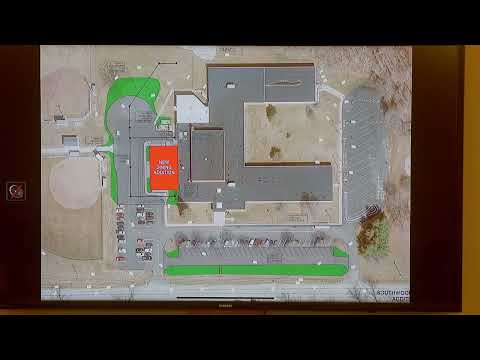
Brian Bollander, a presenter from Barton Co., said, “We are just moving out of what we call schematic design phase, moving into design development phase,” and gave a room-by-room description of the Southwood Elementary work. At Southwood, the plan calls for three tiers of work: finish updates (heating, cooling and finishes), larger renovations (classroom reconfiguration and new restroom/cool-down space for the RISE program) and a proposed west addition. The gym would expand into the current dining area to create an almost regulation-size floor and the new west addition would house a new dining/serving area, dish room, storage, staff dining and restrooms and a conference space that do not currently exist between the enlarged gym and dining area.
Contractors plan to use the new cafeteria space as temporary classroom “swing” space while renovations occur elsewhere in the building, because Southwood has no spare space to relocate students during construction. The design also includes moving student sinks outside restroom stalls for supervision, renovating staff restrooms to meet ADA standards and upgrading classroom door hardware for improved secure-entrance procedures.
On site circulation, the team showed a truck-turn loop northwest of the new addition to preserve the existing kitchen receiving location and described adding roughly 20 parking spaces on the south side of the building to compensate for displaced stalls.
Contractors said the site is currently listed in an assumed flood plain and that the Indiana Department of Natural Resources is working to establish a base flood elevation for the property. Barton Co. said the DNR had the review in their system and gave itself about 90 days to set the marker; the design team said it is proceeding on the assumption of a favorable outcome but that the DNR determination could change what is allowable on the site. “We’re optimistic that we would set that at a point where it wouldn't interfere with the project,” Bollander said.
At the high school, the design differs from the Northfield work. Plans call for a north athletics/field-house addition (east–west orientation because of the road), additional physical-education space, a lobby/entrance and support spaces, possible wrestling room and a three-court layout with a track. The scheme also shows a west CTE expansion to modernize career and technical spaces (ag lab, construction lab, robotics and engineering classrooms) and maintain program continuity where feasible.
The high school site design includes a possible sprinkler tank and pump house (discussed as a combined small structure near a storage tank), stormwater detention north of the building to address increased impervious surface, and expanded parking west of the existing lot. Contractors noted drainage requirements could be updated from prior standards and that the final detention design will be determined in coordination with the county.
Contracting and phasing options: contractors presented single-phase and two-phase approaches for the high school. A single-phase build (doing both the west CTE and the north athletics addition together) is shorter and less expensive in general conditions and mobilization costs — the team said single-phase work could take roughly 20 months — while a split, phased approach would keep the existing CTE program operating during construction but would add roughly six months and additional costs for double mobilizations, extended general conditions and material/price risk for suppliers asked to hold pricing. For the elementary project, the team showed a 10-phase plan with an early priority on the west cafeteria expansion: a targeted construction window for that phase was June 1 to Dec. 15, 2026, so the new cafeteria could accommodate 10 classrooms by December 2026 and allow the remainder of the building to be renovated in subsequent phases. Overall, Barton Co. and Ygrene estimated the elementary project’s construction duration at about 25 months under the proposed phasing.
Logistics and temporary access: the team presented two logistics versions for Southwood. Version 1 uses existing entrances and a consolidated contractor laydown area; version 2 would add a temporary access road off the west tree line (near Say Road) to separate construction traffic from buses, parents and staff. A Ygrene project executive said the district should plan an allowance of about $100,000 to $150,000 for that temporary access road, including culvert and swale work. “We would earmark probably a 100 to a $150,000 just to draw off of permanent allowance,” the project executive said.
Other constraints and procurement: presenters highlighted long lead times for major equipment (electrical switchgear and cafeteria HVAC), and said the team is evaluating early procurement of long-lead items to hold milestone dates. The presentation noted the need to coordinate state approvals, routing and permitting; the team warned that splitting work into phases could force suppliers to hold prices and quotes for up to a year, introducing escalation risk.
Community impacts and unresolved items: contractors acknowledged impacts to practice areas and to parking, and said the location of stormwater detention and the fire suppression tank/pump house will be refined in later design phases. They also said tree removals are likely where the west addition and parking are located and that monument signs may be relocated. The team asked the district to confirm phasing preferences so the designers can align budgets in the next design-development phase.
No formal votes or budget approvals were taken at the work session. Presenters said next steps include completing design development, refining logistics and cost estimates, and returning to the board with recommended phasing and a formal budget request.