Get Full Government Meeting Transcripts, Videos, & Alerts Forever!
Get email alerts on the Supportive Housing Zoning Appeals topic
No spam. Unsubscribe anytime.
Saint Paul council weighs two appeals over conversions to supportive housing; one laid over, one denied
Summary
The City Council on July 9 considered two appeals of Board of Zoning Appeals denials of requests to convert existing properties into supportive housing. The council laid over the appeal for 418 Sherburne Avenue to Aug. 6 for further legal review and denied the appeal for 438 Daley Street, upholding the BZA decision.
The Saint Paul City Council on July 9 took separate actions on two appeals of Board of Zoning Appeals decisions that sought variances to convert existing buildings into supportive housing.
The council laid over the appeal for 418 Sherburne Avenue to Aug. 6 to allow more time for legal review and additional information. The council denied the appeal for 438 Daley Street, upholding the BZA's denial and leaving the existing rooming-house use in place without conversion to a supportive housing facility.
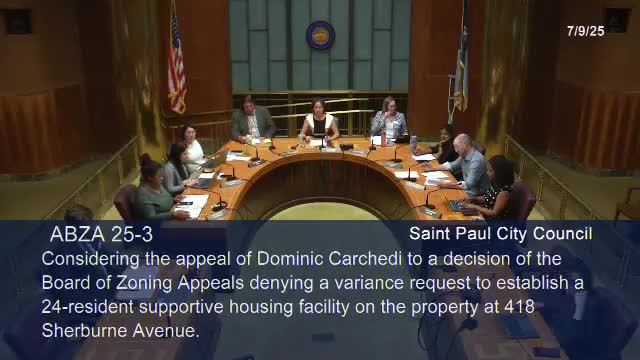
The appeals arise from a change in how state licensing treats certain congregate living operations, prompting some property owners to add on-site services and thus become classified as supportive housing under the city's zoning code. Department of Safety and Inspections staff member David Eid told the council that supportive-housing conversions are treated as a higher-intensity use and that applicants must meet separation and other criteria in the city's code. Eid said the Sherburne application sought to convert a fourplex into a 24-resident supportive housing facility (six residents per unit with on-site services) and that the property sits within the city's quarter-mile separation requirement from other congregate facilities; the closest other facility is about 513 feet away at 470 Western Avenue North.
Appellant Dominic Carchetti, who identified himself as the owner of 418 Sherburne Avenue, told the council he had operated the building “as a sober house for the last 16 months” and that recent state regulation changes—particularly requirements tied to providing food and services—had reclassified his operation. "The Minnesota government wants to regulate this industry better," Carchetti said. He submitted petitions from neighbors and said management had maintained quiet and order.
Neighbors who testified opposed the Sherburne conversion. Robert McLean of 437 Sherburne said he and other residents were not informed and described concern about a sudden increase of people under one roof. Jackie Burgoon, a nearby resident, said safety and existing neighborhood crime were her principal concerns and that clustering of congregate facilities can be destabilizing.
Councilmember Aisha Bui (chairing the item) moved to lay the Sherburne appeal over to Aug. 6 to allow council attorneys and staff to prepare guidance; the motion passed 7–0. The council record shows the deadline for decision in the Sherburne appeal was extended to Aug. 18 to accommodate that schedule.
On the Daley Street appeal, David Eid said the property is a legally nonconforming rooming house in the B2 Community Business district and that the applicant sought to convert it into a 22-resident supportive housing facility. Staff and the BZA recommended denial because the applicant did not satisfy three of the six findings required for a zoning variance—findings that examine whether practical difficulties are unique to the property, whether the hardship was self-created, and whether granting a variance would alter neighborhood character. The BZA recorded unanimous denial by its members at the hearing.
No appellant appeared at the Daley Street public hearing before the council. After reviewing the BZA record and materials submitted by the applicant, a councilmember moved to deny the appeal, saying he had “not found any error in fact finding or procedure” in the BZA decision. The council voted 7–0 to deny the appeal, which means the property may continue to operate as a rooming house but cannot add the on-site services that would reclassify it as supportive housing under the city's code.
Councilmembers expressed concern about a broader policy mismatch between state licensing changes and the city's zoning categories. Councilmembers said they expect more similar cases and requested a near-term policy session with DSI, Planning and Economic Development, the city attorney's office and other relevant staff to recommend code or administrative changes that would allow needed services without creating harmful clustering or unintended land-use consequences.
The council's actions: the Sherburne appeal (418 Sherburne Avenue) was laid over to Aug. 6; the Daley appeal (438 Daley Street) was denied, upholding the BZA.
Looking ahead, staff and council members said they will pursue a policy review so that operators, neighbors and the city have a clearer path to comply with state licensure while avoiding clustering of congregate living facilities in single neighborhoods.