
Mustang High to add 0 hour, open lunch for upperclassmen and shift graduation to Bronco Stadium for 2026
Get AI-powered insights, summaries, and transcripts
Subscribe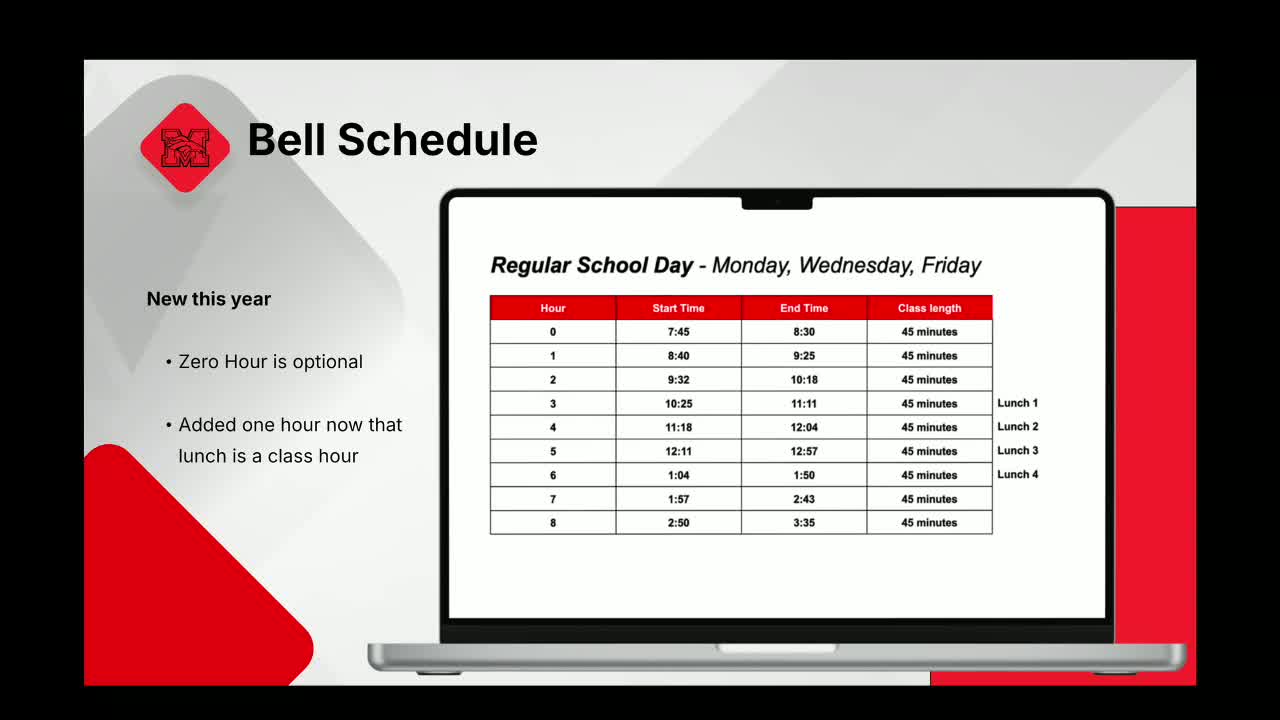
Summary
Administrators outlined a new bell schedule adding a 0 hour, expanded open-campus lunch for juniors and seniors, a narrowed set of concurrent-university partners, changes to course sequencing, and a plan to hold 2026 graduation at Bronco Stadium with backups.
Assistant Superintendent Ryan and Dr. Knowles briefed the board on schedule and program changes at Mustang High School for the 2025–26 school year, including a new bell schedule, open-campus lunch for juniors and seniors, changes to concurrent-enrollment partners, revised course sequencing, new elective offerings and a plan for 2026 graduation.
Bell schedule and 0 hour: The high school will add a 0 hour in 2025–26. Administrators said about 250 students have enrolled in the optional 0 hour. The district will move from a seven-period day to an eight-period day by treating one period as a lunch period; most periods will be 45 minutes. Flex days (Tuesdays and Thursdays) will retain a resource time between sixth and seventh hours and will use a 40-minute block for periods on those days.
Open-campus lunch and local impact: Juniors and seniors will be allowed open-campus lunch as a privilege; the district will continue open-campus lunch for blended learners, concurrent students and career-tech students as before. Officials said maintaining four lunch periods avoids adding a separate additional lunch period and noted open lunch supports nearby local businesses.
Concurrent enrollment: The high school will narrow most concurrent-enrollment partnerships to three universities expected to better honor district requests for communication and student supports: OSU‑OKC, Oklahoma City Community College (OCCC) and the University of Science and Arts of Oklahoma (Redlands was mentioned in the presentation). Administrators said exceptions will be made when a required course is available only at a different university: those cases will go through administrative approval.
Course sequencing and graduation requirements: Science sequencing will change so physical science is offered in freshman year and biology in sophomore year to better support vocabulary-heavy biology before ACT testing. The district is creating "Essentials 1 and 2" for freshmen and sophomores to teach basic technology, speaking and other foundational skills. New electives include guitar, history of rock and roll, lyric writing and expanded aviation/rocket work in career-technical offerings.
Graduation pathways: Beginning with this year's freshmen and sophomores, Mustang will use new statewide-aligned college-and-career-ready graduation requirements for those cohorts. The new requirements call for four years of math and English, three years of social studies and science, and a minimum number of pathway credits (six required pathway credits plus elective pathway credits). The district will require parental opt-in for current freshmen and sophomores to be placed on the new requirements and is developing a one-page pathway summary for each student to be tracked in PowerSchool.
Graduation location and timing: For the class of 2026, the district plans to hold graduation at Bronco Stadium on Friday, May 15 at 7 p.m., with three backup dates/times (Saturday, May 16 at 10 a.m., Saturday, May 16 at 7 p.m., and Sunday, May 17 at 2 p.m.), all at Bronco Stadium. Administrators said the decision responds to scheduling pressure at OU's Lloyd Noble Center and the need to avoid late-May conflicts for students with military or other commitments. The last day of school was announced as May 20.
Community engagement: The district convened parent and student advisory groups last year, toured the high school with parents during passing period and used student feedback to shape course and schedule changes. Administrators told the board they try to schedule tours and meetings at times that let parents see the school in regular operation.
Ending: Board members asked timing and implementation questions; administrators said counselors and site staff will help families understand pathway choices and opt-in forms ahead of the rollouts.