Get Full Government Meeting Transcripts, Videos, & Alerts Forever!
Get email alerts on the Public Safety Marshal Service topic
No spam. Unsubscribe anytime.
Cherokee Nation unveils five-year marshal service plan; council presses on detention costs
Summary
Principal Chief Chuck Hoskin and Acting Marshal Daniel Mead presented the Cherokee Nation’s inaugural five‑year marshal service strategic plan to the Rules Committee on Jan. 14, proposing staffing increases, substations, EMS consolidation and technology upgrades while committee members pressed staff about rising detention costs and housing options.
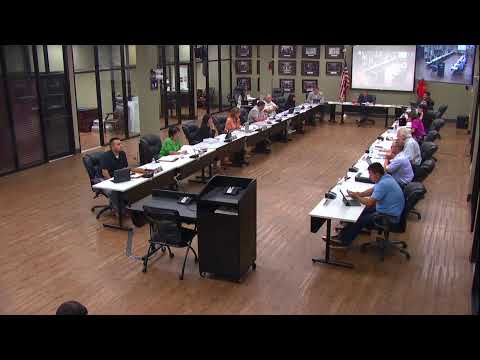
TAHLEQUAH, Okla. — Principal Chief Chuck Hoskin and Acting Marshal Daniel Mead presented the Cherokee Nation’s first publicly released five‑year strategic plan to the Rules Committee on Jan. 14, laying out staffing increases, substations and emergency medical services consolidation while council members pressed staff about rising detention costs and housing for people in custody.
The plan, Hoskin said, was produced following recent changes to the Marshall Act and will be reviewed annually. “It helps keep us all accountable. It helps the public understand what we are trying to do,” Hoskin told the committee as he introduced the document and its intent to make marshal priorities public.
The nut graf: The plan comes as the Cherokee Nation adjusts law enforcement and justice responsibilities after the McGirt decision, which Hoskin and others said requires a larger, more visible marshal presence across the Nation’s roughly 7,000‑square‑mile reservation. Committee members welcomed the transparency but raised detailed questions about detention capacity and budget pressures tied to housing people in county, state and federal facilities.
Plan highlights and operational changes
Acting Marshal Daniel Mead described the document as both a growth and accountability blueprint for the marshal service. “The Cherokee Nation Marshall Service is the best law enforcement agency in Indian country,” Mead said, adding the plan identifies operational gaps and steps to address them.
Key items named in the plan include: - Staffing: an addition of about 48 patrol marshals (described in the presentation as roughly eight marshals per shift) and a target of about 30 investigators. The plan also anticipates adding investigators to support task forces such as ICAC and federal task force work. - Substations and presence: expanded substations throughout the reservation and stronger community policing efforts so citizens see marshal personnel locally. - Emergency services and facilities: construction of a new emergency management/EMS building intended to centralize dispatch and ambulance operations, plus staging areas for natural disaster response. - Specialized teams and equipment: reconstituting a swift‑water team (the marshal service’s presentation called for staffing of about 10 marshals with fast‑boat capabilities), expanding dive and rescue capacity, and adding vehicle and fleet monitoring technology (described in the presentation as “Whip Around,” vehicle telematics, and record systems such as Tyler Tech and Salamander). - Workforce development: leadership development, cultural‑awareness training for marshals (including exposure to council meetings and cultural events), and an EMS workforce program that waives tuition for qualified Cherokee citizens to train as EMTs or paramedics. - Incident management: expanding the Incident Management Team (IMT) roster and maintaining a volunteer pool; presenters said the IMT roster stood at 22 and that roughly 100 applications were received after the plan went public.
Detention, jails and budget questions
Committee members sought clarity about detention costs and whether the marshal service intends to increase arrests or housing in jails. Acting Marshal Mead said the marshal service does not control sentencing but has detention agreements across 14 counties and at least one out‑of‑state arrangement in Texas for longer‑term housing. He told the committee some corrections providers now charge more and that the Nation faces limits because some bed capacity purchased by states sits unused and is not available to tribes.
Mead said the Nation also has about 20 people housed in the Federal Bureau of Prisons under arrangements that the federal government covers. On the budget modification flagged in the committee packet, Mead said higher per‑bed charges and the Nation’s need to expand placements have driven increased detention spending; the presentation cited staffing, jail treatment and facility costs as drivers.
Criminal justice policy context
Councilor Dora Paskowski reminded the committee of a prior criminal justice task force study that estimated costs for a potential Nation‑operated facility and said any future decision to build would be a significant fiscal undertaking. Paskowski urged updating that study before the Nation commits to such an investment.
Transparency and next steps
Hoskin and Mead both emphasized the plan’s public release and annual review as mechanisms for accountability. Hoskin said the plan was not set in stone and would be revised as conditions change; Mead and staff said implementing many elements will depend on securing grants and other funding.
Votes at a glance
- Approval of minutes from the June 26 meeting — Motion approved (mover/second not specified in the transcript). - Resolution authorizing unlimited consent to suit related to acquisition of property from the Oklahoma Historical Society — Motion approved (mover/second not specified). - Resolution authorizing limited waiver of sovereign immunity for a tobacco settlement endowment trust contract with the State of Oklahoma — Motion approved (mover/second not specified). - Motion to schedule the next Rules Committee meeting for Thursday, Aug. 28 at 1 p.m. — Motion approved (mover/second not specified).
Each of the motions above was recorded in the committee transcript as moved and seconded and the chair called the question; the transcript records voice votes with “Aye” and “Motion carries.” The agenda materials presented the two resolutions but did not include ordinance or contract numbers in the transcript.
What the committee did not decide
No formal vote approving the marshal service five‑year strategic plan itself is recorded in the transcript of the Rules Committee meeting; the presentation was delivered, discussed, and staff and leadership announced the plan’s public availability and annual review cadence. Council members requested follow‑up clarification on detention budget details, facility options and the source breakdown for the proposed increases.
Community impact and dependencies
Committee discussion made clear the plan’s implementation depends on external funding and intergovernmental cooperation, including grant awards, FEMA reimbursement eligibility for emergency management staging, and compacting or other agreements with county, state and federal correctional facilities. Hoskin and Mead noted cooperation with local sheriffs and police departments is essential for patrolling a reservation that spans multiple counties.
Ending
The chief and the acting marshal told the Rules Committee the document is intended to be a living plan, updated annually and publicly available so elected officials and citizens can track commitments and progress. Committee members said they support greater marshal presence in communities but want more detailed budget breakdowns and options for long‑term detention capacity before committing additional recurring funding.