Get Full Government Meeting Transcripts, Videos, & Alerts Forever!
Get email alerts on the Natural Resources topic
No spam. Unsubscribe anytime.
Cherokee Nation council hears natural resources report on GIS transfer, wildlife study and livestock losses
Summary
The Cherokee Nation Tribal Council heard a report from Christina Justice, the tribe’s secretary of natural resources, outlining a GIS staff transfer to IT support, a grant-funded wildlife study on a 4,500-acre hunting preserve in Akins (Sallisaw County), outreach plans including a fishing derby behind the Tahlequah Casino, and livestock losses attributed to predatory birds.
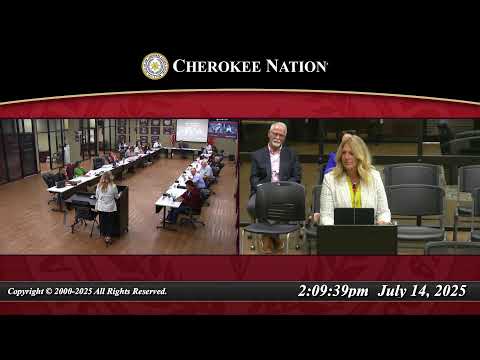
The Cherokee Nation Tribal Council on an unspecified date heard a report from Christina Justice, the tribe’s secretary of natural resources, that outlined administrative changes, upcoming wildlife research and local concerns about predatory birds affecting livestock.
Justice told the council the tribe’s GIS (geographic information systems) staff will move from the natural resources office to the Cherokee Nation IT department to gain more technical support. She said the GIS team will remain located in the natural resources office for now and that the move is intended to expand the program’s capabilities. "They're still located in our office for the time being," Justice said.
Justice described a grant-funded wildlife study scheduled to begin preliminary work this fall and to ramp up in September, with camera deployment planned for the field phase. The study is written for the hunting preserve in Akins in Sallisaw County and will focus on a contiguous 4,500-acre property; Justice said results are expected the following summer. The study will inform any future expansion of the program.
On pollinators, Justice said the tribe currently has no dedicated beekeeping program but is working to incorporate pollinator-friendly practices into projects and has discussed expanding bee-focused grants. She also said hay grown on tribe-managed land is used for the tribe’s livestock herd and is not sold.
Council members asked about the Cherokee holiday fishing derby; Justice said the event will be held behind the Tahlequah Casino, a location the office used last year and found to be better for logistics and space for children.
Justice and council members also discussed growing complaints from livestock owners about predatory "black buzzards," which Justice described as birds that have shifted their range into the area over the past 10 to 15 years and that can kill live animals. Justice said those birds are protected under federal migratory-bird law and that Cherokee Nation holds a permit to take birds to protect livestock operations. She said citizens can apply for state permits and that lost livestock may be eligible for compensation under the U.S. Department of Agriculture’s Livestock Indemnity Program, though specific permit take limits were not specified.
Savannah Hopkins, identified in the meeting as the tribe’s conservation district planner, was named as a staff contact for questions about the permitting process; Justice provided Hopkins’s email as savannah-hopkins@cherokee.org.
No formal action or vote accompanied the natural resources discussion. Council members and staff concluded the report and moved on to other items on the agenda.