Get Full Government Meeting Transcripts, Videos, & Alerts Forever!
Get email alerts on the Legislative Recap topic
No spam. Unsubscribe anytime.
Ramsey County government relations reviews session wins, looming budget pressures and federal policy risks
Summary
County officials summarized outcomes of the 2025 state legislative sessions and flagged potential federal policy changes that could create cost and administrative burdens for Ramsey County, including Medicaid and SNAP changes in federal reconciliation proposals.
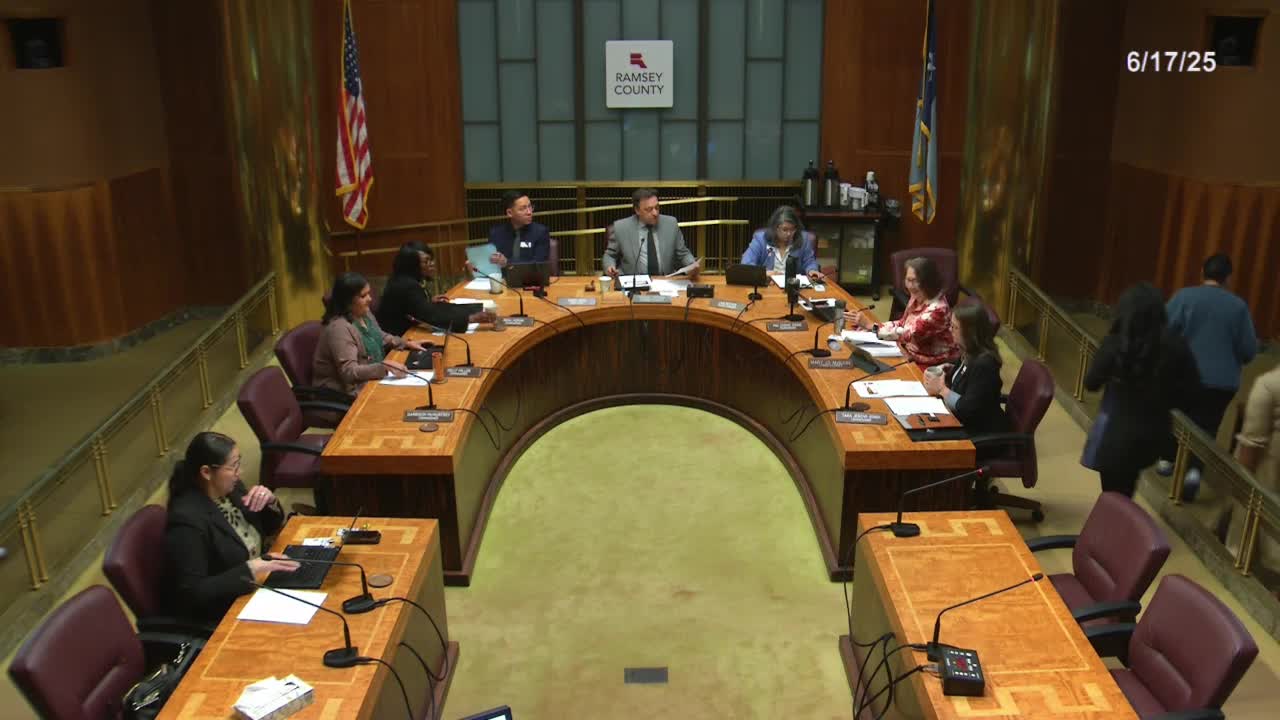
Ramsey County staff on Thursday briefed the Board of Commissioners on the 2025 state legislative session, special session outcomes and federal policy proposals, highlighting several wins for county programs and signaling potential budget and administrative pressures ahead.
Jennifer O'Rourke, director of government relations for Ramsey County, told commissioners the legislature completed a two-year budget in special session and the governor “signed all of the budget bills,” producing a two-year budget the presentation cited as about $66,800,000,000. O'Rourke called the session “one of the most unique and kinda crazy times,” noting a tied House, co-chaired committees and delayed starts that complicated advocacy.
County staff described specific state-level outcomes they said would affect Ramsey County operations: extensions to previously allocated funds for youth treatment homes and youth technology workforce programs; passage of enabling authority to give the Ramsey County HRA Authority certain economic development (EDA) powers; a technical child-support redirection fix requested by the County Attorney’s Office; $35 million for modernization of the state social services information system (SSIS); and funding in the bonding bill for the Miller Building to expand psychiatric bed capacity at Anoka Metro Regional Treatment Center.
Staff cautioned that some of the changes could increase county costs. The presentation and subsequent department briefings noted that Anoka Metro Regional Treatment Center’s rising daily per-diem rates are under analysis and likely to affect Ramsey County’s 2027 budget. “We’re still doing the analysis, but I think the way we understand it is that daily per diem has been has risen, and we’ll have to adjust it,” a county official said when asked about the budget impact.
Policy changes preserved some county funding lines but removed others. According to the presentation, county program aid and local homelessness prevention aid were not cut in the final tax agreement; however, the state repealed a planned local cannabis aid (anticipated revenue that the county had not yet been collecting). Staff said the repeal means the state redirected the revenue to help balance its deficit.
On human services, staff highlighted an advisory council to identify roughly $180 million in long-term services and supports savings by December 2026 and said counties must monitor potential program shifts. The county emphasized that many programs are state overseen but county administered; possible state or federal changes will likely create administrative burdens for county staff.
At the federal level, Chief of Staff Maria Sarabia and Maurice Rabia (chief of staff) outlined risks tied to a House reconciliation bill passed May 22 (referred to in the presentation as H.R.1). County staff said the measure as drafted would limit access to Medicaid (Minnesota’s Medical Assistance) and to SNAP by imposing new work requirements and potential out-of-pocket costs for some enrollees.
Staff provided counts used in internal planning: “There are currently 85,000 MA cases in Ramsey County” and “35,000 SNAP cases,” and that about 37 percent of county residents receive Medical Assistance at least one month in the year, according to the briefing. County staff noted ambiguity about whether “cases” equates to individuals or household files and said they will clarify administrative counts. They warned that verification requirements and additional federal work mandates could increase processing workloads and lead to longer wait times for benefits.
The county also summarized congressionally directed spending proposals advanced by local delegations: an opioid addiction recovery response request for $1.2 million; a heat-sensor “wet bulb” climate project at $750,000; a $5 million joint request for the Ramsey/Washington County Recycling and Energy Center (advanced by a senator because of geographic distribution); and a mobile crisis response vehicle request of $330,000 for the Ramsey County Sheriff’s Office.
O'Rourke and the county’s federal relations staff asked commissioners to stay engaged with legislators as the county prepares its 2026–27 budget and as possible federal and state adjustments are considered. “These are all things we’re gonna wanna be paying attention to as we move forward, later this fall,” O'Rourke said.
County managers and department directors indicated staff will return with more detailed fiscal analyses, particularly regarding per-diem impacts at regional treatment centers and potential increases in county eligibility-processing workload if federal verification rules change.